
Laser Marking vs Stamping for Vehicle Identification
Introduction
Vehicle identification is a critical process in automotive manufacturing. Every vehicle requires a unique, permanent identifier—typically the Vehicle Identification Number (VIN)—that can be traced throughout its lifecycle. The method used to apply this identification must withstand harsh conditions, resist tampering, and remain legible for decades. Two primary technologies dominate this space: traditional stamping and advanced laser marking. While stamping has been used for decades, laser marking—particularly deep laser marking—offers distinct advantages for modern automotive production, especially when dealing with high-strength steel and automated assembly lines. This article compares laser marking and stamping for vehicle identification, examining how each method works, their key characteristics, and why the industry is increasingly adopting laser-based solutions.
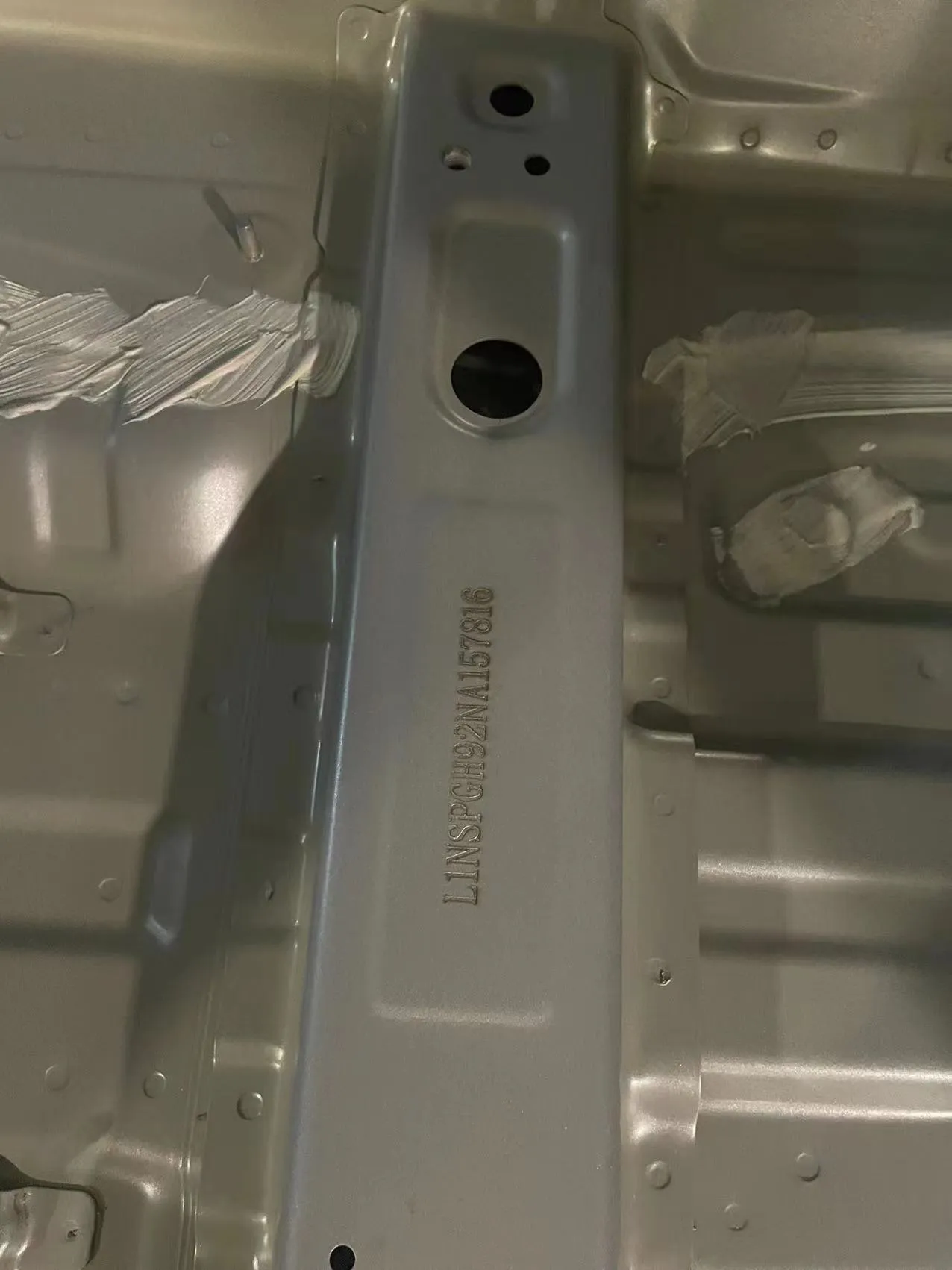
Understanding Vehicle Identification Requirements
Vehicle identification marks must meet strict durability and legibility standards. They are applied to body-in-white (BIW) panels, chassis components, and other critical parts. The marking must survive painting, e-coating, and years of exposure to road salts, temperature fluctuations, and mechanical wear. For high-strength steel and hot-formed steel—common in modern vehicle structures for crash safety and weight reduction—traditional stamping methods face significant challenges. These materials can exceed 700 MPa yield strength, and some hot-formed steels reach up to 1500 MPa. Achieving a deep, permanent mark on such materials requires specialized technology.
How Stamping Works for Vehicle Identification
Stamping, also known as mechanical marking or dot peening, uses a hardened stylus or die to physically indent the metal surface. The stylus is driven into the material, creating a series of dots or a continuous line that forms characters. The depth of the mark depends on the force applied and the material hardness. Stamping is a well-established process, but it has limitations. On high-strength steels, achieving consistent depth without cracking or deforming the panel can be difficult. The tooling wears over time, requiring frequent replacement. Additionally, stamping can create stress concentrations that may affect part integrity. The process is also relatively slow for complex characters and can generate noise and vibration in the production environment.
How Deep Laser Marking Works
Deep laser marking uses a focused, high-power laser beam to melt and vaporize material, creating a permanent mark with significant depth. Unlike surface marking, deep laser marking penetrates the material, producing a mark that is resistant to abrasion and corrosion. KINMARK's Deep Laser Marking Machine, for example, employs a 200W laser to achieve marking depths of ≥0.2mm on body-in-white. This depth ensures the VIN remains legible even after painting and e-coating. The process is non-contact, eliminating tool wear and mechanical stress on the part. It can be integrated with industrial robots and assisted manipulators for automated production lines, thanks to various mounting interfaces. Optional 3D vision guidance enables precise positioning, and optional 3D laser scanning with OCR recognition provides online inspection and 100% traceability.
Key Comparison: Laser Marking vs Stamping
| Aspect | Laser Marking (Deep) | Stamping |
|---|---|---|
| Marking Depth | ≥0.2mm on BIW; capable on high-strength steel up to 1500 MPa | Variable; challenging on high-strength steel |
| Tool Wear | Non-contact; no tool wear | Stylus wears; requires replacement |
| Integration | Easy integration with robots; various mounting interfaces | Requires rigid fixture; less flexible |
| Traceability | Optional 3D vision and OCR for 100% online inspection | Manual inspection; limited automation |
| Material Stress | Minimal heat-affected zone; no mechanical stress | Induces stress; risk of cracking |
| Rubbing After Painting | Special process ensures clear rubbing | May become less legible after painting |
Key Features of Deep Laser Marking for Vehicle Identification
Deep laser marking systems are designed to meet the rigorous demands of automotive production. Key features include:
Deep VIN Marking: Permanent marks on high-strength steel (yield strength >700 MPa) and hot-formed steel (up to 1500 MPa), with depth ≥0.2mm on body-in-white.
Easy Rubbing: Special marking process ensures clear rubbing results after painting, maintaining legibility.
Easy Integration: Various mounting interfaces allow quick integration with industrial robots or assisted manipulators for automated lines.
Vision Guidance: Optional 3D vision guidance system for precise positioning and accurate marking.
Automatic Traceability: Optional 3D laser scanning measurement and OCR recognition for online inspection and 100% traceability.
Applications in Automotive Manufacturing
Deep laser marking is widely used in automotive manufacturing for vehicle identification. It is particularly suitable for:
Body-in-white VIN marking on high-strength steel panels
Chassis and frame marking for traceability
Powertrain component identification
New energy vehicle (NEV) production
Automated assembly lines requiring robot integration
These applications benefit from the permanent, deep marks that resist harsh conditions and support full lifecycle traceability.
Benefits of Choosing Laser Marking Over Stamping
Switching from stamping to deep laser marking offers several industrial advantages:
Permanent Traceability: Deep marks ensure the VIN remains legible for the vehicle's lifetime, supporting regulatory compliance and recall management.
Process Consistency: Laser marking provides repeatable depth and character quality, reducing variability compared to mechanical stamping.
Production Integration: Easy robot integration and optional vision systems enable seamless automation and inline inspection.
Reduced Tooling Costs: Non-contact process eliminates consumable stylus replacement and associated downtime.
Material Versatility: Effective on high-strength and hot-formed steels that challenge traditional stamping.
Why Choose KINMARK for Deep Laser Marking
KINMARK has been a manufacturer of marking and traceability systems since 1996. The company's Deep Laser Marking Machine is designed specifically for automotive VIN marking on high-strength materials. It offers a complete solution with optional 3D vision guidance and OCR-based traceability. KINMARK provides a 12-month warranty, fast response service, and installation and commissioning support to help customers integrate the system into their production lines. With a focus on intelligent factory automation, KINMARK continues to develop advanced solutions for the automotive industry.
Frequently Asked Questions
What is the difference between laser marking and stamping for VIN?
Laser marking uses a focused laser beam to create a deep, permanent mark without contact, while stamping uses a mechanical stylus to indent the metal. Laser marking is better suited for high-strength steel and automated production, offering consistent depth and easier integration.
Can deep laser marking achieve the required depth on high-strength steel?
Yes. KINMARK's Deep Laser Marking Machine can achieve marking depths of ≥0.2mm on body-in-white, including high-strength steel with yield strength exceeding 700 MPa and hot-formed steel up to 1500 MPa.
How does laser marking support traceability?
Optional 3D laser scanning measurement and OCR recognition systems provide online inspection of marking quality, ensuring 100% traceability. This allows manufacturers to verify each VIN and maintain records throughout production.
Is laser marking compatible with robotic automation?
Yes. The system is designed with various mounting interfaces for quick integration with industrial robots or assisted manipulators, making it suitable for automated production lines.
What warranty and support does KINMARK provide?
KINMARK offers a 12-month warranty on the complete machine, along with fast response service, remote diagnosis, and installation and commissioning support to ensure continuous operation.
Conclusion
For vehicle identification on modern high-strength steel, deep laser marking offers clear advantages over traditional stamping. It delivers permanent, deep marks with consistent quality, integrates easily with automation, and supports full traceability. As automotive manufacturing continues to evolve with new materials and smart factory initiatives, laser marking systems like KINMARK's Deep Laser Marking Machine provide a reliable solution for meeting both regulatory and production requirements.
If you're interested in any of the equipment mentioned in this article, feel free to contact our sales engineers for detailed product information and customized technical solutions.