
Force-Controlled vs Displacement-Controlled Servo Pressing
Introduction
In servo press fitting, the control mode determines how the press decides when to stop and how it judges whether a joint is good or bad. Two modes dominate precision assembly: force-controlled pressing and displacement-controlled pressing. The choice between them affects joint quality, process repeatability, and how much useful data the line can capture for traceability.
The distinction matters most in automotive assembly, where press-fit joints such as bearings, bushings, pins, seals, and structural inserts must meet defined quality criteria on every cycle. A control mode that does not match the physical behavior of the joint can produce acceptable-looking parts that fail in service, or reject good parts unnecessarily.
This article explains how each control mode works, where each is appropriate, how they differ in monitoring and evaluation, and how a modern servo press fitting system such as the KINMARK N-Series Servo Press Fitting System supports both approaches within one platform.
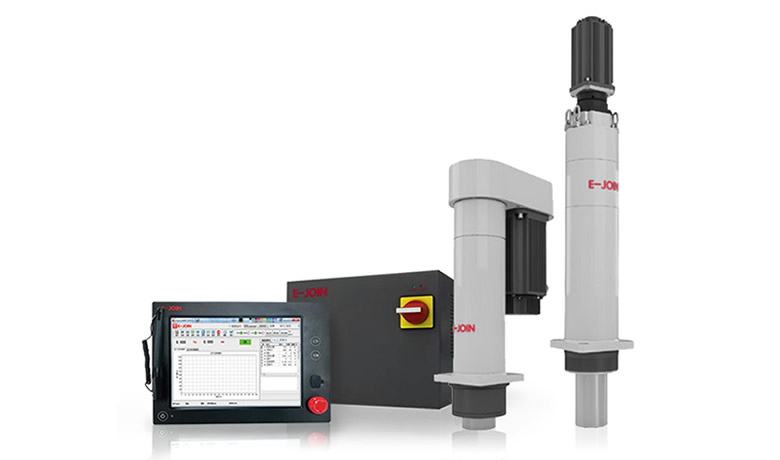
Product Overview
The N-Series Servo Press Fitting System is a high-precision CNC press unit designed for automated assembly and manufacturing applications. It integrates servo motion control, force and displacement measurement, process monitoring, and production data management. The system is built around a modular architecture consisting of a servo electric cylinder, industrial software, control box, monitoring instrument, and cable module.
The platform is available in multiple force configurations from 2 kN to 350 kN, with position accuracy up to 0.01 mm and force accuracy up to 1% FS. Because the system measures both force and displacement continuously throughout each cycle, it can operate in either force-controlled or displacement-controlled mode, and it can evaluate the resulting force-displacement curve against defined criteria.
This makes the N-Series a useful reference point for discussing control mode selection: the same hardware and software platform supports both strategies, so the decision is a process engineering decision rather than a hardware limitation.
Working Principle
What Force-Controlled Pressing Means
In force-controlled pressing, the servo press advances the tooling until the measured force reaches a programmed target, then holds or reverses according to the process definition. The final position is a result of the press cycle, not a commanded endpoint. The press is essentially asking: "How far must I travel to achieve the required force?"
This mode is appropriate when the quality of the joint is defined by the force applied, for example when seating a component against a stop, compressing an elastic element, or achieving a specified clamp load. The resulting displacement is recorded and can be compared against expected values to detect anomalies.
What Displacement-Controlled Pressing Means
In displacement-controlled pressing, the servo press advances the tooling to a programmed position, and the force required to reach that position is measured and evaluated. The press is asking: "How much force does it take to reach the required depth?" The final force is a result of the cycle, not a commanded endpoint.
This mode is appropriate when the joint is defined by geometry, for example pressing a bearing to a specified seat depth, inserting a pin to a defined height, or setting a component to a positional tolerance. The force curve recorded during the stroke provides evidence of whether the interference fit, alignment, and material conditions were within expectation.
Why the Distinction Is Not Always Absolute
In practice, most production press-fit processes use one mode as the primary control target and the other as a monitoring or acceptance criterion. A displacement-controlled insertion may be accepted only if the force at final position falls inside a judgment window. A force-controlled seating operation may be accepted only if the resulting displacement falls within an expected band. The N-Series supports this combined approach through its evaluation functions, including judgment windows, envelope curves, and measurement analysis.
Key Differences Between the Two Control Modes
| Consideration | Force-Controlled Pressing | Displacement-Controlled Pressing |
|---|---|---|
| Primary target | Reach a programmed force | Reach a programmed position |
| Resulting variable | Final displacement | Final force |
| Typical joint type | Elastic compression, clamp load, seating against a stop | Interference fit, insertion to depth, positional seating |
| Quality indicator | Displacement at target force | Force at target position |
| Common failure signature | Excess or insufficient travel to reach force | Excess or insufficient force to reach position |
| Monitoring data used | Force-displacement curve, final position | Force-displacement curve, final force |
The table is a general guide. The correct mode for a specific joint should be determined from the joint design intent and validated during process development.
How to Choose the Right Control Mode
Start From the Joint Function
Ask what makes the joint function correctly. If the joint works because a defined force is applied, force control is the natural primary target. If the joint works because a component sits at a defined depth or height, displacement control is the natural primary target. Many press-fit problems originate from choosing a control mode that does not match the joint's functional requirement.
Consider Material and Tolerance Behavior
Elastic components, seals, and spring elements tend to behave predictably under force control because their response is dominated by stiffness. Rigid interference fits tend to behave predictably under displacement control because their response is dominated by geometry. Mixed joints, such as a rigid insert with an elastic collar, may require one mode as the target and the other as the acceptance criterion.
Define the Acceptance Criteria Separately
The control mode and the acceptance criteria are separate decisions. A displacement-controlled press cycle can be accepted or rejected based on the force recorded at final position, and a force-controlled cycle can be accepted or rejected based on the displacement at target force. The N-Series evaluation functions support judgment windows and envelope curves so that both the target variable and the resulting variable can be checked on every cycle.
Plan for Traceability From the Start
Whichever mode is selected, the recorded force-displacement data is what supports traceability. The N-Series can interact with PLCs and production servers so that measurement data and assembly results are recorded and can be associated with the part or station. Output formats include CSV and XLS, and the E-Press software supports MS SQL and Microsoft Access databases.
Key Features That Support Both Control Modes
The following capabilities of the N-Series are relevant when comparing force-controlled and displacement-controlled pressing:
Servo motion control with position accuracy up to 0.01 mm and force accuracy up to 1% FS
Integrated force and displacement detection with continuous measurement throughout the assembly process
Force-controlled pressing, displacement-controlled pressing, and external signal-based control within the same system
100% process monitoring so each pressing cycle can be checked for deviations
Multiple evaluation functions including judgment windows, envelope curves, and measurement analysis
E-Press industrial software with real-time force-displacement and force-time curve display, multiple pressing steps, OK/NG result evaluation, hierarchical user permissions, history and operation logs, and alarm log management
Fieldbus communication via OPC, EtherNet/IP, and PROFINET
Sampling frequency of 20 kHz with 24-bit acquisition accuracy
Service life greater than 12 million cycles and IP54 protection rating
Applications
Servo press fitting with selectable control mode is relevant across a range of automotive and industrial assembly tasks. The N-Series is described as suitable for press fitting and component assembly, automotive component assembly, forming and riveting, punching operations, elasticity and performance testing, and high-cycle automated assembly.
Automotive component assembly where bearings, bushings, pins, and similar components require defined insertion criteria
Powertrain and drivetrain assembly where press-fit joints must meet defined quality criteria on every cycle
Forming and riveting where force or displacement targets define the formed result
Elasticity and performance testing where controlled force or displacement is applied and the response is measured
High-cycle automated assembly where repeatability and process data capture are required over long production runs
Because the system supports both control modes and external signal-based control, it can be integrated into automated assembly equipment and automotive production lines alongside PLCs, industrial control systems, and production servers.
Benefits of a Dual-Mode Servo Press Platform
Process flexibility — one platform can serve joints that require force control and joints that require displacement control, reducing the number of distinct press configurations on a line
Consistent evaluation — force-displacement curves are captured and evaluated the same way regardless of which mode is the primary target
Traceability — measurement data and assembly results can be recorded and exchanged with production systems
Process visibility — real-time curve display lets operators and engineers observe what is happening during the cycle rather than only after the fact
Integration readiness — fieldbus communication and modular architecture support integration into automated assembly equipment
Why Choose KINMARK
KINMARK has been engaged in automotive intelligent automation equipment since 1996, with product lines covering marking and traceability systems, servo press systems, fluid filling systems, and robot automation systems. The company serves vehicle manufacturers, powertrain and component producers, and new energy vehicle manufacturers, and has supplied automation solutions to automotive and industrial customers across these sectors.
For press-fit applications, this background means the servo press system is positioned within a broader automation context rather than as a standalone press. The N-Series is designed for integration with PLCs, industrial control systems, and production servers, and KINMARK provides installation and commissioning, operator training, a 12-month warranty on the complete machine, and after-sales support including remote diagnosis and technical assistance.
Frequently Asked Questions
Is force control always better than displacement control for press fitting?
No. The appropriate mode depends on how the joint functions. Joints defined by clamp load or elastic compression are typically suited to force control, while joints defined by insertion depth or positional seating are typically suited to displacement control. In many processes, one mode is the control target and the other is used as an acceptance criterion.
Can a single servo press system use both control modes?
Yes. The N-Series Servo Press Fitting System supports force-controlled pressing, displacement-controlled pressing, and external signal-based control. The mode can be selected according to the process requirements of each application.
How is press-fit quality judged if the control mode only targets one variable?
The system measures both force and displacement continuously throughout the cycle. Evaluation functions such as judgment windows and envelope curves allow the resulting variable to be checked against defined limits, so a force-controlled cycle can be judged by its final displacement and a displacement-controlled cycle can be judged by its final force.
What data can be recorded for traceability?
Measurement data and assembly results can interact with PLCs and production servers. The E-Press software supports press fitting history and operation logs, alarm log management, and output in CSV or XLS formats, with support for MS SQL and Microsoft Access databases.
What force range does the N-Series cover?
The N-Series is available in configurations from 2 kN to 350 kN maximum pressure, with stroke options from 100 mm to 400 mm depending on the model. Position accuracy is up to 0.01 mm and force accuracy is up to 1% FS. Specifications may vary by model, so the actual product configuration should be confirmed for a specific application.
Conclusion
Force-controlled and displacement-controlled pressing answer two different process questions. Force control asks how far the press must travel to reach a required force; displacement control asks how much force is needed to reach a required position. Selecting the right mode starts with understanding how the joint functions, and the resulting variable should be evaluated against defined acceptance criteria rather than ignored.
A servo press platform that supports both modes, measures force and displacement continuously, and records process data gives manufacturing engineers the flexibility to match control strategy to joint design while maintaining consistent evaluation and traceability across the line. The N-Series Servo Press Fitting System is built around this principle, combining servo motion control, integrated measurement, process monitoring, and production data management in a modular system suited to automotive assembly and industrial production environments.
If you're interested in any of the equipment mentioned in this article, feel free to contact our sales engineers for detailed product information and customized technical solutions.