
Understanding Force-Time Curves in Servo Pressing Processes
Introduction
In servo press fitting operations, the force-time curve is one of the most direct indicators of what is actually happening during a pressing cycle. Unlike a simple pass/fail signal at the end of a stroke, the force-time curve records how force develops from the start of contact through to the end of the press cycle. For automotive assembly and component manufacturing, where press-fit joints often carry structural, safety, or performance requirements, this curve provides engineers with a continuous view of process behavior rather than a single endpoint result.
The force-time curve is closely related to the force-displacement curve, but it emphasizes the time domain. This makes it useful for evaluating cycle consistency, detecting abnormal friction or seating behavior, and correlating press results with line takt and machine motion. This guide explains what force-time curves represent in servo pressing, how they are generated and evaluated, and how they support quality control and traceability in automated assembly environments.
Product Overview
The N-Series Servo Press Fitting System is a high-precision CNC press unit designed for automated assembly and manufacturing applications. It integrates servo motion control, force and displacement measurement, process monitoring, and production data management. The system is available in multiple force configurations ranging from 2 kN to 350 kN, with position accuracy up to 0.01 mm and force accuracy up to 1% FS.
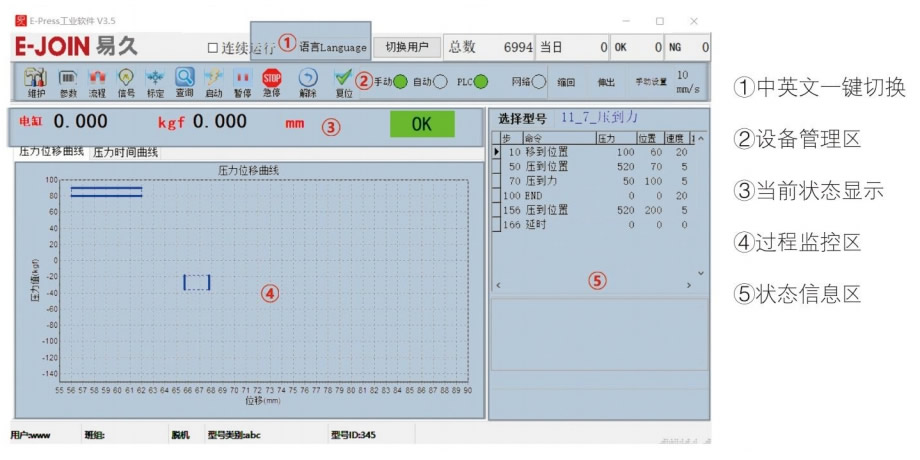
The system is built around a modular architecture that includes a servo electric cylinder, E-Press industrial software, a control box, a monitoring instrument, and a cable module. This modular design allows the servo press to be integrated into automated assembly equipment and automotive production lines. The E-Press software provides the interface for programming, monitoring, and evaluating press fitting processes, including real-time force-displacement and force-time curve display.
The force-time curve is therefore not an external add-on but a native output of the system's measurement and monitoring architecture. Understanding how to read and apply this curve is essential for engineers specifying or operating servo press equipment in production environments.
Working Principle
A servo press generates force through a servo-driven electric cylinder. During a pressing cycle, the system continuously measures force and displacement. The force-time curve plots the measured force against elapsed time throughout the cycle. Because the servo motion is controlled, the relationship between time, position, and force can be observed and evaluated in a repeatable manner.
The N-Series system supports force-controlled pressing, displacement-controlled pressing, and external signal-based control. In force-controlled pressing, the system regulates force according to the programmed profile. In displacement-controlled pressing, the system regulates position, and the resulting force develops according to the mechanical resistance of the workpiece. In both cases, the force-time curve reflects the interaction between the press motion and the part being assembled.
The system samples measurement data at a frequency of 20 kHz with 24-bit acquisition accuracy. This high sampling rate allows the force-time curve to capture rapid changes in force that may occur during contact, seating, or forming. The curve is displayed in real time in the E-Press software and can be recorded for later analysis.
The force-time curve is typically evaluated together with the force-displacement curve. The force-displacement curve shows how force changes with position, which is useful for understanding the mechanical behavior of the joint. The force-time curve shows how force changes with time, which is useful for understanding cycle dynamics, machine response, and consistency across cycles. Together, these two views provide a more complete picture of the pressing process than either one alone.
Key Features of Force-Time Curve Monitoring
Real-time force-time curve display: The E-Press software displays the force-time curve in real time during the pressing cycle, allowing operators to observe process behavior as it happens.
High-speed data acquisition: A sampling frequency of 20 kHz and 24-bit acquisition accuracy support detailed curve capture during short pressing cycles.
Force and displacement measurement: The system integrates force and displacement detection, enabling both force-time and force-displacement evaluation.
Multiple evaluation functions: Built-in evaluation functions include judgment windows, envelope curves, and measurement analysis, which can be applied to curve-based process evaluation.
Multiple pressing steps: The system supports multiple pressing steps and process curves, allowing complex press sequences to be monitored step by step.
Data traceability: Measurement data and assembly results can interact with PLCs and production servers, supporting process data recording and traceability.
History and logs: Press fitting history, operation logs, and alarm logs are managed within the E-Press software, supporting later review of curve data and process events.
Database support: The software supports MS SQL and Microsoft Access databases for data storage and retrieval.
Applications
Force-time curve monitoring is relevant wherever servo pressing is used for precision assembly and process control. The N-Series Servo Press Fitting System is applied in press fitting and component assembly, automotive component assembly, forming and riveting, punching operations, elasticity and performance testing, and high-cycle automated assembly. Related Press Fitting Functional Modules can support different press fitting configurations and automation requirements.
Automotive Component Assembly
In automotive component assembly, press-fit joints such as bearings, bushings, pins, and other inserted components require consistent force application. The force-time curve helps engineers verify that each cycle follows the expected force development pattern and that deviations are detected.
High-Cycle Automated Assembly
In high-cycle automated assembly, cycle-to-cycle consistency is critical. The force-time curve provides a time-based view of each cycle, making it possible to compare cycles and identify drift or abnormal behavior over production runs.
Forming and Riveting
Forming and riveting operations involve controlled force application over time. The force-time curve can be used to monitor how force develops during these operations and to support evaluation of the forming or riveting result.
Elasticity and Performance Testing
For elasticity and performance testing, the force-time curve provides a record of force response over the test duration. This supports analysis of component behavior under controlled pressing conditions.
Benefits of Force-Time Curve Analysis
Process visibility: The force-time curve makes the pressing process observable in the time domain, supporting engineering analysis of cycle behavior.
Deviation detection: Real-time monitoring allows process deviations to be detected during the cycle rather than only at the end of the stroke.
Consistent assembly quality: Curve-based evaluation supports consistent judgment of pressing results across cycles.
Traceability: Recorded curve data and assembly results can be stored and retrieved, supporting process traceability requirements.
Flexible integration: The system can interact with PLCs, industrial control systems, and production servers, allowing curve data to be integrated into production data management.
Evaluation flexibility: Judgment windows, envelope curves, and measurement analysis provide multiple ways to evaluate curve data against process requirements.
Why Choose KINMARK
KINMARK is a manufacturer of marking and traceability systems, servo press systems, fluid filling systems, and robot automation systems for automotive manufacturing and intelligent factory automation. The N-Series Servo Press Fitting System reflects this focus, combining servo motion control, force and displacement measurement, process monitoring, and production data management in a modular architecture. KINMARK provides integrated servo press fitting solutions for different manufacturing and automated assembly requirements.
KINMARK serves automotive manufacturing, automotive components, new energy vehicles, powertrain manufacturing, and intelligent factory automation. The company provides installation and commissioning support, operator training, a 12-month warranty on the complete machine, and after-sales support including remote diagnosis and technical assistance. For engineers evaluating servo press systems for force-time curve monitoring and process traceability, KINMARK's servo press platform offers a configurable and integrable solution.
Frequently Asked Questions
What is a force-time curve in servo pressing?
A force-time curve is a plot of measured force against elapsed time during a pressing cycle. In a servo press system such as the N-Series, force is measured continuously and displayed in real time in the E-Press software. The curve shows how force develops from the start of the cycle to the end, providing a time-based view of the pressing process.
How is the force-time curve different from the force-displacement curve?
The force-displacement curve plots force against position, showing the mechanical behavior of the joint as the press moves through its stroke. The force-time curve plots force against time, showing cycle dynamics and machine response. Both curves are displayed in the E-Press software and are typically evaluated together to support process analysis.
What evaluation functions are available for curve-based process monitoring?
The N-Series system includes built-in evaluation functions such as judgment windows, envelope curves, and measurement analysis. These functions support evaluation of pressing results and OK/NG judgment based on the monitored process data.
Can force-time curve data be stored and traced?
Yes. Measurement data and assembly results can interact with PLCs and production servers, supporting process data recording and traceability. The E-Press software manages press fitting history, operation logs, and alarm logs, and supports MS SQL and Microsoft Access databases. Output formats include CSV and XLS.
What force capacities are available for servo press fitting systems?
The N-Series Servo Press Fitting System is available in multiple force configurations from 2 kN to 350 kN, with position accuracy up to 0.01 mm and force accuracy up to 1% FS. Specific stroke, running speed, and other parameters vary by model, and the actual product configuration should be consulted for detailed specifications.
Conclusion
Force-time curves provide a practical, time-based view of servo pressing processes that complements force-displacement analysis. By capturing force development throughout each cycle, engineers can monitor process behavior, detect deviations, evaluate assembly results, and support traceability in automated production. In automotive assembly and component manufacturing, where press-fit quality and process consistency are essential, force-time curve monitoring is a valuable part of a controlled pressing strategy. The N-Series Servo Press Fitting System integrates this capability into a modular, configurable platform designed for automated assembly and manufacturing environments.
If you're interested in any of the equipment mentioned in this article, feel free to contact our sales engineers for detailed product information and customized technical solutions.