
Laser VIN Marking in Body-in-White Production
Introduction
The vehicle identification number is the primary identity record for a vehicle, and it is applied long before the finished car leaves the assembly hall. In most production systems, the VIN is marked on the body-in-white (BIW) so that every downstream operation — painting, powertrain installation, final assembly, and end-of-line inspection — can be linked to a single, stable identity. Laser VIN marking in body-in-white production is the process step that creates this identity on the bare metal structure.
The challenge is that modern body structures increasingly use high-strength and hot-formed steel in exactly the areas where the VIN must be applied. These materials resist conventional marking methods, and a shallow or inconsistent mark can become unreadable after painting and rubbing. This application guide explains how deep laser marking addresses these conditions, what equipment characteristics matter for BIW lines, and how marking integrates with robot automation, vision guidance, and traceability systems.
Product Overview
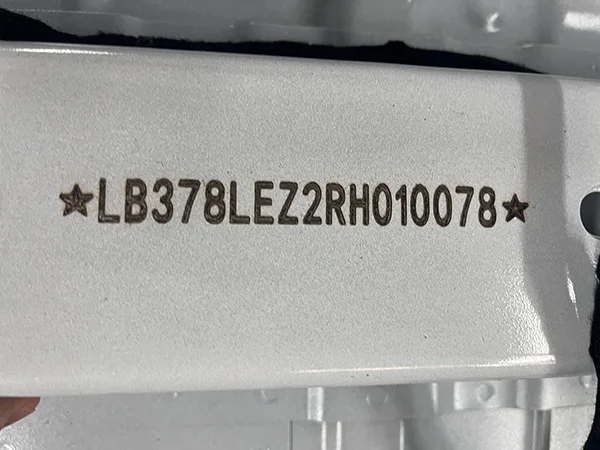
A deep laser marking machine for VIN applications is a dedicated marking system designed to produce permanent, deep characters on body-in-white structures. Unlike general-purpose laser markers, a deep marking system is specified around a specific combination of marking depth, marking area, and integration requirements.
The KINMARK Deep Laser Marking Machine is built for deep VIN marking on high-strength materials. It enables permanent VIN deep marking on high-strength steel plates with yield strength exceeding 700 MPa and on hot-formed steel plates with strength up to 1500 MPa. On body-in-white, the marking depth can reach more than 0.2 mm.
The system is positioned as a production-line asset rather than a standalone marking station. It is designed with various mounting interfaces so that it can be quickly integrated with industrial robots or assisted manipulators for automated production lines, and it can be combined with optional vision guidance and online inspection functions.
Technical Specifications
| Power Supply | AC220V ±10%, 50Hz ±2% |
| Power Consumption | <1000W |
| Laser Power | 200W |
| Marking Area | 112mm × 112mm |
| Marking Depth | ≥0.2mm |
| Operating Temperature | 0~40°C |
| Operating Humidity | ≤90% RH (Non-condensing) |
Working Principle
Deep laser marking removes or displaces material from the workpiece surface to create characters with measurable depth, rather than relying only on a surface color change. Because the mark is formed in the material itself, it remains identifiable after the body passes through the paint shop, where coatings are applied over the marked area.
A key process consideration in BIW production is the rubbing step. After painting, the VIN area is typically rubbed to expose the characters for visual and documentary verification. The KINMARK deep laser marking system adopts a special marking process to ensure clear rubbing results after painting. This process design is what connects marking depth to practical readability on the finished vehicle.
In an automated line, the marking head is positioned relative to the body by a robot or assisted manipulator. When the optional 3D vision guidance system is used, the system performs precise positioning before marking. When the optional 3D laser scanning measurement and OCR recognition systems are used, marking quality can be inspected online and the character content can be verified automatically.
Key Features
Deep VIN marking on high-strength materials: The system enables permanent VIN deep marking on high-strength steel plates with yield strength exceeding 700 MPa and hot-formed steel plates with strength up to 1500 MPa. Marking depth on body-in-white can reach more than 0.2 mm.
Easy rubbing: A special marking process ensures clear rubbing results after painting.
Easy integration: Various mounting interfaces allow the marking system to be quickly integrated with industrial robots or assisted manipulators for automated production lines.
Vision guidance: An optional 3D vision guidance system enables precise positioning and accurate marking.
Automatic traceability: Optional 3D laser scanning measurement and OCR recognition systems provide online inspection of marking quality and support full traceability.
Defined marking envelope: A marking area of 112mm × 112mm accommodates standard VIN character layouts.
Application note: Deep marking parameters must be validated for the specific body material, panel thickness, and paint process used on each line. The material grades and marking depth stated above define the qualified working range of the system, not a universal setting for every BIW variant.
Applications
Laser VIN marking in body-in-white production sits at the start of the vehicle identity chain. The following application areas are directly supported by the system design.
Body-in-White VIN Marking
The primary application is marking the VIN directly on the body-in-white structure, including panels made from high-strength steel and hot-formed steel. The mark is created before painting so that the identity is present throughout the remaining production flow.
Robotic Marking Stations
Because the system is designed with various mounting interfaces, it can be integrated with industrial robots or assisted manipulators. This supports automated marking stations where the body is presented by a conveyor or skid and the marking head is positioned automatically.
Vision-Guided Positioning
Where body positioning varies within tolerance, the optional 3D vision guidance system supports precise positioning and accurate marking. This is relevant for lines handling multiple body variants on the same station.
Inline Marking Quality Inspection
With the optional 3D laser scanning measurement and OCR recognition systems, marking quality and character content can be inspected online. This supports 100% traceability of the marking operation within the production data chain.
Automotive Manufacturing and Traceability Systems
The marking function is part of a broader marking and traceability system. In automotive manufacturing, the VIN record created at BIW becomes the reference point for downstream identification, quality records, and production documentation.
Benefits
Permanent identification on difficult materials: Deep marking produces a durable VIN on high-strength and hot-formed steel rather than a surface-only mark.
Readability after painting: The special marking process is designed to deliver clear rubbing results after the paint process.
Production integration: Mounting interfaces and robot compatibility allow the marking system to be built into an existing or new automated line.
Positioning accuracy: Optional 3D vision guidance supports precise positioning for accurate marking.
Traceability: Optional 3D laser scanning measurement and OCR recognition provide online inspection of marking quality and support full traceability.
Process consistency: Automated positioning and marking reduce dependence on manual marking operations.
Why Choose KINMARK
KINMARK (Jinan Zhongzheng Jinma Technology Co., Ltd.) has been engaged in marking and traceability equipment since 1996, beginning with marking machines and expanding into automotive intelligent automation equipment. The company is a Shandong Province “Gazelle” enterprise and a “Specialized, Refined, Distinctive and Innovative” enterprise.
The company’s product scope covers marking and traceability systems, servo press systems, fluid filling systems, and robot automation systems, with business spanning complete vehicles, powertrain, automotive components, engineering machinery, home appliances, new energy, electronic communications, and rail transit. KINMARK has established long-term cooperation with automotive manufacturers and also supplies automation solutions to industrial companies outside the automotive sector.
For BIW marking, this background matters in three practical ways. First, deep marking development has progressed through defined milestones, including the introduction of the robot automatic marking system and VIN automatic identification system, and the successful development and commissioning of the VIN laser deep marking system in 2023. Second, the company maintains offices and service centers in cities including Shanghai, Beijing, Guangzhou, Changchun, Wuhan, and Chongqing, which supports local service response. Third, the equipment is delivered with a 12-month warranty, installation and commissioning support, operator training, and remote diagnosis and technical assistance.
Frequently Asked Questions
What marking depth can be achieved on body-in-white?
The system supports a marking depth of ≥0.2mm on body-in-white. Actual results depend on the specific material and process conditions, and parameters should be validated for each application.
Can the system mark high-strength and hot-formed steel?
Yes. The deep laser marking system enables permanent VIN deep marking on high-strength steel plates with yield strength exceeding 700 MPa and on hot-formed steel plates with strength up to 1500 MPa.
Will the VIN remain readable after painting?
The system adopts a special marking process intended to ensure clear rubbing results after painting. This is a core design objective of the deep marking process for VIN applications.
Can the marking head be integrated with a robot?
Yes. The system is designed with various mounting interfaces and can be quickly integrated with industrial robots or assisted manipulators for automated production lines.
Is online inspection of marking quality available?
Optional 3D laser scanning measurement and OCR recognition systems provide online inspection of marking quality and support 100% traceability. An optional 3D vision guidance system is also available for precise positioning before marking.
Conclusion
Laser VIN marking in body-in-white production is a materials problem as much as a marking problem. As body structures increasingly rely on high-strength and hot-formed steel, the marking system must produce a deep, permanent character that survives painting and rubbing, while fitting into an automated line with robot handling and inline inspection.
The KINMARK Deep Laser Marking Machine addresses this combination directly: deep VIN marking on high-strength steel and hot-formed steel, marking depth of ≥0.2mm on body-in-white, a special process for clear rubbing after painting, integration interfaces for robots and manipulators, and optional 3D vision guidance and 3D laser scanning measurement with OCR recognition for online quality verification and traceability. For production and manufacturing engineers planning a BIW marking station, these are the characteristics that determine whether the VIN remains a reliable identity record from the first station to the finished vehicle.
If you're interested in any of the equipment mentioned in this article, feel free to contact our sales engineers for detailed product information and customized technical solutions.