
How to Solve Automotive Traceability Problems
Introduction
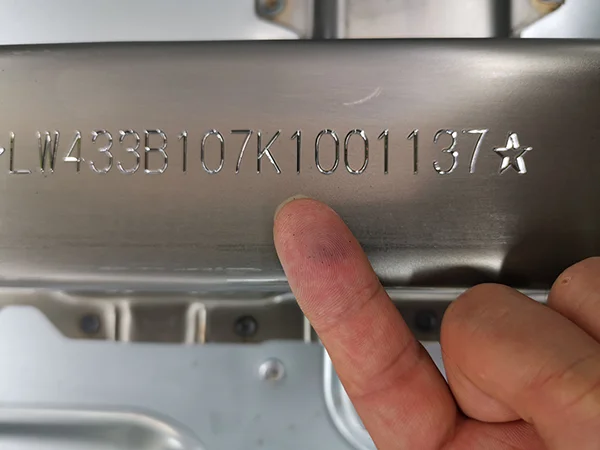
Traceability is a structural requirement in automotive manufacturing, not a paperwork task. Every vehicle that leaves a final assembly line carries a Vehicle Identification Number that must remain readable for the entire life of the vehicle, and every major component behind that vehicle may need to be linked back to its production record. When the marking is shallow, mispositioned, or unreadable after painting, the traceability chain breaks, and the cost of repairing that chain appears later in rework, audits, and warranty investigations.
The practical question for manufacturing and process engineers is therefore not whether traceability matters, but how to solve marking traceability problems in a way that survives real production conditions: high-strength steel, hot-formed panels, high line rates, robotic handling, and paint shop processes that can erase a marginal mark. This article examines the main causes of traceability failure in automotive marking and describes the technical approaches used to address them, including deep laser marking, vision guidance, and online marking quality inspection.
Why Automotive Traceability Problems Occur
Traceability failures rarely come from a single source. In body-in-white and powertrain production, several conditions interact, and a marking system that works on one material or one station may not hold up on another.
Material Strength and Surface Condition
Modern body structures increasingly use high-strength steel and hot-formed steel. Marking these materials with a conventional shallow process can produce a mark that looks acceptable at the marking station but loses contrast after painting or rubbing. If the marking depth is insufficient, the characters may not transfer clearly to the rubbing medium, and the identification data becomes difficult or impossible to read.
Positioning Accuracy on Moving Lines
A VIN must be placed at a defined location on the body. When the body arrives with normal dimensional variation, or when it is moving on a conveyor or carried by a manipulator, a fixed marking position can produce offset characters. Offset marking is a traceability problem because it affects both readability and compliance with the defined marking location.
Lack of In-Line Verification
If marking quality is only checked manually or after the fact, defective marks are discovered late. By then the body may have moved downstream, and the correction requires additional handling. Without in-line inspection, there is no reliable way to confirm that each mark meets the required depth and character quality.
Integration Gaps in Automated Lines
Traceability equipment must work inside an automated production line. If a marking head cannot be integrated with robots or assisted manipulators, or if it lacks suitable mounting interfaces, the marking operation becomes a manual island. Manual marking introduces variability in position, depth, and cycle time, all of which weaken traceability.
Product Overview: Deep Laser Marking for VIN Traceability
KINMARK Deep Laser Marking Machine is a marking system developed for permanent VIN marking on high-strength body materials. It is positioned at the point in the production flow where the vehicle identity must be created and preserved: body-in-white marking, where the VIN is applied before painting and downstream assembly.
The system is designed to mark high-strength steel plates with yield strength exceeding 700 MPa and hot-formed steel plates with strength up to 1500 MPa. On body-in-white, the marking depth can reach more than 0.2 mm. This depth is the basis for traceability, because a deep mark remains legible through painting and rubbing processes that would obscure a shallow mark.
The machine is also built for integration. It is designed with various mounting interfaces so that it can be quickly integrated with industrial robots or assisted manipulators for automated production lines. Optional 3D vision guidance and optional 3D laser scanning measurement with OCR recognition extend the system from marking alone to positioning and verification within the same traceability workflow.
Working Principle of Deep Laser Marking
Deep laser marking uses a laser source to remove or displace material at the surface of the workpiece, creating a permanent mark rather than a surface discoloration. Because the mark is formed into the material, it is not removed by normal paint shop processes. KINMARK Deep Laser Marking Machine uses a 200W laser and a marking area of 112 mm × 112 mm, with a marking depth of at least 0.2 mm.
The system also adopts a special marking process intended to ensure clear rubbing results after painting. In practice, this means the mark is structured so that the rubbing operation, which transfers the VIN to a record medium, produces a clear and readable result. The combination of sufficient depth and a controlled marking process is what allows the VIN to remain traceable after the body has passed through paint.
When the optional 3D vision guidance system is used, the system positions the marking head relative to the actual body position before marking. When the optional 3D laser scanning measurement and OCR recognition systems are used, the marked characters are measured and identified online. These functions support the marking operation itself and close the loop between marking and verification.
Key Features That Address Traceability Problems
Deep VIN marking: Enables permanent VIN deep marking on high-strength steel plates with yield strength exceeding 700 MPa and hot-formed steel plates with strength up to 1500 MPa. Marking depth on body-in-white can reach more than 0.2 mm.
Easy rubbing: Adopts a special marking process to ensure clear rubbing results after painting, so the VIN remains transferable to records after the paint shop.
Easy integration: Designed with various mounting interfaces for quick integration with industrial robots or assisted manipulators, supporting automated production lines rather than manual marking stations.
Vision guidance: Optional 3D vision guidance system enables precise positioning and accurate marking, addressing positional variation on the line.
Automatic traceability: Optional 3D laser scanning measurement and OCR recognition systems provide online inspection of marking quality and support 100% traceability.
Technical Specifications
| Power Supply | AC220V ±10%, 50Hz ±2% |
| Power Consumption | <1000W |
| Laser Power | 200W |
| Marking Area | 112mm × 112mm |
| Marking Depth | ≥0.2mm |
| Operating Temperature | 0~40℃ |
| Operating Humidity | ≤90% RH (Non-condensing) |
How Deep Laser Marking Solves Traceability Problems
Solving the Readability Problem After Painting
The most common traceability failure in body-in-white marking is a mark that cannot be read or rubbed after painting. A marking depth of more than 0.2 mm on body-in-white, combined with a marking process designed for clear rubbing, addresses this directly. The VIN is formed into the material rather than applied on top of it, so the paint process does not cover or blur the identification data.
Solving the Positioning Problem
Positional variation on a moving production line can cause the VIN to be marked outside the defined area. The optional 3D vision guidance system enables precise positioning and accurate marking. Instead of assuming the body is in a nominal position, the system locates the actual marking surface and marks accordingly.
Solving the Verification Problem
Traceability requires evidence that each mark is correct. The optional 3D laser scanning measurement system inspects marking depth, while OCR recognition identifies the printed characters online. Together they provide online inspection of marking quality and support 100% traceability, so a defective mark can be identified at the marking station rather than after the body has moved downstream.
Solving the Integration Problem
Manual marking introduces variability. The machine is designed with various mounting interfaces so it can be quickly integrated with industrial robots or assisted manipulators. This allows the marking operation to become part of the automated production line, with consistent positioning and cycle behavior.
Applications in Automotive Manufacturing
Deep laser marking for traceability is relevant wherever a permanent vehicle or component identity must survive downstream processes.
Body-in-white VIN marking: Permanent VIN marking on high-strength steel and hot-formed steel body structures, with marking depth greater than 0.2 mm.
Automotive manufacturing lines: Integration with robots or assisted manipulators for automated marking stations.
New energy vehicle production: Traceability marking within modern vehicle assembly environments where material strength and process integration requirements are demanding.
Powertrain and component manufacturing: Permanent identification marking on high-strength metal parts where the mark must remain readable through subsequent processing.
Intelligent factory automation: Marking stations that combine positioning, marking, and online inspection within a connected production workflow.
Benefits for Production and Quality Teams
Improved traceability: Deep, permanent marks and optional online inspection support a complete identification record from body-in-white onward.
Better process consistency: Robot integration and vision guidance reduce the variability associated with manual marking.
Reliable post-paint readability: A marking process designed for clear rubbing helps preserve the VIN through paint shop operations.
Production integration: Mounting interfaces and optional vision and inspection modules allow the marking system to operate as part of an automated line.
Quality management support: OCR recognition and 3D scanning measurement provide online marking quality data that quality teams can use for process control.
Note on configuration: The 3D vision guidance system and the 3D laser scanning measurement with OCR recognition are optional. Traceability scope and inspection capability depend on the configuration selected for the production line.
Why Choose KINMARK for Traceability Marking
KINMARK has been engaged in automotive intelligent automation equipment since its founding in 1996, with marking and traceability systems as one of its core product lines. The company develops and manufactures marking and traceability systems, servo press systems, fluid filling systems, and robot automation systems.
Its marking technology has been applied in cooperation with automotive manufacturers and suppliers across vehicle assembly, powertrain, and component production. The Deep Laser Marking Machine reflects this application experience: it is designed around the actual conditions of body-in-white marking, including high-strength materials, robot integration, and the need for post-paint readability.
For production and purchasing teams evaluating traceability solutions, the relevant considerations are material capability, integration with existing automation, and the ability to verify marking quality online. KINMARK supports these requirements through deep VIN marking, optional vision guidance, and optional 3D scanning and OCR inspection, together with installation, commissioning, and operator training services.
Frequently Asked Questions
What marking depth is required for reliable VIN traceability?
For body-in-white marking, KINMARK Deep Laser Marking Machine can achieve a marking depth of more than 0.2 mm. This depth supports permanent identification and clear rubbing results after painting. The appropriate depth for a specific application should be confirmed with the equipment supplier based on the material and process.
Can the system mark high-strength and hot-formed steel?
Yes. The system is designed to perform deep VIN marking on high-strength steel plates with yield strength exceeding 700 MPa and on hot-formed steel plates with strength up to 1500 MPa.
How is marking quality verified in the production line?
The optional 3D laser scanning measurement system inspects marking depth, and the optional OCR recognition system identifies the marked characters online. Together they provide online inspection of marking quality and support 100% traceability when these options are configured.
Can the marking machine be integrated with robots?
Yes. The machine is designed with various mounting interfaces so it can be quickly integrated with industrial robots or assisted manipulators for automated production lines. An optional 3D vision guidance system can be added for precise positioning and accurate marking.
What support is provided after installation?
The complete machine is covered by a 12-month warranty. KINMARK provides installation and commissioning, operator training, remote diagnosis, and technical assistance to support continuous operation.
Conclusion
Automotive traceability problems usually originate at the marking station: insufficient depth on high-strength materials, positioning errors on moving lines, and the absence of in-line verification. Addressing these causes requires a marking system that is designed for the material, integrated into the production line, and supported by inspection where full traceability is required.
KINMARK Deep Laser Marking Machine addresses these requirements through deep VIN marking on high-strength and hot-formed steel, a marking process intended for clear rubbing after painting, mounting interfaces for robot integration, and optional 3D vision guidance and 3D laser scanning measurement with OCR recognition. For manufacturing engineers and production managers, the result is a traceability workflow that begins with a permanent mark and continues with online verification, rather than a marking operation whose quality is only discovered later.
If you're interested in any of the equipment mentioned in this article, feel free to contact our sales engineers for detailed product information and customized technical solutions.