
How to Integrate Laser Marking into Production Lines
Introduction
Integrating laser marking into an existing or new production line is a critical step for automotive manufacturers aiming to achieve permanent traceability, meet regulatory requirements, and maintain high throughput. Unlike standalone marking stations, inline laser marking must synchronize with conveyors, robots, and plant-level MES/ERP systems. This guide explains the technical and operational considerations for successfully integrating a deep laser marking system into automotive production lines, with a focus on VIN marking on high-strength steel and other demanding applications.
Product Overview
The KINMARK Deep Laser Marking Machine is designed for permanent VIN deep marking on high-strength steel plates with yield strength exceeding 700 MPa and hot-formed steel plates with strength up to 1500 MPa. The marking depth on body-in-white can reach more than 0.2 mm, ensuring durability and readability throughout the vehicle's lifecycle. The system supports automation through various mounting interfaces for quick integration with industrial robots or assisted manipulators, making it suitable for modern automotive assembly lines.
Working Principle
The deep laser marking process uses a high-power laser (200W) to ablate material from the surface, creating a permanent mark with a depth of at least 0.2 mm. This is achieved through a special marking process that ensures clear rubbing results after painting. The system can be equipped with an optional 3D vision guidance system for precise positioning and an optional 3D laser scanning measurement and OCR recognition system for online inspection of marking quality and 100% traceability. The marking area is 112mm × 112mm, and the system operates on AC220V ±10%, 50Hz ±2% power with consumption under 1000W.
Key Features
Deep VIN Marking: Permanent marking on high-strength steel and hot-formed steel with depth ≥0.2mm.
Easy Rubbing: Special marking process ensures clear rubbing after painting.
Easy Integration: Various mounting interfaces for quick integration with robots or manipulators.
Vision Guidance (Optional): 3D vision system for precise positioning and accurate marking.
Automatic Traceability (Optional): 3D laser scanning and OCR for online quality inspection and 100% traceability.
Robust Design: Operates in temperatures 0~40℃ and humidity ≤90% RH (non-condensing).
Integration Steps for Production Lines
1. Assess Marking Requirements and Line Layout
Begin by defining the marking content (e.g., VIN, serial numbers, Data Matrix codes), material type (high-strength steel, aluminum, etc.), and required marking depth. Evaluate the available space on the production line, including conveyor height, robot reach, and access for maintenance. The KINMARK deep laser marking machine has a compact marking head and multiple mounting interfaces, which facilitates integration into space-constrained areas.
2. Select the Integration Method
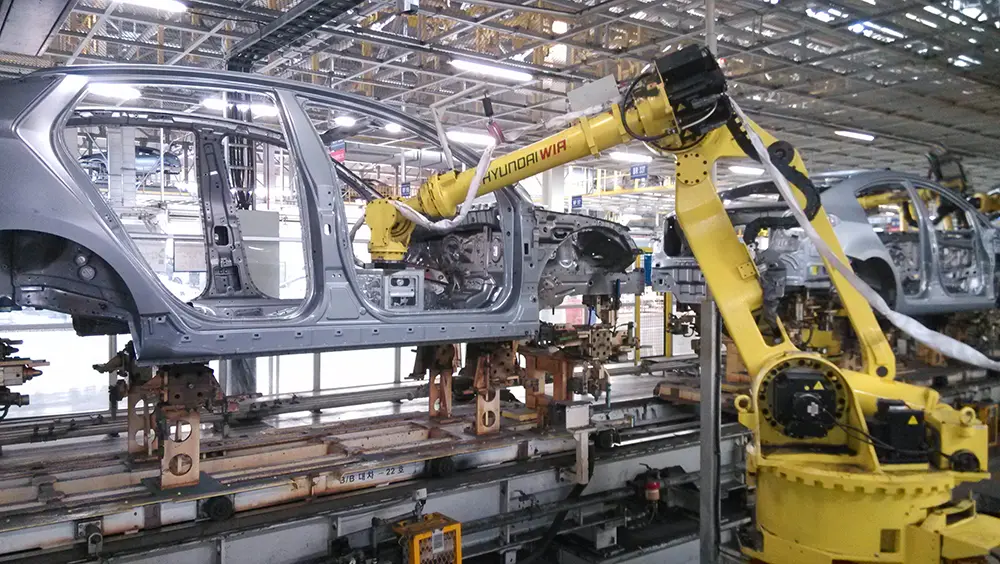
Laser marking can be integrated as a standalone station or as part of a robotic cell. For high-volume automotive lines, robot-mounted marking heads are common. The KINMARK system is designed for quick integration with industrial robots or assisted manipulators, allowing flexible positioning and marking of complex geometries. If the line uses a fixed station, ensure the marking head is mounted securely and aligned with the workpiece.
3. Implement Vision Guidance and Positioning
For precise marking on moving or varied workpieces, an optional 3D vision guidance system can be used. This system identifies the exact position and orientation of the part, compensating for any misalignment. This is particularly useful when marking VINs on body-in-white where tolerances may vary. The vision system communicates with the marking controller to adjust the marking path in real time.
4. Integrate with Plant Control Systems
To achieve full traceability, the laser marking system should interface with the plant's MES, ERP, or PLC. This allows automatic retrieval of marking data (e.g., VIN from production order) and transmission of marking results and quality data back to the database. The KINMARK system supports standard industrial communication protocols; however, specific interface details should be confirmed with the supplier based on your control architecture.
5. Install Quality Inspection and Traceability
After marking, online inspection is critical. An optional 3D laser scanning measurement system combined with OCR recognition can verify mark depth, character legibility, and correctness. This ensures 100% traceability and immediate feedback for process control. The inspection system can be integrated inline or as a separate station, depending on cycle time requirements.
6. Commissioning and Operator Training
Once installed, the system requires commissioning to optimize marking parameters for the specific material and depth. KINMARK provides installation, commissioning, and operator training to help customers start production smoothly. Regular maintenance and calibration are recommended to maintain marking quality and system reliability.
Applications
The deep laser marking machine is primarily used in automotive manufacturing for VIN marking on body-in-white, chassis components, and other safety-critical parts. It is suitable for:
Automotive Manufacturing: VIN marking on high-strength steel and hot-formed steel.
Automotive Components: Permanent marking for traceability of engine, transmission, and safety parts.
New Energy Vehicles: Battery tray and structural component marking.
Powertrain Manufacturing: Marking on engine blocks, cylinder heads, and gears.
Intelligent Factory Automation: Integration with robotic cells and automated lines.
Benefits of Integration
Permanent Traceability: Deep marks (≥0.2mm) survive painting and harsh environments, ensuring VIN readability for decades.
Process Consistency: Automated marking eliminates human error and ensures uniform depth and quality.
Production Integration: Quick robot integration and optional vision systems reduce cycle time and improve line efficiency.
Quality Management: Optional online inspection provides real-time quality data and 100% traceability.
Flexibility: Supports various materials and marking contents, adapting to different vehicle models.
Why Choose KINMARK for Laser Marking Integration
KINMARK (Jinan Zhongzheng Jinma Technology Co., Ltd.) has been developing and manufacturing marking and traceability systems since 1996. The company is a Shandong Province "Gazelle" and "Specialized and New" enterprise, with a focus on automotive intelligent automation equipment. KINMARK's deep laser marking machine is designed for easy integration with robots and production lines, and the company provides installation, commissioning, and training services. With long-term cooperation with major automotive manufacturers, KINMARK has the experience to support complex integration projects.
Frequently Asked Questions
What materials can the deep laser marking machine mark?
The system is designed for high-strength steel plates with yield strength exceeding 700 MPa and hot-formed steel plates with strength up to 1500 MPa. It is primarily used for VIN marking on body-in-white, but can also mark other metals used in automotive components.
How deep is the marking?
The marking depth on body-in-white can reach more than 0.2 mm, ensuring permanent traceability even after painting.
Can the laser marking system be integrated with existing robots?
Yes, the system is designed with various mounting interfaces for quick integration with industrial robots or assisted manipulators. It can be mounted on robot arms or fixed stations.
What are the power requirements?
The system operates on AC220V ±10%, 50Hz ±2% power with consumption under 1000W.
Is vision guidance necessary for integration?
Vision guidance is optional but recommended for applications requiring high positioning accuracy on moving or varied workpieces. It helps compensate for part misalignment and improves marking accuracy.
Conclusion
Integrating laser marking into production lines requires careful planning, from assessing marking requirements to selecting the right integration method and implementing quality inspection. The KINMARK Deep Laser Marking Machine offers deep VIN marking on high-strength steel, easy robot integration, and optional vision and traceability systems. By following the steps outlined in this guide, automotive manufacturers can achieve permanent traceability, process consistency, and efficient production. For specific integration questions, consult with KINMARK's technical team to tailor the solution to your line.
If you're interested in any of the equipment mentioned in this article, feel free to contact our sales engineers for detailed product information and customized technical solutions.