
How to Improve Refrigerant Filling Process Efficiency
Introduction
In automotive manufacturing and assembly, fluid filling is a critical but often overlooked bottleneck. When the refrigerant filling process is too slow, it directly impacts takt time, line balance, and overall production output. Unlike simple gravity filling, refrigerant and coolant circuits require precise evacuation, leak verification, and controlled pressure filling to ensure system integrity and long-term vehicle reliability. This article examines the root causes of slow refrigerant filling and explains how modern vacuum filling technology—specifically PLC-controlled systems with integrated leak testing and back suction—can improve process efficiency without compromising quality.
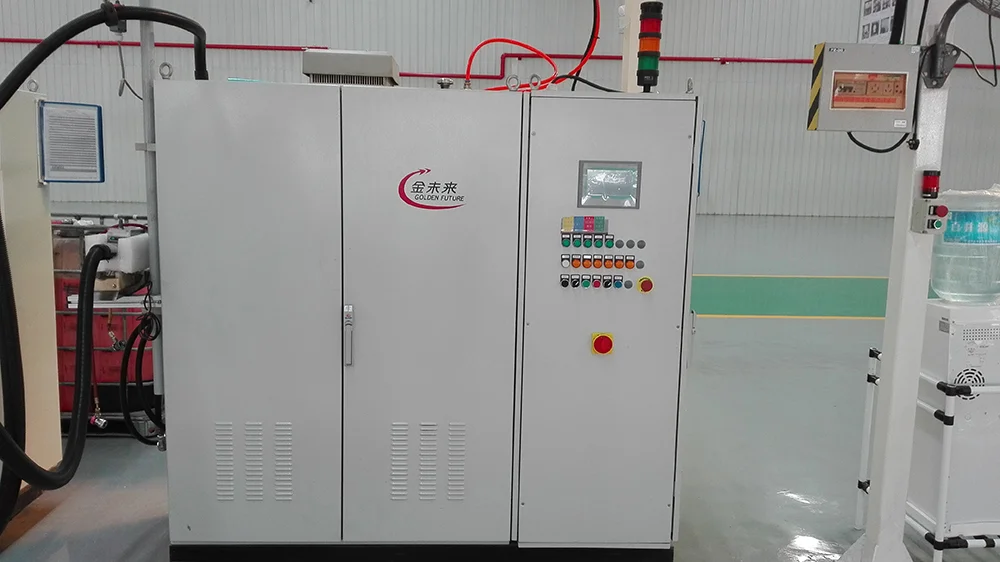
Why Refrigerant Filling Processes Become Slow
Several factors contribute to slow filling cycles on automotive assembly lines:
Inadequate vacuum evacuation: If the vacuum pump capacity is too low or the evacuation path is restricted, it takes longer to remove air and moisture from the system.
Manual leak testing: Separate leak test stations add time and require additional handling.
Single-stage filling: Filling without a secondary vacuum or pressure equilibrium step can cause foam, inaccurate liquid levels, and rework.
Lack of back suction: Without controlled back suction, excess fluid remains in the line, leading to spills or level correction later.
Operator dependency: Manual valves and gauges introduce variability and slow down cycle times.
Addressing these issues requires an integrated approach rather than isolated equipment upgrades.
Product Overview: Antifreeze Vacuum Filling Machine
The Antifreeze Vacuum Filling Machine is designed for automated coolant and antifreeze filling on automotive production and assembly lines. It combines vacuum evacuation, leak testing, pressure filling, and back suction into a single PLC-controlled cycle. The system is suitable for filling volumes from 1 to 400 liters, with a maximum filling speed of 60 L/min and filling precision of ±0.5%. Liquid level accuracy is maintained at ±2 mm, ensuring a stable level after filling.
Working Principle
The machine operates through a defined sequence:
Vacuum evacuation: The system removes air and moisture from the coolant circuit.
Leak testing: Under vacuum and pressure conditions, the system checks for leaks. The negative pressure leak rate is ≤0.5 mbar / 60 s, and positive pressure leakage is<1.4 g/year.
Secondary vacuum: After confirming tightness, a second vacuum is created to prepare for filling.
Pressure filling: Coolant is introduced under controlled pressure (1–4 bar) until equilibrium is reached.
Venting and back suction: The system automatically vents to atmospheric pressure and performs back suction to remove excess coolant, achieving the specified liquid level.
This integrated cycle eliminates the need for separate leak test stations and reduces manual intervention.
Key Features for Faster Filling
PLC-controlled automation: The entire cycle is automated, reducing operator dependency and cycle time variability.
High-capacity vacuum pump: With a capacity of 40–65 m³/h, evacuation is faster than smaller pumps.
Integrated leak testing: Vacuum and pressure leak tests are performed in-cycle, eliminating a separate station.
Precise filling control: Filling pressure of 1–4 bar and precision of ±0.5% ensure accurate fill volumes.
Back suction: Removes excess coolant to achieve the target liquid level without manual correction.
Stable liquid level: ±2 mm accuracy prevents level drop after filling.
Measurement display: 0.0–999.9 L range for clear monitoring.
Applications
This vacuum filling machine is used in:
Automotive manufacturing and assembly lines
Powertrain manufacturing
New energy vehicle thermal management systems
Automotive components production
Intelligent factory automation
It is suitable for filling antifreeze and coolant in engines, battery cooling circuits, and HVAC systems. For other industrial automation solutions, KINMARK also provides equipment designed for different manufacturing processes.
Benefits of Upgrading to Vacuum Filling
Shorter cycle times: Integrated vacuum, leak test, and fill reduce total process time compared to sequential manual steps.
Improved traceability: PLC control allows data logging of fill volumes and leak test results.
Consistent quality: Automated back suction and level control reduce rework and spills.
Flexible integration: The machine can be integrated into existing assembly lines with customizable dimensions (1800 × 1000 × 800 mm).
Reduced operator error: Automatic sequence eliminates manual valve adjustments.
Why Choose KINMARK
KINMARK (Jinan Zhongzheng Jinma Technology Co., Ltd.) has been developing marking and traceability, servo press, fluid filling, and robot automation systems since 1996. The company is a Shandong Province "Gazelle" and "Specialized and Sophisticated" enterprise. With service centers in Shanghai, Beijing, Guangzhou, Changchun, Wuhan, and Chongqing, KINMARK provides installation, commissioning, and operator training. The Antifreeze Vacuum Filling Machine is backed by a 12-month warranty and fast-response after-sales support.
Frequently Asked Questions
What causes slow refrigerant filling?
Common causes include insufficient vacuum pump capacity, separate manual leak testing, lack of back suction, and operator-dependent valve adjustments. Integrated vacuum filling systems address these issues in one cycle.
How does vacuum filling improve efficiency?
Vacuum filling combines evacuation, leak testing, pressure filling, and back suction into a single automated cycle, reducing handling and cycle time while maintaining accuracy.
What is the filling precision of the Antifreeze Vacuum Filling Machine?
The machine achieves filling precision of ±0.5% and liquid level accuracy of ±2 mm, ensuring stable and repeatable fills.
Can this machine be integrated into an existing assembly line?
Yes. The equipment dimensions are customizable (standard: 1800 × 1000 × 800 mm), and the PLC-controlled system can be integrated with line controls.
What is the maximum filling speed?
The maximum filling speed is 60 L/min, with a filling volume range of 1–400 L.
Conclusion
Improving refrigerant filling process efficiency requires more than just a faster pump—it demands an integrated approach that combines vacuum evacuation, leak testing, pressure filling, and back suction. The Antifreeze Vacuum Filling Machine from KINMARK delivers this integration with PLC control, high-capacity vacuum pump, and precise filling parameters. By reducing manual steps and cycle time, it helps automotive manufacturers achieve stable liquid levels and consistent quality on production lines.
If you're interested in any of the equipment mentioned in this article, feel free to contact our sales engineers for detailed product information and customized technical solutions.