
How to Evaluate Dot Peen Marking Equipment for Brake Disc Production
Introduction
Dot peen disc marking equipment is used in automotive manufacturing to create permanent, traceable marks on brake discs and other round metal components. These marks support production traceability, quality control, and regulatory compliance. Selecting the right system requires evaluating several technical and operational factors, from marking depth and positioning flexibility to inspection capabilities and integration with factory data systems.
This guide outlines the key criteria for evaluating dot peen disc marking equipment for industrial production. It covers working principles, essential features, applications, and practical considerations to help engineers and production managers make informed decisions.
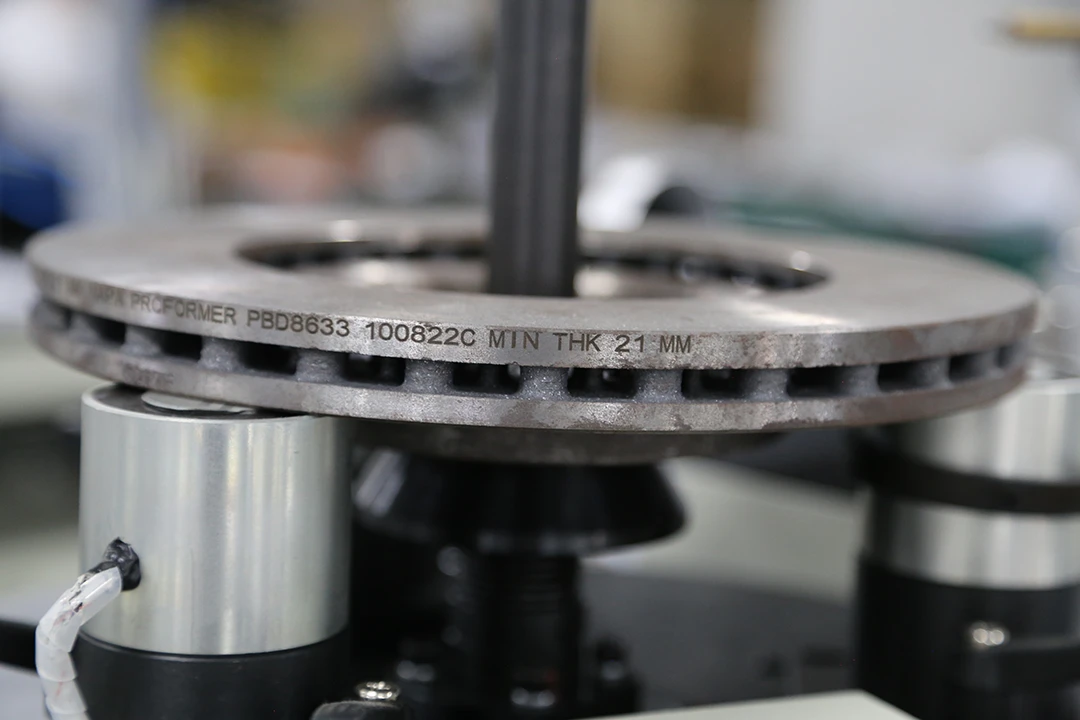
Product Overview
An automatic dot peen brake disc marking machine is designed for high-volume marking of automotive brake discs and similar round metal parts. It uses a high-performance marking head and flexible positioning system to produce deep, permanent marks that remain legible throughout the component's service life.
These systems are built for multi-model production environments, where brake disc sizes and designs change frequently. They support automatic product changeover and various positioning methods, making them suitable for integration into automated production lines. The equipment also includes automatic inspection technology to monitor marking quality during operation.
Working Principle
Dot peen marking creates characters or patterns by striking the metal surface with a hard stylus. Each strike produces a small indentation, and by controlling the stylus movement, a series of dots forms the required mark. The depth of the mark can be adjusted by controlling the impact force, allowing adaptation to different materials and production requirements.
In disc marking equipment, the brake disc is positioned and secured before marking. The system supports multiple positioning methods, including inner hole expansion, outer diameter clamping, threaded positioning, spring positioning, electromagnetic positioning, and chuck positioning. This flexibility ensures stable and accurate marking across different disc designs.
After marking, an integrated inspection system uses audio-based detection to verify mark quality. This helps identify incomplete or defective marks in real time, reducing the risk of unreadable codes entering the production flow.
Key Features to Evaluate
When assessing dot peen marking equipment, consider the following features that directly affect production performance and traceability.
Marking Depth and Permanence
The system should produce deep, permanent marks that withstand handling, storage, and operational wear. Adjustable marking depth is important for adapting to different materials and traceability requirements.
Positioning Flexibility
Brake discs vary in size and design. Equipment that supports multiple positioning methods—such as inner hole expansion, outer diameter clamping, threaded positioning, spring positioning, electromagnetic positioning, and chuck positioning—can handle a wider range of products without dedicated fixtures.
Automatic Positioning and Changeover
For multi-model production, automatic positioning and changeover reduce manual adjustment time and minimize the risk of setup errors. This feature supports efficient changeovers between different brake disc models.
Integrated Marking Quality Inspection
Audio-based marking detection monitors mark quality during production. This allows immediate detection of defects and supports consistent traceability.
Production Efficiency
Evaluate marking speed and cycle time in relation to your production volume. The equipment should provide stable operation and seamless integration with automated production lines.
Factory Data Management Integration
The system should support connection with factory management platforms for centralized management of marking templates, fonts, and production data. This enables consistent marking across lines and simplifies data traceability.
Reliability and Maintenance
In environments with high metal dust exposure, protective design and easy maintenance are critical. Look for equipment designed for high availability and simple service access.
Applications
Dot peen disc marking equipment is primarily used in automotive manufacturing for brake disc traceability. It is suitable for:
Automotive brake disc production lines
Round metal component marking in powertrain manufacturing
Automotive components requiring permanent identification
New energy vehicle brake systems
Intelligent factory automation environments
The equipment is designed for high-volume production and can be integrated into automated lines for continuous operation.
Benefits of Proper Evaluation
Choosing the right dot peen disc marking equipment offers several operational benefits:
Improved traceability: Permanent marks ensure each disc can be traced throughout its lifecycle.
Better process consistency: Automatic positioning and inspection reduce variation in marking quality.
Production integration: Seamless connection with automated lines and factory data platforms.
Reduced manual adjustment: Automatic changeover minimizes operator intervention.
Quality management: Real-time inspection helps prevent defective marks from advancing.
Why Choose KINMARK
KINMARK is a manufacturer of marking and traceability systems, servo press systems, fluid filling systems, and robot automation systems. With experience in automotive manufacturing and intelligent factory automation, KINMARK provides dot peen disc marking equipment designed for high-volume production environments.
The company offers a 12-month warranty on the complete machine, fast response service, and installation and commissioning support. KINMARK engineers provide equipment installation, commissioning, and operator training to help customers start production smoothly.
Frequently Asked Questions
What is dot peen disc marking equipment used for?
It is used to create permanent, traceable marks on brake discs and other round metal components in automotive production. These marks support quality control, traceability, and regulatory compliance.
How does the equipment handle different brake disc models?
The system supports multiple positioning methods, including inner hole expansion, outer diameter clamping, threaded positioning, spring positioning, electromagnetic positioning, and chuck positioning. It also features automatic positioning and changeover to accommodate different disc sizes and designs.
Can marking quality be inspected automatically?
Yes. The equipment is equipped with audio-based marking detection technology that monitors marking quality during operation to reduce defective products and ensure reliable traceability.
Is the system compatible with factory data management platforms?
Yes. The system supports connection with factory management platforms, enabling centralized management of marking templates, fonts, and production data.
What support is available after purchase?
KINMARK provides a 12-month warranty, fast response service, remote diagnosis, technical assistance, installation and commissioning, and operator training.
Conclusion
Evaluating dot peen disc marking equipment for industrial production requires attention to marking depth, positioning flexibility, automatic changeover, inspection capability, data integration, and reliability. These factors directly influence traceability, production efficiency, and quality management in automotive manufacturing.
By focusing on these criteria, engineers and production managers can select equipment that meets the demands of high-volume brake disc production and integrates smoothly into automated factory environments.
If you're interested in any of the equipment mentioned in this article, feel free to contact our sales engineers for detailed product information and customized technical solutions.