
How to Remove Air from an Automotive AC System Before Refrigerant Charging
Introduction
Air and moisture are the two most common contaminants in an automotive refrigeration or coolant circuit. When a system is opened for service, assembly, or component replacement, ambient air enters the circuit and brings water vapor with it. If that air is not removed before charging, it occupies volume that should be filled with refrigerant or coolant, raises discharge pressure, and can lead to inconsistent cooling performance or corrosion inside the loop.
Removing air is therefore not an optional step. It is a controlled process that combines vacuum evacuation, leak testing, and pressure-controlled filling. This guide explains the principle behind air removal, the sequence of operations used on automotive production and assembly lines, and the equipment features that support a stable, repeatable result. Learn more about KINMARK fluid filling systems for industrial production applications.
Why Air Must Be Removed Before Charging
A refrigeration or coolant circuit is designed to hold a specific charge of liquid or refrigerant. Air is a non-condensable gas in this context. When it remains in the system, it does not behave like the working fluid and instead creates several practical problems:
It reduces the effective volume available for the refrigerant or coolant.
It can raise system pressure and cause unstable operating conditions.
Moisture carried by the air can contribute to internal corrosion and freezing at low-temperature points.
It makes the final liquid level or charge weight difficult to control accurately.
For automotive assembly lines, these issues translate into rework, inconsistent fill results, and potential quality escapes. Removing air before charging is the most direct way to protect both the component and the final vehicle.
The Working Principle of Vacuum-Based Air Removal
The standard method for removing air from a closed circuit is vacuum evacuation. A vacuum pump reduces the pressure inside the system below atmospheric pressure. As the pressure drops, air and water vapor are drawn out of the circuit and expelled through the pump. For related equipment options, see vacuum filling machines.
A controlled filling cycle typically follows this sequence:
Primary vacuum evacuation – the circuit is evacuated to remove the bulk of the air.
Leak testing under vacuum – the system is monitored to confirm that pressure does not rise, which would indicate an inward leak.
Leak testing under pressure – the circuit is checked under positive pressure to confirm tightness in the opposite direction.
Secondary vacuum – a second evacuation step removes any residual air or moisture released during testing.
Controlled pressure filling – the refrigerant or coolant is introduced under regulated pressure.
Pressure equalization and back suction – the system vents to atmospheric pressure and removes excess liquid to reach the specified level.
This integrated cycle is the basis of automated vacuum filling equipment used for coolant and antifreeze filling on automotive production and assembly lines.
Equipment Overview: Antifreeze Vacuum Filling Machine
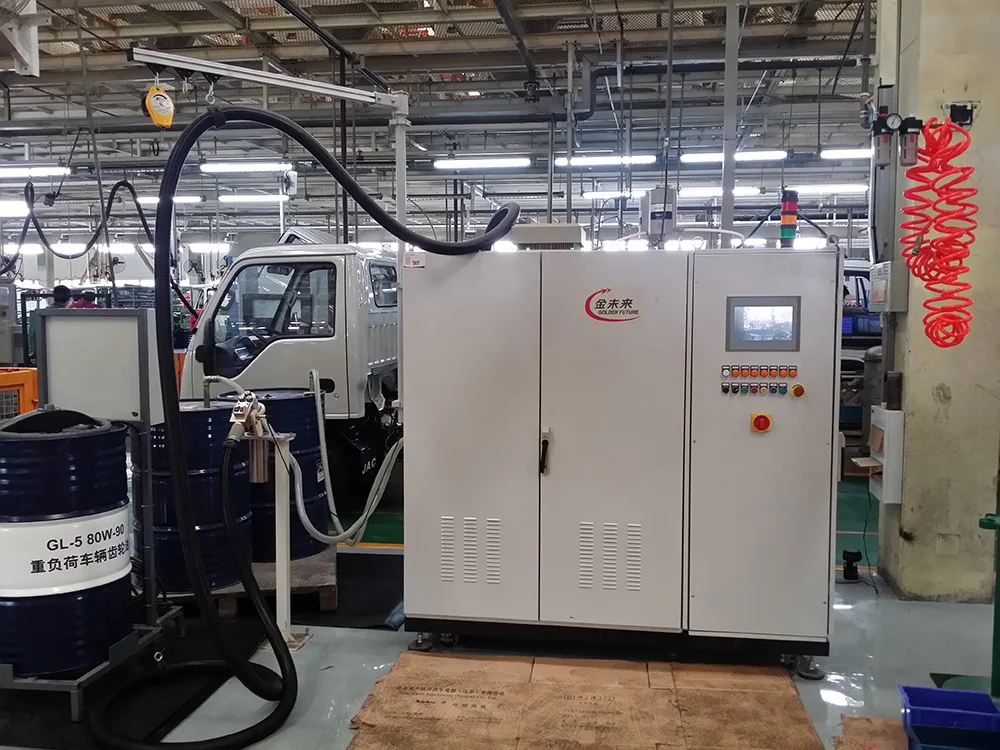
The Antifreeze Vacuum Filling Machine is a PLC-controlled system designed to automate the complete coolant filling process. It performs vacuum evacuation, leak testing under vacuum and pressure conditions, secondary vacuum, pressure filling, and back suction in a single cycle.
The machine is intended for automated coolant and antifreeze filling applications on automotive production and assembly lines. It is described as delivering precise filling with a stable liquid level, which is relevant when the same fill result must be repeated across many vehicles or components.
How the Filling Cycle Works
The system first performs vacuum evacuation. It then carries out leak testing under vacuum and pressure conditions. After confirming system tightness, a secondary vacuum is created before the coolant is introduced under controlled pressure. Once the filling pressure reaches equilibrium, the system automatically vents to atmospheric pressure and performs back suction to remove excess coolant. This helps achieve the specified liquid level and prevents the coolant level from dropping after filling.
Key Features
PLC-controlled automation of the complete coolant filling process.
Integrated vacuum evacuation to remove air before charging.
Leak testing under vacuum and pressure conditions to confirm system tightness.
Secondary vacuum before the coolant is introduced.
Pressure-controlled filling with automatic venting to atmospheric pressure.
Back suction to remove excess coolant and achieve the specified liquid level.
Stable liquid level that does not drop after filling.
Technical Specifications
| Parameter | Specification |
|---|---|
| Filling Medium | Antifreeze / Coolant |
| Filling Volume | 1–400 L |
| Filling Pressure | 1–4 bar |
| Maximum Filling Speed | 60 L/min |
| Filling Precision | ±0.5% |
| Liquid Level Accuracy | ±2 mm |
| Measurement Display Range | 0.0–999.9 L |
| Vacuum Pump Capacity | 40–65 m³/h |
| Negative Pressure Leak Rate | ≤0.5 mbar / 60 s |
| Positive Pressure Leakage | <1.4 g/year |
| Power Supply | AC 380 V ±10%, 50 Hz ±2% |
| Equipment Dimensions | 1800 × 1000 × 800 mm (customizable) |
Applications
The machine is suitable for automated coolant and antifreeze filling applications on automotive production and assembly lines. Its cycle design supports use wherever a closed circuit must be evacuated, checked for tightness, and filled to a controlled level.
Typical areas of use include:
Automotive manufacturing and final assembly.
Automotive components that require a controlled liquid charge.
New energy vehicle thermal management and cooling circuits, including new energy vehicle cooling system applications.
Powertrain manufacturing where coolant filling is part of the build process.
Intelligent factory automation environments that require repeatable, automated filling.
Benefits of Vacuum-Based Air Removal
Improved traceability of the fill process – the cycle follows a defined sequence that can be repeated across units.
Better process consistency – controlled pressure and back suction help maintain a stable liquid level.
Integrated quality checks – leak testing is built into the same cycle as evacuation and filling.
Reduced manual intervention – the PLC-controlled system automates evacuation, testing, filling, and venting.
Protection against post-fill level drop – back suction helps prevent the coolant level from falling after filling.
Why Choose KINMARK
KINMARK is a developer and manufacturer of marking and traceability systems, servo press systems, fluid filling systems, and robot automation systems. The company was founded in 1996 and is based in the eastern high-tech development zone of Jinan. Its product lines cover marking and traceability, servo press-fitting, and fluid delivery and filling.
KINMARK serves automotive manufacturing, automotive components, new energy vehicles, powertrain manufacturing, and intelligent factory automation. The company has established long-term cooperation with automotive manufacturers and also provides automation solutions to industrial customers outside the automotive sector.
For filling applications, KINMARK provides:
12-month warranty covering the complete machine, with professional technical support and long-term maintenance service.
Fast response service including efficient after-sales support, remote diagnosis, and technical assistance to help maintain continuous operation.
Installation and commissioning by engineers, including equipment installation, commissioning, and operator training to help customers start production smoothly.
Note: The correct evacuation time, vacuum level, and leak-test acceptance criteria depend on the specific circuit volume, component design, and manufacturer requirements. Always follow the vehicle or component specification when configuring the filling cycle.
Frequently Asked Questions
Why is vacuum evacuation necessary before charging a refrigeration or coolant system?
Vacuum evacuation removes air and moisture from the circuit before the working fluid is introduced. If air remains, it occupies volume intended for the refrigerant or coolant, can raise system pressure, and makes the final charge or liquid level harder to control. The Antifreeze Vacuum Filling Machine performs vacuum evacuation as the first step of its automated cycle.
How does the machine confirm that the system is leak-free?
The system performs leak testing under vacuum and pressure conditions. After the initial evacuation, it monitors the circuit to confirm tightness. The equipment specification lists a negative pressure leak rate of ≤0.5 mbar / 60 s and positive pressure leakage of <1.4 g/year. Only after system tightness is confirmed does the cycle proceed to a secondary vacuum and filling.
What prevents the coolant level from dropping after filling?
Once the filling pressure reaches equilibrium, the system automatically vents to atmospheric pressure and performs back suction to remove excess coolant. This step helps achieve the specified liquid level and prevents the coolant level from dropping after filling. The machine is specified with a liquid level accuracy of ±2 mm.
What filling media and volumes can the machine handle?
The Antifreeze Vacuum Filling Machine is designed for antifreeze and coolant. It supports a filling volume range of 1–400 L, a filling pressure range of 1–4 bar, and a maximum filling speed of 60 L/min. The measurement display range is 0.0–999.9 L, and the filling precision is ±0.5%.
Is the equipment suitable for automated production lines?
Yes. The machine integrates vacuum evacuation, leak testing, pressure filling, and back suction into one PLC-controlled cycle, making it suitable for automated coolant and antifreeze filling on automotive production and assembly lines. Equipment dimensions are 1800 × 1000 × 800 mm and are customizable.
Conclusion
Removing air before charging an automotive refrigeration or coolant system is a controlled, multi-step process. Vacuum evacuation pulls air and moisture out of the circuit, leak testing confirms that the system is tight, a secondary vacuum clears residual contaminants, and pressure-controlled filling introduces the coolant. Back suction then removes excess liquid so the specified level is reached and maintained.
For automotive production and assembly lines, integrating these steps into one automated cycle supports consistent results and reduces manual intervention. The Antifreeze Vacuum Filling Machine applies this principle with a PLC-controlled sequence, defined filling parameters, and built-in leak testing, making it a practical option for automated coolant filling in vehicle and component manufacturing. For refrigerant-focused applications, you can also explore the Refrigerant Vacuum Filling Machine.
If you're interested in any of the equipment mentioned in this article, feel free to contact our sales engineers for detailed product information and customized technical solutions.