Automotive Laser Marking Machine Applications
Introduction
Laser marking has become a core process in automotive manufacturing, where every vehicle body, powertrain component, and safety-critical part must carry a durable, readable, and traceable identification code. Among the different marking technologies available, the automotive laser marking machine is widely used because it produces permanent marks without consumables, tool contact, or mechanical wear. KINMARK provides a range of laser marking machines for industrial identification applications.
In vehicle assembly, marking is not only about printing a number. The Vehicle Identification Number (VIN) must remain legible after painting, rubbing, and years of service. On modern body structures built from high-strength steel and hot-formed steel, conventional marking methods often struggle to reach the required depth. This is where deep laser marking systems are applied.
This application guide reviews the main applications of automotive laser marking machines, how deep VIN marking works on high-strength materials, where these systems are integrated in production lines, and what engineering teams should consider during selection and integration.
Product Overview
A deep laser marking machine is a marking system designed to create permanent identification marks on metallic surfaces, including high-strength steel plates and hot-formed steel plates used in vehicle body construction. It is used in automotive mass production environments where marking depth, mark stability, and traceability are required.
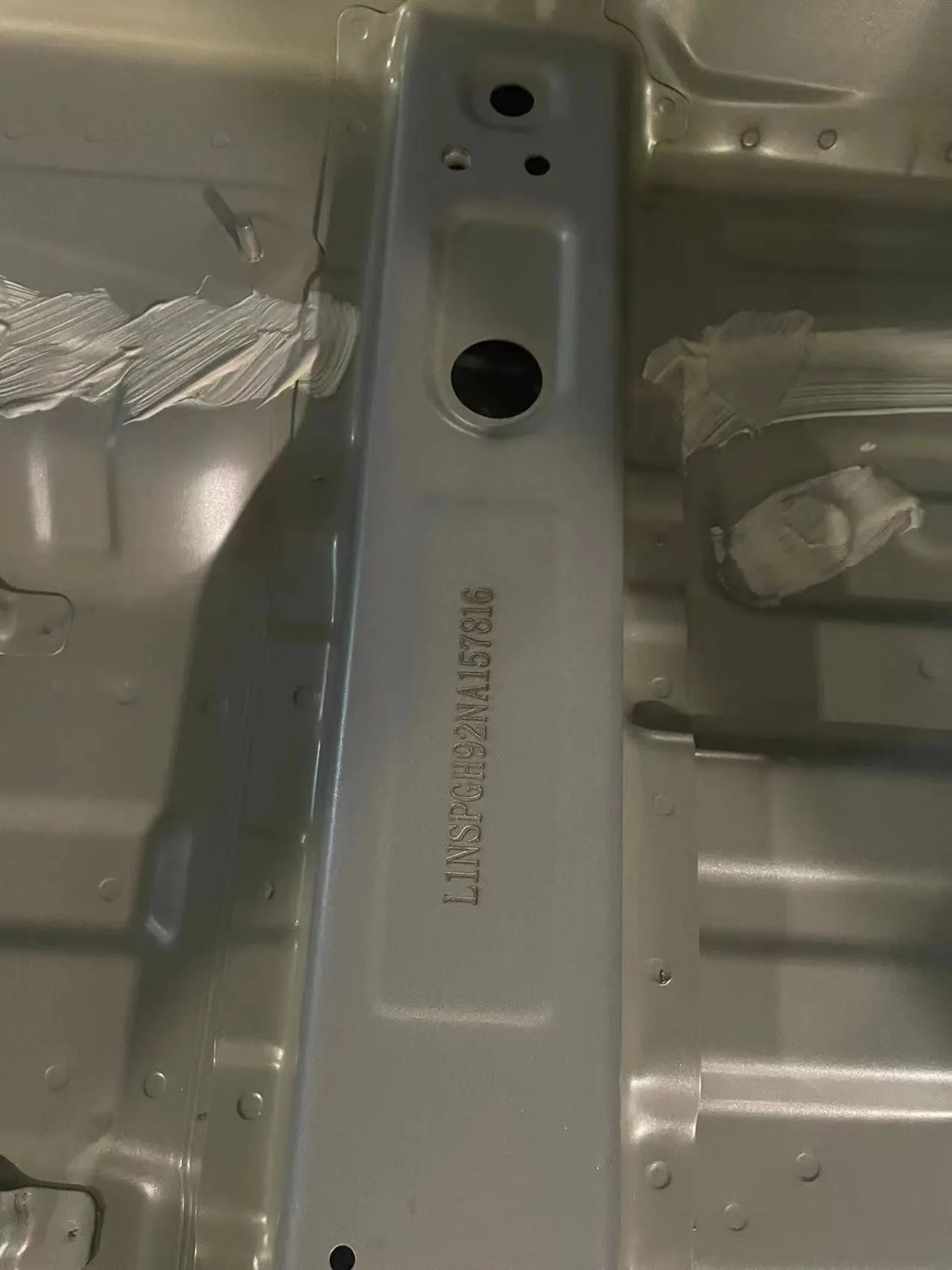
The KINMARK Deep Laser Marking Machine is developed for deep VIN marking on high-strength materials. According to the product information, the system can mark VIN codes on steel plates with yield strength exceeding 700 MPa and hot-formed steel plates with strength up to 1500 MPa. The marking depth on body-in-white can reach more than 0.2 mm.
The system is positioned for automated production lines. It supports integration with industrial robots or assisted manipulators through different mounting interfaces, and optional vision and inspection modules are available for positioning and traceability. These capabilities support broader automotive marking solutions.
Technical Specifications
| Power Supply | AC220V ±10%, 50Hz ±2% |
| Power Consumption | <1000W |
| Laser Power | 200W |
| Marking Area | 112mm × 112mm |
| Marking Depth | ≥0.2mm |
| Operating Temperature | 0~40℃ |
| Operating Humidity | ≤90% RH (Non-condensing) |
Working Principle
A laser marking machine uses a focused laser beam to modify the surface of a metal workpiece. In deep marking applications, the laser energy is controlled to remove or displace material to a defined depth, creating a mark that remains readable after subsequent processes such as painting and rubbing.
For VIN marking on body-in-white, the marking depth is a critical quality characteristic. The KINMARK deep laser marking process is designed to produce a marking depth greater than 0.2 mm on high-strength steel. A special marking process is applied to ensure clear rubbing results after painting, which supports the legal and traceability requirements of vehicle identification.
The system can be integrated with a robot or an assisted manipulator. Optional 3D vision guidance supports precise positioning before marking. Optional 3D laser scanning measurement and OCR recognition can be used for online inspection of marking quality and to support traceability.
Key Features
Deep VIN Marking: Permanent VIN deep marking on high-strength steel plates with yield strength exceeding 700 MPa and hot-formed steel plates with strength up to 1500 MPa. Marking depth on body-in-white can reach more than 0.2 mm.
Easy Rubbing: A special marking process ensures clear rubbing results after painting.
Easy Integration: Various mounting interfaces allow quick integration with industrial robots or assisted manipulators for automated production lines.
Vision Guidance: Optional 3D vision guidance system for precise positioning and accurate marking.
Automatic Traceability: Optional 3D laser scanning measurement and OCR recognition systems provide online inspection of marking quality and support 100% traceability.
Applications
Automotive laser marking machines are applied in several stages of vehicle and component manufacturing. The following applications are directly supported by the deep laser marking system described above.
Body-in-White VIN Marking
VIN marking on body-in-white is one of the primary applications. The system is designed to mark VIN codes on high-strength steel and hot-formed steel body structures, where conventional marking methods may not achieve the required depth. The mark must remain readable after painting and rubbing. For more details, see the deep laser marking machine range.
Automotive Manufacturing and Assembly Lines
The marking system is designed for automated production lines. It can be integrated with industrial robots or assisted manipulators, allowing marking to be performed inline as part of the assembly process. This supports consistent marking in mass production environments.
Traceability and Quality Inspection
With optional 3D laser scanning measurement and OCR recognition, the system can perform online inspection of marking quality. This supports marking and traceability requirements in automotive production, where each vehicle body must be linked to its identification data.
New Energy Vehicle and Powertrain Manufacturing
KINMARK serves automotive manufacturing, automotive components, new energy vehicles, powertrain manufacturing, and intelligent factory automation. Laser marking and traceability systems are part of the company's product portfolio for these industries.
Benefits
The application of deep laser marking in automotive production provides several engineering and production benefits.
Permanent identification: Deep marking creates a durable VIN mark that is designed to remain readable after painting and rubbing.
High-strength material capability: The system supports marking on high-strength steel and hot-formed steel, which are common in modern body structures.
Process consistency: Automated marking with robot integration supports repeatable marking in mass production.
Traceability support: Optional inspection systems allow online verification of mark quality and support traceability data collection.
Production integration: The system is designed to be integrated into existing automated lines through mounting interfaces and optional vision guidance.
Why Choose
KINMARK is a manufacturer of marking and traceability systems, servo press systems, fluid filling systems, and robot automation systems. The company has been involved in automotive intelligent automation equipment since 1996 and serves vehicle manufacturers, powertrain manufacturers, and automotive component suppliers.
For deep VIN marking applications, the KINMARK Deep Laser Marking Machine is designed around the requirements of automotive mass production: marking depth on high-strength materials, integration with robots and manipulators, and optional traceability functions. The company provides installation and commissioning, operator training, remote diagnosis, and after-sales support. The complete machine is covered by a 12-month warranty.
Frequently Asked Questions
What materials can the deep laser marking machine mark?
The system is designed for deep VIN marking on high-strength steel plates with yield strength exceeding 700 MPa and hot-formed steel plates with strength up to 1500 MPa. Marking depth on body-in-white can reach more than 0.2 mm.
Does the mark remain readable after painting?
The system adopts a special marking process to ensure clear rubbing results after painting. This supports VIN readability through the paint and rubbing process.
Can the marking system be integrated with robots?
Yes. The system is designed with various mounting interfaces for quick integration with industrial robots or assisted manipulators for automated production lines.
Is vision guidance available?
An optional 3D vision guidance system is available for precise positioning and accurate marking.
How is marking quality verified?
Optional 3D laser scanning measurement and OCR recognition systems provide online inspection of marking quality and support 100% traceability.
Conclusion
Automotive laser marking machine applications center on permanent identification, deep VIN marking on high-strength materials, and traceability in automated production lines. For body-in-white and other high-strength steel structures, deep laser marking provides a way to achieve the required marking depth and readability after painting.
When evaluating a marking system, production and manufacturing engineers should consider material strength, required marking depth, integration with robots or manipulators, and the level of traceability needed. The KINMARK Deep Laser Marking Machine addresses these requirements with deep VIN marking capability, robot integration interfaces, and optional vision guidance and inspection systems.
If you're interested in any of the equipment mentioned in this article, feel free to contact our sales engineers for detailed product information and customized technical solutions.