
Inside an Automated Marking System for Brake Disc Production
Introduction
Brake discs are safety-critical components, and every disc that leaves a production line needs to be identifiable. An automatic brake disc marking system is built for exactly this task: applying a permanent, machine-readable mark to round metal components at production speed. In high-volume automotive manufacturing, the marking step is not a standalone operation. It sits between machining and final inspection, and it has to keep pace with the line while producing marks that survive handling, storage, and years of service.
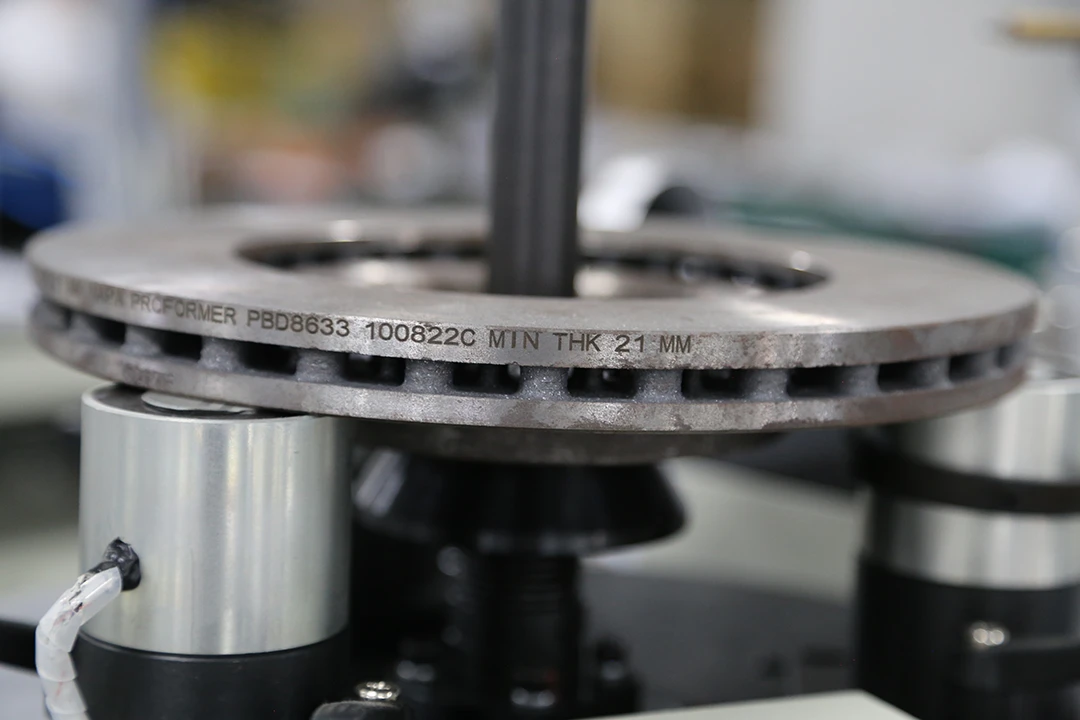
This article examines how an automated dot peen marking system for brake disc production works, what design features matter on a real production line, and how flexible positioning and automatic inspection support traceability across mixed product runs. It is written for manufacturing engineers, production managers, and purchasing teams evaluating marking equipment for brake disc and round metal component production.
Product Overview
The automatic dot peen brake disc marking machine is a purpose-built system for high-volume marking of automotive brake discs and round metal components. Rather than adapting a general-purpose marking unit to a brake disc line, the system is designed around the geometry of round parts and the realities of multi-model production.
At the center of the machine is a high-performance marking head that uses impact-based dot peen technology to create deep, permanent marks on metal surfaces. Around it, a flexible positioning system and automatic inspection technology work together to deliver stable marking results for production line traceability. For other industrial identification requirements, KINMARK also offers a range of marking and traceability systems.
The system supports multiple positioning methods and automatic product changeover, which makes it suitable for multi-model and high-efficiency automotive manufacturing environments. Instead of dedicating a separate fixture or station to each brake disc variant, the equipment adapts to different disc sizes and designs within the same production flow.
Where the System Fits in a Brake Disc Line
A brake disc marking system typically operates as an inline station within a larger production sequence. Discs arrive from upstream processes, are positioned and marked, and then continue to downstream operations such as inspection, packaging, or assembly. Because the marking station is part of a continuous flow, its cycle time, positioning reliability, and integration capability all influence overall line performance.
Working Principle
Dot peen marking is an impact-based process. A marking stylus strikes the metal surface at controlled intervals, creating a series of closely spaced indentations that form characters, codes, or symbols. Because the mark is produced by material displacement rather than surface application, it is deep and permanent rather than a coating or label that can wear away.
On this machine, the marking head is combined with a positioning system that locates and holds each brake disc before marking begins. The system supports several positioning methods, including inner hole expansion, outer diameter clamping, threaded positioning, spring positioning, electromagnetic positioning, and chuck positioning. This range allows the equipment to handle different brake disc sizes and designs without building a dedicated fixture for every variant.
The intelligent positioning system automatically adjusts according to product specifications. When the production mix changes, the system reduces manual adjustment time and supports efficient changeover between models. Marking depth can be adjusted according to different materials and production requirements, which allows the same equipment to serve a range of disc specifications.
During operation, audio-based marking detection technology monitors marking quality. This integrated inspection approach helps identify marking issues as they occur, reducing defective products and supporting reliable traceability data.
Note: The positioning methods, inspection technology, and marking depth adjustment described here are the features specified for this machine. Actual configuration depends on the brake disc variants and production requirements of each application.
Key Features
The following features are defined by the product specification and shape how the system performs in brake disc production.
Deep and permanent dot peen marking – High-strength impact marking technology creates clear, durable marks on metal surfaces, with marking depth adjustable according to material and production requirements.
Flexible positioning system – Supports inner hole expansion, outer diameter clamping, threaded positioning, spring positioning, electromagnetic positioning, and chuck positioning, allowing adaptation to different brake disc sizes and designs.
Automatic positioning and changeover – The intelligent positioning system adjusts automatically according to product specifications, reducing manual adjustment time in multi-product manufacturing.
Integrated marking quality inspection – Audio-based marking detection monitors marking quality during operation to reduce defective products and support reliable traceability.
High-efficiency production design – Built for large-scale brake disc production with fast marking speed, stable operation, and integration with automated production lines.
Factory data management integration – Supports connection with factory management platforms for centralized management of marking templates, fonts, and production data.
Reliable industrial design – Protective design suited to automotive environments with high metal dust exposure, with easy maintenance and high equipment availability.
Applications
The automatic dot peen brake disc marking machine is designed for high-volume automotive brake disc and round metal component marking applications. Its positioning flexibility and automatic changeover make it relevant wherever multiple disc variants run through the same production area.
Brake Disc Production
The primary application is marking brake discs on high-volume production lines. Deep, permanent marks support part identification and traceability through the manufacturing process and beyond. For applications that require laser-based identification instead of impact marking, KINMARK also provides a brake disc laser marking machine.
Round Metal Component Marking
Beyond brake discs, the system is specified for marking round metal components. The multiple positioning methods allow the equipment to hold and mark parts with different locating features.
Automotive Manufacturing and Component Production
The system is intended for automotive manufacturing environments, including automotive component production, where inline marking supports production line traceability and integration with factory management platforms. These requirements are part of broader automotive marking solutions.
Multi-Model Production Environments
Because the positioning system adjusts automatically to product specifications and supports automatic product changeover, the machine suits production environments where several brake disc models are manufactured on shared equipment.
Benefits
The value of an automated marking system in brake disc production comes from combining permanent marking, flexible part handling, and in-process quality monitoring in a single inline station.
Improved traceability – Deep, permanent dot peen marks provide durable identification for brake discs and round metal components, supporting production line traceability.
Better process consistency – Automatic positioning and automatic product changeover reduce reliance on manual fixture adjustment, helping maintain consistent marking across product variants.
Reduced defective products – Audio-based marking detection monitors marking quality during operation, allowing issues to be identified as they occur.
Production integration – The system is designed for seamless integration with automated production lines and supports connection with factory management platforms.
Support for multi-model manufacturing – Multiple positioning methods and automatic changeover help manufacturers handle different brake disc sizes and designs on the same equipment.
High equipment availability – A protective design for high metal dust environments, combined with easy maintenance, supports continuous operation in automotive manufacturing conditions.
Why Choose KINMARK
KINMARK is a manufacturer of marking and traceability systems, servo press systems, fluid filling systems, and robot automation systems for automotive intelligent manufacturing. The company began with marking equipment and has developed its product range around automotive intelligent automation applications.
Marking and traceability is one of KINMARK's core product lines, alongside servo press and fluid filling systems. This focus matters when specifying a marking system for brake disc production: the equipment is developed as part of a traceability-oriented product family rather than as an isolated marking device.
KINMARK serves vehicle manufacturers, powertrain and component producers, new energy vehicle manufacturers, and intelligent factory automation projects. The company maintains offices and service centers in several cities across China, including Shanghai, Beijing, Guangzhou, Changchun, Wuhan, and Chongqing, and provides installation, commissioning, and operator training to help customers start production smoothly.
For brake disc marking applications, the relevant strengths are the combination of flexible positioning, automatic changeover, integrated marking inspection, and factory data management integration — the capabilities that determine whether a marking station can keep up with a mixed-model production line.
Frequently Asked Questions
What is an automatic brake disc marking system used for?
It is used to apply permanent marks to brake discs and round metal components in high-volume automotive production. The marks support production line traceability, and the system is designed to integrate with automated production lines and factory management platforms.
How does the system handle different brake disc models?
The machine supports multiple positioning methods, including inner hole expansion, outer diameter clamping, threaded positioning, spring positioning, electromagnetic positioning, and chuck positioning. The intelligent positioning system adjusts automatically according to product specifications and supports automatic product changeover, which reduces manual adjustment time in multi-product manufacturing.
Why is dot peen marking used instead of a label or surface mark?
Dot peen marking uses high-strength impact marking technology to create deep, permanent marks on metal surfaces. Because the mark is produced by impact rather than applied to the surface, it provides durable identification suited to brake discs and other round metal components.
How is marking quality checked during production?
The system is equipped with audio-based marking detection technology that monitors marking quality during operation. This integrated inspection helps reduce defective products and supports reliable traceability.
Can the system connect to factory management software?
Yes. The system supports connection with factory management platforms, enabling centralized management of marking templates, fonts, and production data.
Conclusion
An automated marking system for brake disc production has to do more than make a mark. It must locate parts reliably across different disc designs, change over automatically as the production mix shifts, verify marking quality during operation, and connect to the systems that manage production data. The automatic dot peen brake disc marking machine addresses these requirements through flexible positioning methods, automatic positioning and changeover, audio-based marking inspection, and factory data management integration, all built around deep and permanent dot peen marking on metal surfaces.
For manufacturers producing brake discs and round metal components at volume, the practical question is whether a marking station can support traceability without becoming a bottleneck or a source of manual adjustment. Evaluating positioning flexibility, inspection capability, and integration options against actual production requirements is the right starting point.
If you're interested in any of the equipment mentioned in this article, feel free to contact our sales engineers for detailed product information and customized technical solutions.