
How Vacuum Pump Capacity Affects Refrigerant Evacuation
Introduction
Vacuum pump capacity is one of the most important variables in any refrigerant or coolant evacuation process. In automotive production and assembly lines, the ability to remove air, moisture, and non-condensable gases from a sealed system directly affects filling accuracy, leak detection reliability, and long-term system performance. Engineers and production managers who specify or operate vacuum filling equipment need to understand how pump capacity interacts with the rest of the filling cycle.
This technical guide explains what refrigerant vacuum pump capacity means, how it influences evacuation and leak testing, and how it fits into the broader architecture of automated coolant and antifreeze filling systems. The discussion is intended for automotive engineers, manufacturing engineers, production managers, and purchasing decision makers who evaluate fluid filling equipment for vehicle assembly and powertrain applications.
What Refrigerant Vacuum Pump Capacity Means
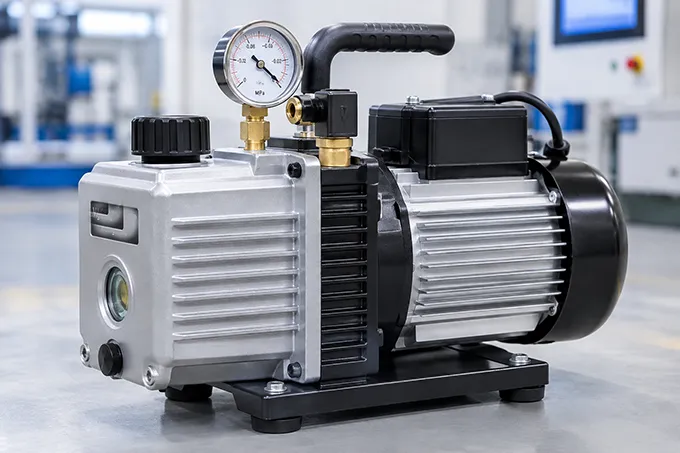
In the context of automotive fluid filling, vacuum pump capacity refers to the volumetric displacement rate of the vacuum pump used to evacuate a system before filling. It is typically expressed in cubic meters per hour (m³/h) and describes how much gas volume the pump can move per unit of time under defined conditions.
Capacity should not be confused with ultimate vacuum level. A pump with high capacity moves gas quickly but may not reach the deepest vacuum. Conversely, a pump with lower capacity may achieve a deeper vacuum but require more time. In automated filling systems, both characteristics matter, but capacity has the most direct effect on cycle time and on how quickly the system reaches the pressure conditions required for reliable leak testing and filling.
For reference, the Antifreeze Vacuum Filling Machine from KINMARK uses a vacuum pump with a capacity range of 40–65 m³/h. This range reflects the practical requirements of automotive coolant and antifreeze filling, where the system must evacuate the vehicle circuit, verify tightness, and then introduce coolant under controlled pressure within a defined production cycle.
Why Evacuation Matters in Coolant and Refrigerant Systems
Air and moisture trapped in a cooling or refrigerant circuit can cause several problems. They reduce heat transfer efficiency, promote corrosion and internal oxidation, and can lead to inaccurate filling volumes because gas pockets occupy space that should be filled with liquid. In refrigerant systems, non-condensable gases raise head pressure and reduce system performance. In coolant circuits, trapped air can create hot spots and unstable temperature behavior.
Evacuation before filling addresses these issues by removing the gas phase from the circuit. Once the system is evacuated, the filling process can introduce liquid under controlled pressure with a known and stable liquid level. This is why vacuum evacuation is a standard step in automated coolant and antifreeze filling, and why the capacity of the vacuum pump is a key specification in filling equipment.
How Vacuum Pump Capacity Affects Evacuation Performance
The relationship between pump capacity and evacuation performance can be understood in terms of gas removal rate and time to target pressure. A higher-capacity pump removes a given volume of gas in less time, which shortens the evacuation phase of the filling cycle. In high-volume assembly lines, this directly affects takt time and throughput.
However, capacity alone does not determine the final result. The evacuation time also depends on the volume of the circuit being evacuated, the internal surface area of hoses and components, the presence of dead ends or traps, and the conductance of the connections between the pump and the system. A large pump connected through a restrictive path may not deliver the expected evacuation speed. This is why filling system design considers not only pump capacity but also the layout and cross-section of the evacuation path.
In the Antifreeze Vacuum Filling Machine, the vacuum pump capacity range of 40–65 m³/h is matched to the filling volume range of 1–400 L. This pairing allows the system to handle a wide range of coolant circuits, from small component-level assemblies to larger vehicle systems, while maintaining a practical evacuation time.
Capacity and Leak Testing Under Vacuum
Leak testing is closely linked to evacuation. After the initial vacuum is established, the system monitors pressure to detect leaks. The Antifreeze Vacuum Filling Machine performs leak testing under both vacuum and pressure conditions. The specified negative pressure leak rate is ≤0.5 mbar / 60 s, and the positive pressure leakage specification is <1.4 g/year.
Pump capacity influences this stage in two ways. First, it determines how quickly the system can reach the vacuum level at which leak testing begins. Second, it affects the stability of the vacuum during the test. A pump with adequate capacity can hold the system at the required pressure while the leak rate is measured, reducing the risk of false readings caused by residual outgassing or slow evacuation.
If capacity is too low for the circuit volume, the evacuation phase may take longer than the production cycle allows, or the system may not reach the target vacuum at all. If capacity is oversized relative to the circuit, the pump may pull down quickly but the system may still be limited by conductance, and the additional capacity may not translate into a shorter cycle. Matching capacity to the application is therefore a design decision rather than a simple matter of choosing the largest available pump.
The Role of Capacity in the Complete Filling Cycle
The Antifreeze Vacuum Filling Machine uses a PLC-controlled system to automate the complete coolant filling process. The cycle integrates several stages: vacuum evacuation, leak testing under vacuum and pressure conditions, a secondary vacuum, pressure filling, and back suction to achieve the specified liquid level.
Vacuum pump capacity affects the first and third stages most directly. During initial evacuation, capacity determines how quickly the circuit is cleared of air and moisture. During the secondary vacuum, capacity helps establish the conditions for controlled filling. Once the filling pressure reaches equilibrium, the system automatically vents to atmospheric pressure and performs back suction to remove excess coolant. This sequence helps achieve the specified liquid level and prevents the coolant level from dropping after filling.
The filling specifications of the machine include a filling volume of 1–400 L, a filling pressure of 1–4 bar, a maximum filling speed of 60 L/min, a filling precision of ±0.5%, and a liquid level accuracy of ±2 mm. The measurement display range is 0.0–999.9 L. These parameters describe the filling side of the cycle, while the vacuum pump capacity of 40–65 m³/h describes the evacuation side. Together, they define the operating envelope of the system.
Key Considerations When Selecting Vacuum Pump Capacity
Selecting the right vacuum pump capacity for a refrigerant or coolant evacuation application involves several practical considerations.
Circuit volume: Larger circuits require more gas removal and generally benefit from higher capacity, provided the evacuation path can support the flow.
Target vacuum level: The required vacuum level determines how far the pump must pull down the system, which interacts with capacity and pump design.
Cycle time: Production takt time sets the maximum allowable evacuation duration, which in turn sets a minimum practical capacity.
Leak test requirements: The leak rate specification and test duration influence how stable the vacuum must be during testing.
System conductance: Hose diameter, fitting size, and valve design affect how effectively pump capacity is translated into evacuation speed at the circuit.
Filling volume range: Equipment that must handle a wide range of filling volumes, such as 1–400 L, benefits from a capacity range that can be adjusted to the application.
These considerations are interrelated. Increasing capacity can shorten evacuation time, but it may also require changes to the evacuation path, valve sizing, and control logic to realize the benefit. In many cases, the most effective approach is to select a capacity range that covers the intended applications and then optimize the surrounding system for conductance and control.
Applications in Automotive Manufacturing
Vacuum-based coolant and antifreeze filling is used across a range of automotive manufacturing and assembly applications. These include vehicle assembly lines, powertrain manufacturing, automotive component production, and new energy vehicle thermal management systems. In each case, the goal is the same: remove air and moisture, verify tightness, and fill to a precise liquid level.
The Antifreeze Vacuum Filling Machine is designed for automated coolant and antifreeze filling applications on automotive production and assembly lines. Its combination of vacuum evacuation, leak testing, pressure filling, and back suction makes it suitable for integration into intelligent factory automation environments where process consistency and traceability are important. For electric vehicle thermal management applications, explore KINMARK's new energy cooling system solutions.
Benefits of Correctly Sized Vacuum Pump Capacity
When vacuum pump capacity is correctly matched to the application, several benefits follow.
Consistent evacuation: The system reaches the required vacuum level within the production cycle, supporting repeatable filling results.
Reliable leak testing: Stable vacuum conditions during testing reduce the risk of false leak readings.
Accurate liquid level: Proper evacuation supports the filling precision and liquid level accuracy specified for the equipment.
Production integration: Cycle times that fit the line takt allow the filling system to operate as part of an automated assembly process.
Process consistency: PLC-controlled sequencing ensures that evacuation, testing, filling, and back suction are performed in a repeatable order.
These benefits are not the result of capacity alone. They depend on the complete system design, including the vacuum pump, valves, sensors, control logic, and the physical layout of the evacuation and filling paths.
Why Choose KINMARK for Vacuum Filling Systems
KINMARK is a manufacturer of marking and traceability systems, servo press systems, fluid filling systems, and robot automation systems for automotive manufacturing. The company has been active in automotive intelligent automation equipment since 1996 and serves vehicle manufacturers, powertrain producers, automotive component suppliers, and new energy vehicle manufacturers.
The Antifreeze Vacuum Filling Machine reflects KINMARK's focus on automated fluid filling for automotive production. The machine is covered by a 12-month warranty, supported by professional technical support and long-term maintenance service. KINMARK provides fast response service, including remote diagnosis and technical assistance, as well as installation and commissioning by engineers, along with operator training to help customers start production smoothly.
For production managers and purchasing decision makers, these support services are relevant because they affect equipment uptime and the ability to integrate the filling system into an existing assembly line.
Frequently Asked Questions
What is refrigerant vacuum pump capacity?
Refrigerant vacuum pump capacity refers to the volumetric displacement rate of the vacuum pump used to evacuate a refrigerant or coolant circuit before filling. It is typically expressed in cubic meters per hour (m³/h) and indicates how much gas volume the pump can move per unit of time.
How does vacuum pump capacity affect evacuation time?
Higher capacity generally reduces the time required to remove a given volume of gas from the circuit. However, the actual evacuation time also depends on circuit volume, the conductance of the evacuation path, and the target vacuum level. Capacity alone does not determine evacuation time.
What vacuum pump capacity is used in the Antifreeze Vacuum Filling Machine?
The Antifreeze Vacuum Filling Machine uses a vacuum pump with a capacity range of 40–65 m³/h. This range is matched to a filling volume range of 1–400 L and supports the evacuation, leak testing, and filling stages of the cycle.
Why is leak testing performed under vacuum?
Leak testing under vacuum allows the system to verify circuit tightness before coolant is introduced. The Antifreeze Vacuum Filling Machine performs leak testing under both vacuum and pressure conditions, with a specified negative pressure leak rate of ≤0.5 mbar / 60 s and positive pressure leakage of <1.4 g/year.
Can vacuum pump capacity be too high?
Oversizing the pump relative to the circuit and evacuation path may not deliver additional cycle time benefits, because the system can be limited by conductance rather than pump capacity. Matching capacity to the application is more effective than simply selecting the largest available pump.
Conclusion
Vacuum pump capacity is a central parameter in refrigerant and coolant evacuation. It influences how quickly a circuit is cleared of air and moisture, how stable the vacuum is during leak testing, and how well the filling cycle fits into production takt time. Understanding the relationship between capacity, circuit volume, conductance, and target vacuum level helps engineers and production managers specify filling equipment that performs reliably in automated assembly environments.
In systems such as the Antifreeze Vacuum Filling Machine, vacuum pump capacity works together with filling pressure, filling precision, liquid level accuracy, and PLC-controlled sequencing to deliver a complete evacuation, testing, and filling cycle. Correctly matching capacity to the application supports consistent filling results, reliable leak detection, and smooth integration into automotive production and assembly lines. For more equipment options, see KINMARK's vacuum filling machines.
If you're interested in any of the equipment mentioned in this article, feel free to contact our sales engineers for detailed product information and customized technical solutions.