
What to Look for in an Automatic Dot Peen Brake Disc Marking Machine
Introduction
Brake discs are safety-critical components, and every disc that leaves a production line needs a permanent, readable identity that can be traced back through manufacturing, assembly, and service. Paint, labels, and ink-based marking methods are poorly suited to the machining environment of a brake disc cell, where coolant, metal dust, and handling contact quickly degrade surface marks. Dot peen marking has therefore become a practical choice for stamping part numbers, batch codes, and traceability data directly into the metal.
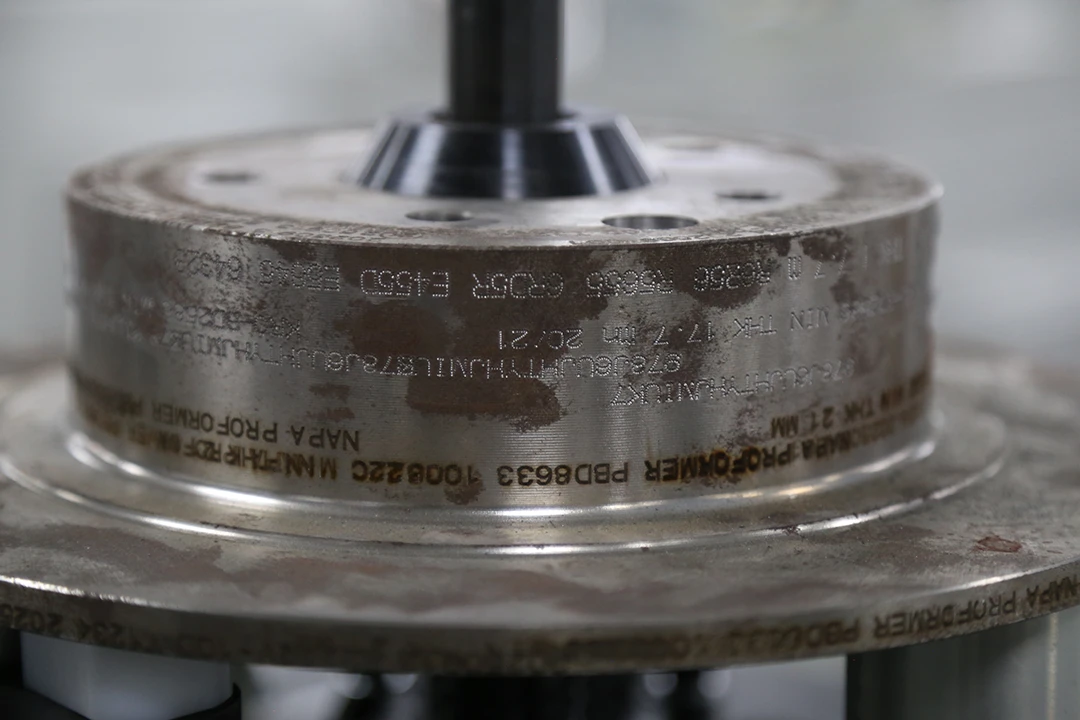
The challenge for production and manufacturing engineers is not whether dot peen marking works, but which machine configuration will hold up in a high-volume, multi-model brake disc line. Discs vary in diameter, hat height, venting design, and material, and a marking station that cannot adapt quickly becomes a bottleneck. This guide explains what an automatic dot peen brake disc marking machine does, how it works, and which technical and operational points deserve attention during specification and evaluation.
Product Overview
An automatic dot peen brake disc marking machine is a production-line marking system designed for high-volume marking of automotive brake discs and other round metal components. Rather than a standalone benchtop marker, it is built as an integrated station: a marking head creates the characters, a positioning system locates and holds the disc, and an automatic inspection function verifies that the mark has actually been produced. Explore KINMARK's marking and traceability systems for industrial identification applications.
The system is intended for environments where several disc variants run through the same line and where manual fixture changes would slow output. It supports multiple positioning methods and automatic product changeover, so the station can adapt to different disc sizes and designs without stopping production for mechanical rework.
Typical problems this type of equipment addresses include:
Marks that are too shallow to survive handling, storage, or service life.
Manual or semi-automatic marking stations that cannot keep pace with line cycle time.
Fixture changes required every time a new disc model is introduced.
Missing or unreadable marks discovered only after the part has left the cell.
Marking data managed locally instead of being connected to factory systems.
Working Principle
Dot peen marking is an impact-based process. A hardened stylus is driven into the workpiece surface in a controlled sequence of strikes, and each strike produces a small indentation. By positioning the stylus along a programmed path, the individual dots form characters, codes, or data strings. Because the mark is created by material displacement rather than surface deposition, it becomes part of the component itself and is not removed by normal cleaning or light abrasion.
In an automatic brake disc marking station, the sequence is generally organized around four functional elements:
Positioning and clamping — the disc is located and held so that the marking area is presented consistently to the marking head.
Marking head operation — the marking head executes the programmed dot pattern using high-strength impact marking technology.
Automatic positioning and changeover — the intelligent positioning system adjusts according to product specifications, so the station can switch between disc models without manual fixture replacement.
Integrated inspection — audio-based marking detection monitors marking quality during operation and helps identify defective marks before the part moves downstream.
Marking depth can be adjusted according to different materials and production requirements, which allows the same station to serve discs produced from different grades and with different surface conditions.
Key Features to Evaluate
Deep and Permanent Dot Peen Marking
The first question to ask is whether the marking method produces a mark that survives the rest of the production and logistics chain. High-strength impact marking creates clear and durable marks on metal surfaces, and adjustable marking depth lets engineers match the mark to the material and to the traceability requirement. When comparing suppliers, ask how depth is controlled and whether it can be changed per part program rather than by mechanical adjustment.
Flexible Positioning System
Brake discs are not geometrically uniform across a product family. A flexible positioning system supports multiple locating methods, including inner hole expansion, outer diameter clamping, threaded positioning, spring positioning, electromagnetic positioning, and chuck positioning. This range matters because it allows the same station to handle different disc sizes and designs without dedicated hard tooling for every variant.
Automatic Positioning and Changeover
In multi-product manufacturing, changeover time is a direct cost. An intelligent positioning system that automatically adjusts according to product specifications reduces manual adjustment time and improves production efficiency when the line runs several disc models in sequence. During evaluation, confirm how the changeover is triggered — for example, from a part program or from line control — and how much operator intervention remains.
Integrated Marking Quality Inspection
A mark that is not verified is an assumption, not a traceability record. Audio-based marking detection monitors marking quality during operation, which helps reduce defective products and supports reliable traceability. This is particularly relevant where marks are a regulatory or customer requirement, since unverified marks tend to surface as problems much later in the process.
High-Efficiency Production Capability
The machine is designed for large-scale brake disc production, with fast marking speed, stable operation, and integration into automated production lines. For a transactional purchase decision, the relevant point is not a single speed figure but whether the marking station can be synchronized with the surrounding cell and whether it introduces waiting time upstream or downstream.
Factory Data Management Integration
Marking content is production data. The system supports connection with factory management platforms, enabling centralized management of marking templates, fonts, and production data. This capability is worth confirming early, because retrofitting data connectivity after installation is usually more disruptive than specifying it at the start.
Reliable Industrial Design
Brake disc machining areas expose equipment to metal dust and debris. A machine designed for these conditions features protective design, easy maintenance, and high equipment availability. Ask about service access, wear-part replacement, and how the enclosure protects the marking head and positioning elements from contamination.
Specification tip: When preparing a technical comparison, list the disc variants the line will run over the next few years — including planned model additions — and check each supplier's positioning and changeover concept against that list rather than against today's single part number.
Applications
Automatic dot peen brake disc marking machines are used where brake discs and similar round metal components require permanent identification in a production environment. KINMARK's automatic dot peen brake disc marking machine is relevant to production environments that require permanent component identification and traceability. Relevant application areas include:
Automotive manufacturing — brake disc marking stations integrated into vehicle and component production lines.
Automotive components — high-volume marking of brake discs and other round metal parts produced by tier suppliers.
New energy vehicles — traceability marking for brake and rotating components used on electrified vehicle platforms.
Powertrain manufacturing — marking of round metal components in powertrain and drivetrain production environments.
Intelligent factory automation — marking stations connected to factory management platforms as part of a digitalized production line.
For other automotive component identification requirements, KINMARK provides industrial marking machine solutions designed for manufacturing and traceability applications.
Benefits
The value of an automatic dot peen brake disc marking machine comes from the combination of marking method, positioning flexibility, and inspection, rather than from any single feature:
Improved traceability — permanent marks that remain readable through subsequent handling and service.
Better process consistency — automatic positioning and changeover reduce variation introduced by manual adjustment.
Fewer defective marks — integrated marking quality inspection identifies problems during operation rather than after the fact.
Production integration — the station is designed to work within automated lines rather than as an isolated manual operation.
Multi-model flexibility — one station can serve several disc sizes and designs through the flexible positioning system.
Centralized data management — marking templates, fonts, and production data can be managed through factory management platforms.
Maintainable uptime — protective design and easy maintenance support high equipment availability in dusty environments.
Why Choose KINMARK
KINMARK (Jinan Zhongzheng Jinma Technology Co., Ltd.) has been active in automotive intelligent automation equipment since 1996, developing and manufacturing marking and traceability systems, servo press systems, fluid filling systems, and robot automation systems. The company's marking technology began with printing and marking equipment for engine and body production lines and has since expanded into automatic marking systems, VIN identification, and laser depth marking systems.
For brake disc marking projects, this background is relevant in several ways. The company works with vehicle manufacturers, powertrain producers, and component suppliers across conventional and new energy vehicle production, and it operates service offices and maintenance centers in Shanghai, Beijing, Guangzhou, Changchun, Wuhan, and Chongqing. For buyers evaluating an automatic dot peen brake disc marking machine, that combination of marking-specific experience and automotive production-line integration is a practical starting point.
KINMARK also provides installation and commissioning support, with engineers handling equipment installation, commissioning, and operator training, along with a 12-month warranty on the complete machine and ongoing technical support and maintenance service.
Frequently Asked Questions
What is an automatic dot peen brake disc marking machine used for?
It is used to mark brake discs and other round metal components with permanent, traceable identification during production. The machine combines a dot peen marking head with a flexible positioning system and automatic inspection, and it is designed for high-volume automotive production lines.
How does the machine handle different brake disc models?
The equipment supports several positioning methods, including inner hole expansion, outer diameter clamping, threaded positioning, spring positioning, electromagnetic positioning, and chuck positioning. Combined with automatic positioning and changeover, this allows the station to adapt to different disc sizes and designs with reduced manual adjustment.
Can the marking depth be adjusted?
Yes. The machine uses high-strength impact marking technology, and the marking depth can be adjusted according to different materials and production requirements. The appropriate depth depends on the material and on the level of traceability durability required.
How is marking quality verified?
The system is equipped with audio-based marking detection technology, which monitors marking quality during operation. This helps reduce defective products and supports reliable traceability by identifying marking problems as they occur.
Can the marking system connect to factory management software?
Yes. The system supports connection with factory management platforms, enabling centralized management of marking templates, fonts, and production data. This is typically specified at the project stage so that data connectivity is planned together with the marking station.
Conclusion
Selecting an automatic dot peen brake disc marking machine comes down to whether the station can produce permanent, verifiable marks across every disc variant the line will run. The key evaluation points are the marking method and depth control, the breadth of the flexible positioning system, the speed and reliability of automatic changeover, the presence of integrated marking quality inspection, and the ability to connect marking data to factory management platforms.
Because brake disc marking sits directly in the traceability chain of automotive manufacturing, these decisions affect quality records and downstream processes as much as they affect line throughput. Specifying the machine against the full range of disc models and the actual production environment — including metal dust exposure and maintenance access — gives a more reliable basis for comparison than a feature checklist alone.
If you're interested in any of the equipment mentioned in this article, feel free to contact our sales engineers for detailed product information and customized technical solutions.