
Automatic Vacuum Evacuation Before Refrigerant Filling
Introduction
Automatic vacuum evacuation before refrigerant filling is a controlled process step in which a sealed circuit or fluid system is evacuated, checked for leaks, and then filled with the required medium under defined pressure conditions. In automotive manufacturing, this step is used wherever a closed system must be filled accurately and reliably, such as coolant and antifreeze circuits on production and assembly lines.
The value of automatic vacuum evacuation is not limited to removing air. Evacuation also creates the conditions for leak testing, removes trapped gas that could affect filling accuracy, and prepares the circuit so that the liquid level remains stable after filling. For manufacturing engineers and production managers, the process directly influences fill consistency, system tightness verification, and the amount of manual intervention required at the station.
This technical guide explains the working sequence of automatic vacuum evacuation before filling, the role of leak testing under vacuum and pressure, the equipment characteristics that support the process, and the applications where this approach is used. It focuses on the filling cycle as implemented by a PLC-controlled antifreeze vacuum filling machine and on the practical questions engineers ask when specifying such a system.
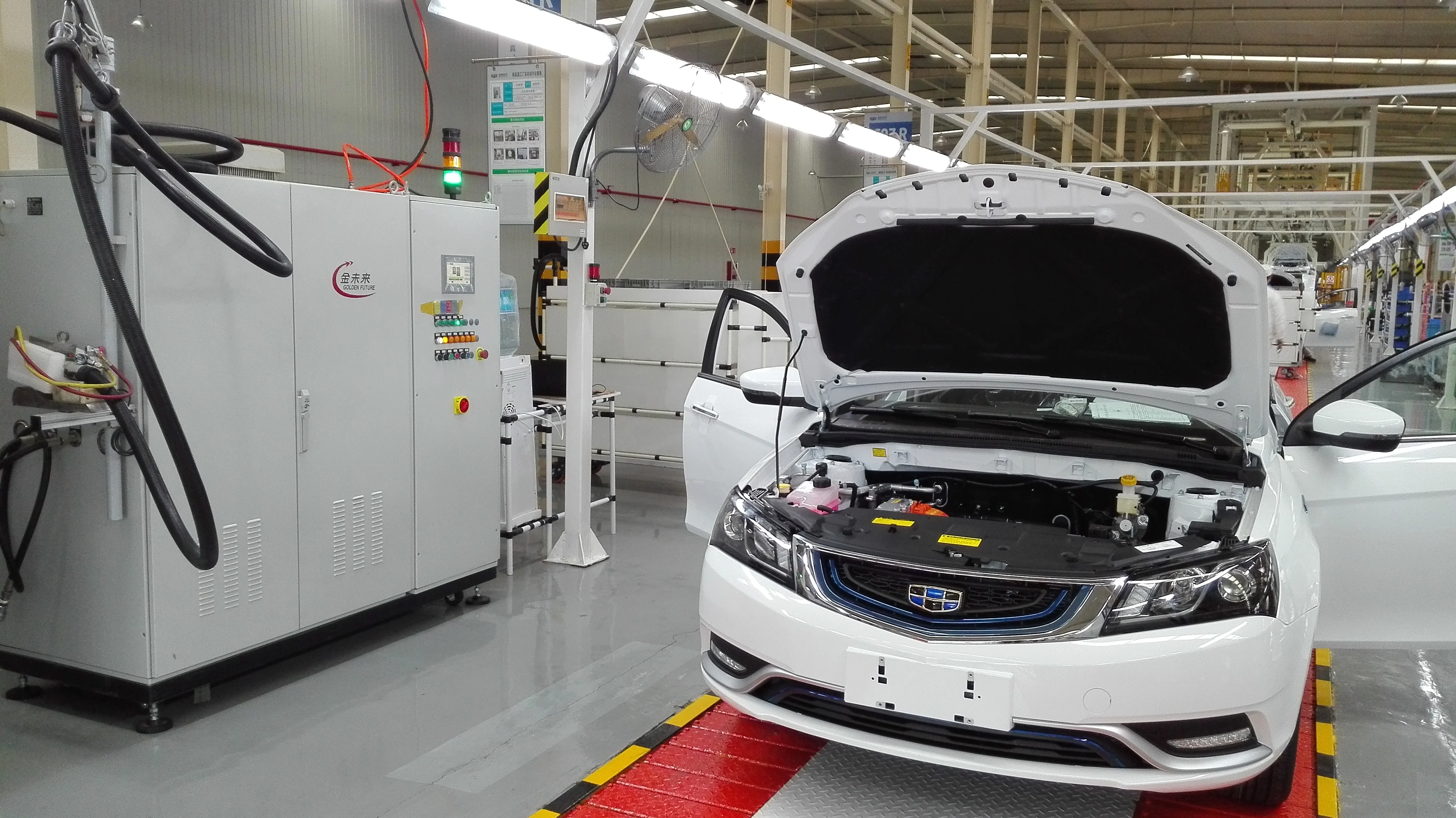
Product Overview
The Antifreeze Vacuum Filling Machine is an automated system for coolant and antifreeze filling with a stable liquid level. It is designed for automated coolant and antifreeze filling applications on automotive production and assembly lines. The machine combines vacuum evacuation, leak testing, pressure filling, and back suction in one controlled cycle.
The equipment is controlled by a PLC system that automates the complete coolant filling process. Rather than treating evacuation and filling as separate manual operations, the machine executes them as a connected sequence, which supports repeatable results at the station.
The machine addresses a common industrial problem: filling a closed circuit accurately while confirming that the circuit is tight. If a system is filled without proper evacuation, residual gas can interfere with the fill, and a leak may not be detected until later. The Antifreeze Vacuum Filling Machine approaches this by performing vacuum evacuation first, then verifying tightness under vacuum and pressure conditions before the medium is introduced.
Equipment Specifications
| Filling Medium | Antifreeze / Coolant |
| Filling Volume | 1–400 L |
| Filling Pressure | 1–4 bar |
| Maximum Filling Speed | 60 L/min |
| Filling Precision | ±0.5% |
| Liquid Level Accuracy | ±2 mm |
| Measurement Display Range | 0.0–999.9 L |
| Vacuum Pump Capacity | 40–65 m³/h |
| Negative Pressure Leak Rate | ≤0.5 mbar / 60 s |
| Positive Pressure Leakage | <1.4 g/year |
| Power Supply | AC 380 V ±10%, 50 Hz ±2% |
| Equipment Dimensions | 1800 × 1000 × 800 mm (customizable) |
Working Principle
The filling cycle follows a defined sequence. The system first performs vacuum evacuation of the circuit. This step removes gas from the closed volume and establishes the low-pressure condition required for the subsequent check.
After evacuation, the machine carries out leak testing under vacuum and pressure conditions. This dual check allows the system to evaluate tightness from two directions rather than relying on a single measurement. The negative pressure leak rate is specified as ≤0.5 mbar / 60 s, and positive pressure leakage is specified as <1.4 g/year.
Once system tightness is confirmed, a secondary vacuum is created. The coolant is then introduced under controlled pressure, with filling pressure set within the range of 1–4 bar. Introducing the medium into an evacuated circuit supports consistent filling behaviour and limits the amount of trapped gas in the system.
When the filling pressure reaches equilibrium, the system automatically vents to atmospheric pressure. It then performs back suction to remove excess coolant. This back suction step helps achieve the specified liquid level and prevents the coolant level from dropping after filling.
The complete cycle therefore integrates vacuum evacuation, leak testing, pressure filling, and back suction. Because the sequence is PLC-controlled, the same process steps are repeated for each unit, which supports process consistency across a production shift. For other applications requiring vacuum-based filling, see KINMARK's vacuum filling machines.
Process sequence at a glance: vacuum evacuation → leak testing under vacuum and pressure → secondary vacuum → pressure filling → venting to atmospheric pressure → back suction to the specified liquid level.
Key Features
PLC-controlled automation — the complete coolant filling process is automated, covering evacuation, leak testing, filling, and back suction.
Integrated leak testing — tightness is verified under both vacuum and pressure conditions before the medium is introduced.
Secondary vacuum before filling — a second evacuation step is performed after tightness confirmation, ahead of coolant introduction.
Controlled pressure filling — filling pressure is adjustable within 1–4 bar.
Automatic venting and back suction — the system vents to atmospheric pressure at equilibrium and removes excess coolant to reach the specified liquid level.
Stable liquid level — back suction helps prevent the coolant level from dropping after filling, with liquid level accuracy of ±2 mm.
Filling precision of ±0.5% — supports accurate delivery of the required volume.
Wide filling volume range — 1–400 L, with a measurement display range of 0.0–999.9 L.
High-capacity vacuum pump — vacuum pump capacity of 40–65 m³/h.
Maximum filling speed of 60 L/min — supports throughput requirements on production and assembly lines.
Customizable equipment dimensions — standard dimensions are 1800 × 1000 × 800 mm, and the machine can be customized to suit the installation.
Applications
The Antifreeze Vacuum Filling Machine is intended for automated coolant and antifreeze filling applications on automotive production and assembly lines. Its process design suits stations where a closed circuit must be evacuated, checked for tightness, and filled to a defined level.
Typical areas of use include:
Automotive manufacturing — coolant and antifreeze filling at assembly stations where repeatable fill results are required.
Automotive components — filling of closed circuits or assemblies that require evacuation and tightness verification before operation.
New energy vehicles — filling operations on vehicle production lines where automated fluid handling is part of the assembly process.
Powertrain manufacturing — filling and leak-check steps integrated into powertrain-related production flows.
Intelligent factory automation — stations that need a PLC-controlled, automated filling cycle rather than manual evacuation and filling.
The filling volume range of 1–400 L allows the machine to serve different circuit sizes within the same equipment platform, while the adjustable filling pressure of 1–4 bar supports adaptation to different filling requirements. For related applications in electric vehicle thermal management, see KINMARK's new energy cooling system solutions.
Benefits
The main benefit of automatic vacuum evacuation before filling is that it combines several process steps into a single controlled cycle. Instead of evacuating, checking, and filling as separate operations, the machine performs them in sequence under PLC control.
Improved process consistency — the same evacuation, leak test, filling, and back suction sequence is executed for each unit, which supports repeatable results.
Verified tightness before filling — leak testing under vacuum and pressure conditions confirms system tightness before the coolant is introduced.
Stable liquid level after filling — automatic venting and back suction help achieve the specified level and reduce the risk of the level dropping afterwards.
Reduced manual intervention — the automated cycle limits the need for operators to manage evacuation and filling steps individually.
Production integration — the machine is designed for automated filling applications on production and assembly lines.
Traceable filling data — the measurement display range of 0.0–999.9 L supports monitoring of the delivered volume during the cycle.
Why Choose
When specifying a filling system for coolant and antifreeze circuits, the process sequence matters as much as the fill volume. A machine that performs automatic vacuum evacuation before refrigerant filling or coolant filling helps ensure that the circuit is prepared, checked, and filled in a defined order.
The Antifreeze Vacuum Filling Machine is built around this sequence. Its PLC-controlled cycle integrates evacuation, leak testing, pressure filling, and back suction, and its specifications support a range of filling requirements, from 1 L to 400 L, with filling precision of ±0.5% and liquid level accuracy of ±2 mm.
Support considerations also matter for production equipment. The complete machine is covered by a 12-month warranty, with professional technical support and long-term maintenance service. Efficient after-sales support, remote diagnosis, and technical assistance are provided to help ensure continuous operation. Engineers also provide equipment installation, commissioning, and operator training to help customers start production smoothly.
KINMARK develops marking and traceability systems, servo press systems, fluid filling systems, and robot automation systems for automotive manufacturing, automotive components, new energy vehicles, powertrain manufacturing, and intelligent factory automation. This focus on automotive intelligent automation equipment provides the context in which the antifreeze vacuum filling machine is designed and supported.
Frequently Asked Questions
Why is vacuum evacuation performed before filling?
Vacuum evacuation removes gas from the closed circuit and establishes the low-pressure condition needed for leak testing. In the Antifreeze Vacuum Filling Machine, evacuation is followed by leak testing under vacuum and pressure conditions, then a secondary vacuum before the coolant is introduced under controlled pressure.
How is leak testing carried out during the cycle?
Leak testing is performed under both vacuum and pressure conditions after the initial evacuation. The specified negative pressure leak rate is ≤0.5 mbar / 60 s, and positive pressure leakage is specified as <1.4 g/year. System tightness is confirmed before filling proceeds.
What prevents the coolant level from dropping after filling?
Once the filling pressure reaches equilibrium, the system automatically vents to atmospheric pressure and performs back suction to remove excess coolant. This helps achieve the specified liquid level and prevents the coolant level from dropping after filling. Liquid level accuracy is specified as ±2 mm.
What filling volume and pressure ranges are supported?
The machine supports a filling volume of 1–400 L and a filling pressure of 1–4 bar, with a maximum filling speed of 60 L/min. The measurement display range is 0.0–999.9 L, and filling precision is ±0.5%.
What support is provided with the equipment?
The complete machine is covered by a 12-month warranty, with professional technical support and long-term maintenance service. Efficient after-sales support, remote diagnosis, and technical assistance are available, and engineers provide installation, commissioning, and operator training.
Conclusion
Automatic vacuum evacuation before refrigerant filling is a process approach that prepares a closed circuit, verifies its tightness, and fills it under controlled conditions. In the Antifreeze Vacuum Filling Machine, this approach is implemented as a PLC-controlled cycle that integrates vacuum evacuation, leak testing under vacuum and pressure, a secondary vacuum, pressure filling, automatic venting, and back suction.
For automotive production and assembly lines, the result is a filling process designed around consistency and a stable liquid level, supported by defined specifications such as filling volume of 1–400 L, filling pressure of 1–4 bar, filling precision of ±0.5%, and liquid level accuracy of ±2 mm. When evaluating filling equipment for coolant and antifreeze applications, the sequence of evacuation, testing, and filling is a practical starting point for matching the machine to the requirements of the station.
If you're interested in any of the equipment mentioned in this article, feel free to contact our sales engineers for detailed product information and customized technical solutions.