
Body-in-White Component Marking
Introduction
Body-in-white (BIW) component marking is the process of applying permanent identification marks to the structural components of a vehicle body before painting and final assembly. The body-in-white is the welded steel structure that forms the load-bearing skeleton of a vehicle, and it includes components such as the front and rear longitudinal beams, B-pillars, side sills, suspension mounting points, and floor reinforcements. These parts are frequently produced from high-strength and hot-formed steels, which makes marking them a different technical challenge than marking mild steel or cast components.
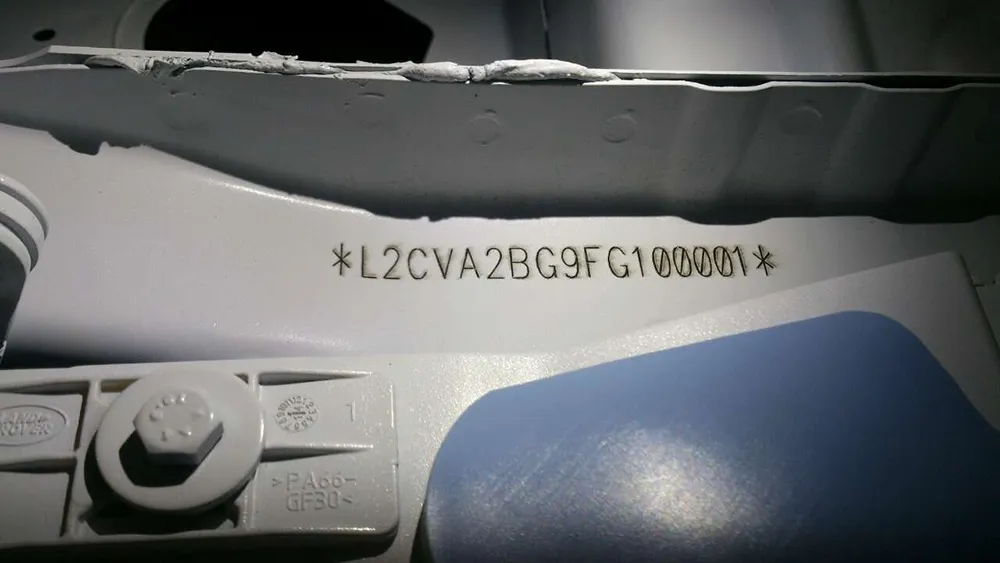
For automotive manufacturers, BIW marking is not a cosmetic operation. It supports production identification, component tracking, and regulatory traceability across the vehicle lifecycle. A VIN that must remain legible after painting, rubbing, and years of service places specific requirements on marking depth, process stability, and integration with the production line. This guide explains what BIW component marking involves, how deep laser marking works on high-strength body materials, where the process is applied, and what engineering teams should consider when specifying equipment.
Product Overview
A deep laser marking machine is the equipment category used for permanent marking on body-in-white components. KINMARK's Deep Laser Marking Machine is designed for deep VIN marking on high-strength materials, specifically for automotive mass production environments where marking must be integrated into existing body shop or final assembly lines.
The system is built around a 200W laser source with a marking area of 112mm × 112mm and a marking depth of 0.2mm or more. It is intended for applications where the mark must survive the painting process and remain readable after rubbing, which is a common requirement for VIN marking on body structures. The machine can be installed as a standalone station or integrated with industrial robots and assisted manipulators for automated production lines.
The industrial problem this equipment addresses is straightforward: conventional marking methods may not achieve sufficient depth on advanced high-strength steels, and marks that are too shallow can become illegible after paint application or rubbing. A marking system that produces a controlled, repeatable depth on these materials supports both production identification and long-term traceability.
Working Principle
Deep laser marking uses a focused laser beam to remove or displace material from the workpiece surface, creating a recessed mark rather than a surface discoloration. The depth of the mark is controlled by the laser parameters and the marking process, and the result is a permanent identification that is integrated into the material itself.
For body-in-white components, the marking process must account for the mechanical properties of the material. KINMARK's deep laser marking system is designed to mark high-strength steel plates with yield strength exceeding 700 MPa and hot-formed steel plates with strength up to 1500 MPa. On body-in-white, the achievable marking depth is greater than 0.2mm. This depth is what allows the VIN or component identifier to remain legible after the body passes through the paint shop and after the rubbing operation.
The system uses a special marking process intended to ensure clear rubbing results after painting. In practice, this means the mark geometry and depth are selected so that the identifier can be transferred or read after the paint layer is applied. For automated lines, the marking head can be mounted on a robot or assisted manipulator, and optional vision and inspection systems can support positioning and verification.
Key Features
Deep VIN marking: Enables permanent VIN deep marking on high-strength steel plates with yield strength exceeding 700 MPa and hot-formed steel plates with strength up to 1500 MPa. Marking depth on body-in-white can reach more than 0.2mm.
Easy rubbing: Adopts a special marking process to ensure clear rubbing results after painting.
Easy integration: Designed with various mounting interfaces so the system can be quickly integrated with industrial robots or assisted manipulators for automated production lines.
Vision guidance: An optional 3D vision guidance system enables precise positioning and accurate marking to improve production efficiency.
Automatic traceability: Optional 3D laser scanning measurement and OCR recognition systems provide online inspection of marking quality and support 100% traceability.
Technical Specifications
| Power Supply | AC220V ±10%, 50Hz ±2% |
| Power Consumption | <1000W |
| Laser Power | 200W |
| Marking Area | 112mm × 112mm |
| Marking Depth | ≥0.2mm |
| Operating Temperature | 0~40℃ |
| Operating Humidity | ≤90% RH (Non-condensing) |
Applications
Body-in-white component marking is applied in automotive manufacturing environments where structural components require permanent identification. Typical application areas include:
Automotive manufacturing: Marking of body-in-white structures and components during vehicle production.
Automotive components: Identification of structural parts produced from high-strength and hot-formed steels.
New energy vehicles: Marking applications in body structures for electric vehicle platforms.
Powertrain manufacturing: Marking and traceability in powertrain production environments.
Intelligent factory automation: Integration of marking systems into automated production lines with robot handling and online inspection.
The system is also relevant to general industrial sectors where permanent marking on high-strength materials is required, including engineering machinery, home appliances, electronics and communication, and rail transportation.
Benefits
Deep laser marking on body-in-white components provides several practical benefits for production and quality teams:
Improved traceability: Permanent marks support component identification and tracking through production and after painting.
Better process consistency: A controlled marking process helps maintain mark quality across high-strength and hot-formed steel components.
Production integration: Mounting interfaces and robot compatibility allow the marking system to be integrated into automated lines.
Quality management: Optional 3D scanning and OCR recognition support online inspection of marking quality.
Automation support: Optional 3D vision guidance supports precise positioning for accurate marking.
Note: Optional vision guidance, 3D laser scanning measurement, and OCR recognition systems are configuration options. The appropriate configuration depends on the specific production line requirements and marking verification strategy.
Why Choose
KINMARK has been engaged in automotive intelligent automation equipment since 1996 and develops marking and marking systems, servo press systems, fluid filling systems, and robot automation systems. The company's product lines support vehicle manufacturing, powertrain, automotive components, engineering machinery, new energy, and other industrial sectors.
For body-in-white component marking, the relevant capability is the deep laser marking system designed for high-strength materials. The system addresses the specific requirement of permanent VIN marking on steels that are difficult to mark with conventional methods, and it is designed for integration into automated production lines through robot and manipulator interfaces.
KINMARK provides a 12-month warranty on the complete machine, along with professional technical support and long-term maintenance service. The company also offers fast response service, remote diagnosis, and technical assistance, as well as installation and commissioning support with operator training to help customers start production smoothly.
Frequently Asked Questions
What materials can be marked with a deep laser marking system for body-in-white components?
The KINMARK Deep Laser Marking Machine is designed to mark high-strength steel plates with yield strength exceeding 700 MPa and hot-formed steel plates with strength up to 1500 MPa. Marking depth on body-in-white can reach more than 0.2mm.
Why is marking depth important for body-in-white VIN marking?
The body-in-white passes through the paint shop and rubbing operation after marking. A marking depth of more than 0.2mm, combined with a special marking process, is intended to ensure clear rubbing results after painting so the identifier remains legible.
Can the marking system be integrated into an automated production line?
Yes. The system is designed with various mounting interfaces and can be quickly integrated with industrial robots or assisted manipulators for automated production lines. An optional 3D vision guidance system is available for precise positioning and accurate marking.
How is marking quality verified?
Optional 3D laser scanning measurement and OCR recognition systems provide online inspection of marking quality and support 100% traceability. These are configuration options that can be selected based on production requirements.
What support is available after installation?
KINMARK provides a 12-month warranty on the complete machine, professional technical support, long-term maintenance service, fast response service, remote diagnosis, and technical assistance. Engineers also provide equipment installation, commissioning, and operator training.
Conclusion
Body-in-white component marking is a production process that must satisfy both identification and traceability requirements on materials that are increasingly difficult to mark. High-strength and hot-formed steels used in modern vehicle bodies require a marking method capable of producing a controlled, permanent depth that survives painting and rubbing.
Deep laser marking addresses this requirement by creating marks with a depth of more than 0.2mm on body-in-white, supported by a special marking process for clear rubbing results. Integration options such as robot mounting interfaces, 3D vision guidance, and optional 3D scanning with OCR recognition allow the marking operation to be incorporated into automated production lines and connected to traceability systems. For automotive engineers and production teams specifying BIW marking equipment, the key considerations are material compatibility, marking depth, line integration, and verification capability.
If you're interested in any of the equipment mentioned in this article, feel free to contact our sales engineers for detailed product information and customized technical solutions.