
How Force-Displacement Monitoring Helps Evaluate Servo Pressing
Introduction
Force-displacement monitoring is a core evaluation method used in servo press systems to verify that a pressing cycle has produced the intended mechanical result. In automotive assembly and component manufacturing, press fitting operations such as bearing insertion, bushing pressing, riveting, and forming depend on the relationship between the force applied and the displacement achieved. When that relationship is measured continuously, engineers gain a direct view of what happens inside the joint during each cycle.
Traditional press evaluation often relies on end-of-stroke force or a simple OK/NG limit switch. These methods cannot reveal how force developed as the tool advanced, so subtle process deviations may pass unnoticed. Servo press systems with integrated force and displacement measurement address this gap by recording the full pressing curve and comparing it against defined evaluation criteria.
This technical guide explains how force-displacement monitoring works in servo pressing, what the resulting curves reveal, and how manufacturing and quality engineers can use this data to evaluate assembly quality, support traceability, and integrate pressing equipment into automated production lines.
Product Overview
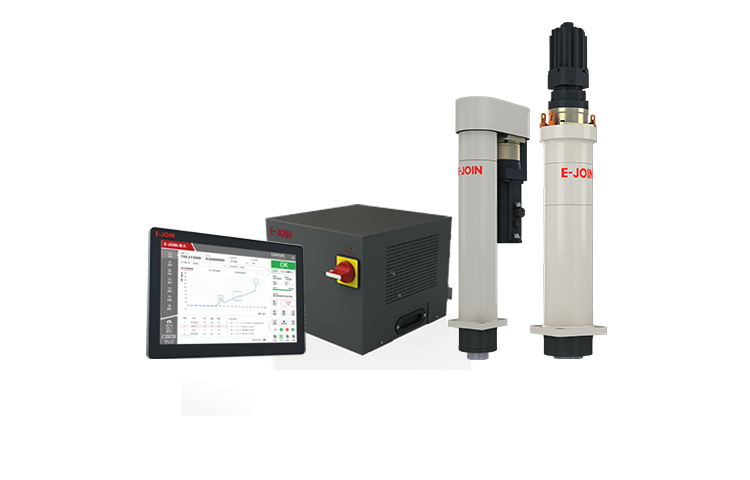
The N-Series Servo Press Fitting System is a high-precision CNC press unit designed for automated assembly and manufacturing applications. It integrates servo motion control, force and displacement measurement, process monitoring, and production data management. The system is available in multiple force configurations from 2 kN to 350 kN, with position accuracy up to 0.01 mm and force accuracy up to 1% FS, making it suitable for precision assembly in automotive manufacturing and industrial production lines.
The system is built around a modular architecture consisting of a servo electric cylinder, industrial software, control box, monitoring instrument, and cable module. This modular design allows the press unit to be flexibly integrated into automated assembly equipment and automotive production lines. The servo electric cylinder includes a high-strength mechanical structure, an integrated pressure sensor for accurate force measurement, and an anti-torsion press rod that can be directly connected to press tooling.
Force-displacement monitoring is central to how the N-Series system evaluates pressing results. The integrated force and displacement detection enables real-time monitoring of pressing conditions and continuous measurement throughout the assembly process, which is the foundation for reliable process evaluation.
Working Principle of Force-Displacement Monitoring
During a servo pressing cycle, the servo electric cylinder advances the press tool along a controlled stroke. As the tool contacts and deforms the workpiece, the integrated pressure sensor measures the force applied, while the servo motion control provides position feedback. The system samples force and displacement simultaneously and continuously, producing a force-displacement curve that represents the entire pressing cycle.
The N-Series system samples at a frequency of 20 kHz with 24-bit acquisition accuracy, which allows the force-displacement relationship to be captured in fine detail. This continuous measurement is what distinguishes force-displacement monitoring from simple endpoint inspection: the curve shows how force develops at each point of the stroke, not just the final result.
The E-Press industrial software displays the force-displacement curve and the force-time curve in real time. Operators and engineers can observe the pressing process as it happens and compare the live curve against reference criteria. The software supports multiple pressing steps and process curves, allowing multi-stage pressing sequences to be evaluated individually.
Evaluation is carried out through built-in functions including judgment windows and envelope curves. A judgment window defines the acceptable force range at specified displacement positions, while an envelope curve defines the acceptable boundary of the entire force-displacement profile. Measurement and OK/NG result evaluation determine whether a pressing cycle conforms to the defined process requirements. Because each pressing cycle can be monitored in real time, process deviations can be detected as they occur rather than discovered later during downstream inspection.
Key Features That Support Evaluation
High-precision servo control: Force accuracy up to 1% FS and position accuracy up to 0.01 mm provide a stable and precise basis for force-displacement evaluation.
Integrated force and displacement detection: Continuous measurement throughout the assembly process captures the full pressing curve.
Flexible process control: Force-controlled pressing, displacement-controlled pressing, and external signal-based control allow the evaluation strategy to match the assembly requirement.
Multiple evaluation functions: Judgment windows, envelope curves, and measurement analysis support different pressing requirements.
Real-time process detection: Each pressing cycle can be monitored to detect process deviations and maintain consistent assembly quality.
Process data traceability: Measurement data and assembly results can interact with PLCs and production servers, supporting process data recording and traceability.
E-Press industrial software: Real-time curve display, hierarchical user permission management, press fitting history and operation logs, alarm log management, and support for MS SQL and Microsoft Access databases.
Fieldbus communication: OPC, EtherNet/IP, and PROFINET support integration with production control systems.
What the Force-Displacement Curve Reveals
The force-displacement curve is the primary output of the monitoring process, and its shape carries information about the assembly itself. Engineers evaluate the curve against defined criteria to judge whether the pressing result is acceptable.
Detection of Process Deviations
When the force at a given displacement falls outside the judgment window, or when the curve crosses the envelope boundary, the cycle can be flagged as NG. This allows deviations to be identified during the pressing cycle itself, supporting consistent assembly quality.
Evaluation of Different Pressing Requirements
Different applications demand different evaluation approaches. Force-controlled pressing evaluates the result based on force targets, while displacement-controlled pressing evaluates based on position targets. The built-in evaluation functions allow the appropriate method to be selected for each pressing requirement, and multiple pressing steps can be programmed and evaluated separately.
Measurement Analysis
Beyond pass/fail judgment, the system supports measurement analysis of the recorded data. This helps engineers understand how a pressing process behaves and supports decisions about process settings, tooling, and component fit.
Evaluation note: Force-displacement monitoring evaluates the pressing process against criteria defined for the specific application. The N-Series system provides the measurement, monitoring, and evaluation functions; the judgment criteria themselves are configured according to the assembly requirement.
Applications in Automotive and Industrial Assembly
The N-Series Servo Press Fitting System is designed for automated manufacturing environments and can be integrated with PLCs, industrial control systems, and production servers. Its precise control and process data capabilities make it suitable for automotive assembly lines requiring high repeatability, quality control, and process traceability.
Typical applications supported by the system include:
Press fitting and component assembly
Automotive component assembly
Forming and riveting
Punching operations
Elasticity and performance testing
High-cycle automated assembly
In these applications, force-displacement monitoring provides a consistent basis for evaluating each cycle. Because the force configurations range from 2 kN to 350 kN, the same monitoring approach can be applied to low-force precision assembly as well as high-force industrial pressing.
Benefits of Force-Displacement Monitoring
Improved traceability: Measurement data and assembly results can be recorded and exchanged with production servers, supporting process data traceability.
Better process consistency: Real-time monitoring of each pressing cycle helps detect deviations and maintain consistent assembly quality.
Production integration: Fieldbus communication and PLC interaction allow the press system to operate as part of an automated production line.
Quality management support: Judgment windows, envelope curves, OK/NG evaluation, and operation logs provide documented evidence of process evaluation.
Flexibility across applications: Multiple force configurations and flexible process control methods allow the evaluation approach to be adapted to different pressing requirements.
Why Choose KINMARK for Servo Pressing Evaluation
KINMARK is a developer and manufacturer of marking and traceability systems, servo press systems, fluid filling systems, and robot automation systems. Since its establishment in 1996, the company has focused on intelligent automation equipment for the automotive industry and related sectors, serving vehicle manufacturers, powertrain and component producers, new energy vehicle companies, and other industrial customers.
The N-Series Servo Press Fitting System reflects this focus on automotive intelligent manufacturing. Its combination of servo motion control, integrated force and displacement measurement, real-time process monitoring, and production data management addresses the evaluation and traceability needs of modern assembly lines. The modular architecture supports integration into automated assembly equipment, and the E-Press software provides the interface for programming, monitoring, and evaluating pressing processes.
KINMARK supports customers with installation and commissioning, operator training, a 12-month warranty on the complete machine, and after-sales technical support including remote diagnosis. With offices and service centers in multiple cities and long-term cooperation with automotive manufacturers and industrial companies, KINMARK provides a practical foundation for servo pressing projects.
Frequently Asked Questions
What is force-displacement monitoring in servo pressing?
Force-displacement monitoring is the continuous measurement of the force applied and the displacement achieved during a pressing cycle. The N-Series system records both values simultaneously and displays the resulting curve in the E-Press software, allowing the pressing process to be evaluated against defined criteria.
How does the system evaluate whether a pressing cycle is acceptable?
The system uses built-in evaluation functions including judgment windows, envelope curves, and measurement analysis. These functions compare the recorded force-displacement data against the criteria defined for the application and produce OK/NG results.
Can pressing data be traced and stored?
Yes. Measurement data and assembly results can interact with PLCs and production servers, supporting process data recording and traceability. The E-Press software also maintains press fitting history and operation logs, alarm logs, and supports MS SQL and Microsoft Access databases.
What force and position accuracy does the N-Series provide?
The N-Series Servo Press Fitting System provides force accuracy up to 1% FS and position accuracy up to 0.01 mm, with sampling at 20 kHz and 24-bit acquisition accuracy.
Can the servo press be integrated into an existing production line?
Yes. The system supports OPC, EtherNet/IP, and PROFINET fieldbus communication and can be integrated with PLCs, industrial control systems, and production servers. Its modular architecture allows it to be flexibly integrated into automated assembly equipment and automotive production lines.
Conclusion
Force-displacement monitoring gives engineers a direct, continuous view of what happens during each servo pressing cycle. By capturing force and displacement together and evaluating the resulting curve against judgment windows and envelope criteria, the N-Series Servo Press Fitting System supports consistent assembly quality, real-time detection of process deviations, and process data traceability. For automotive assembly lines and industrial pressing applications that require precise control and documented evaluation, force-displacement monitoring provides a practical foundation for quality management and production integration.
If you're interested in any of the equipment mentioned in this article, feel free to contact our sales engineers for detailed product information and customized technical solutions.