
Laser Marking Applications in Automotive Manufacturing
Introduction
Laser marking has become a core process in automotive manufacturing, where every vehicle and major component must carry a permanent, readable, and traceable identity. From body-in-white VIN plates to powertrain components and safety-critical parts, marking quality directly affects regulatory compliance, assembly accuracy, and after-sales traceability.
This application guide explains how laser marking is used across automotive production, with particular focus on deep laser marking of VIN codes on high-strength steel, system integration with robots and manipulators, and inline quality verification. It is written for automotive engineers, manufacturing engineers, production managers, and purchasing teams evaluating marking and traceability equipment.
What Laser Marking Does in Automotive Manufacturing
Laser marking creates permanent marks on metal and other surfaces without ink, labels, or mechanical stamping tools. In automotive production, the mark usually carries a unique identifier such as a VIN, engine number, component serial number, or production code. Because the mark is produced by a focused laser beam, it resists abrasion, painting, and normal production handling far better than printed labels.
Automotive manufacturers use laser marking at several stages:
Body-in-white VIN marking before painting and assembly
Engine, transmission, and powertrain component marking
Chassis and safety-related part identification
New energy vehicle battery and drive unit marking
Component supplier marking for inbound traceability
The marking process must satisfy two conditions at the same time: the mark must remain legible after downstream processes such as painting and rubbing, and it must be produced reliably within the takt time of the production line.
Deep Laser Marking for VIN and High-Strength Materials
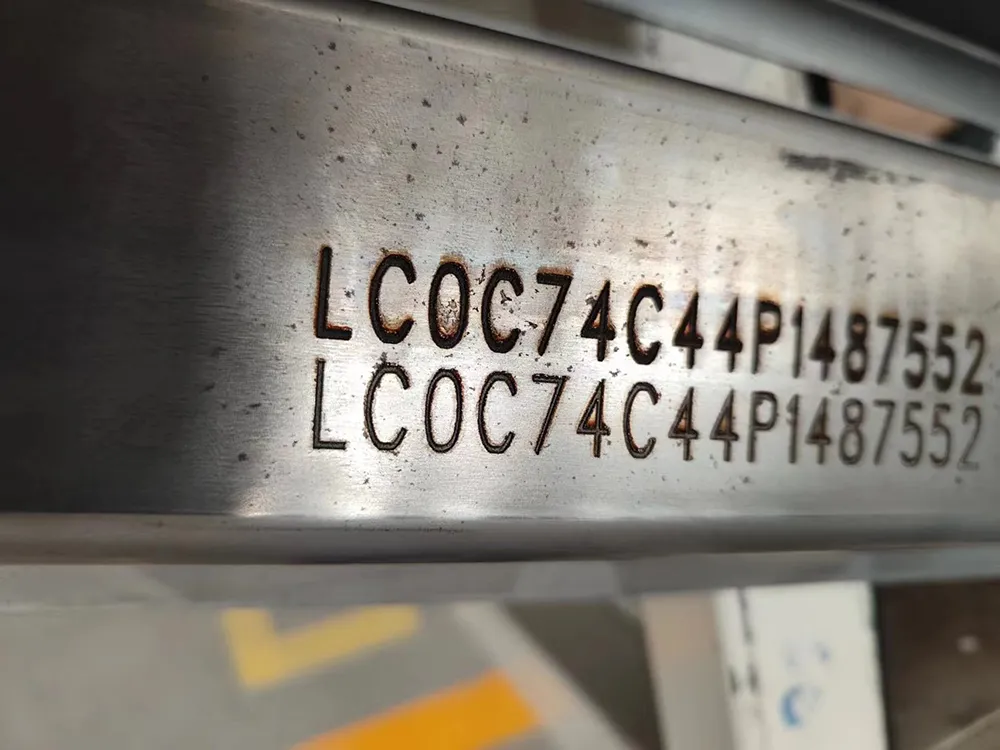
Modern vehicle bodies increasingly use high-strength and hot-formed steel to meet crash safety and lightweight targets. These materials make conventional marking more difficult. A shallow surface mark can become unreadable after painting, rubbing, or long-term exposure.
Deep laser marking addresses this by removing or displacing material to a controlled depth. KINMARK deep laser marking systems are designed to mark VIN codes on high-strength steel plates with yield strength exceeding 700 MPa and hot-formed steel plates with strength up to 1500 MPa. On body-in-white, the marking depth can reach more than 0.2 mm.
A special marking process is used to ensure clear rubbing results after painting. This is important because VIN verification often relies on a physical rubbing or tracing of the mark after the body has passed through the paint shop.
Application note: Deep marking parameters should be validated against the actual material grade, sheet thickness, and paint process used on the line. Marking depth and legibility are process outputs that must be confirmed during commissioning.
Product Overview: Deep Laser Marking Machine
The KINMARK Deep Laser Marking Machine is a marking and traceability system built for automotive mass production. It is positioned as a deep VIN marking solution for high-strength materials, supporting robot integration and intelligent traceability.
The system is intended for production environments where marking must be permanent, repeatable, and integrated into an automated line rather than performed as a standalone manual operation.
Technical Specifications
| Power Supply | AC220V ±10%, 50Hz ±2% |
| Power Consumption | <1000W |
| Laser Power | 200W |
| Marking Area | 112mm × 112mm |
| Marking Depth | ≥0.2mm |
| Operating Temperature | 0~40℃ |
| Operating Humidity | ≤90% RH (Non-condensing) |
Working Principle
The system uses a 200W laser source to produce a focused beam that is directed onto the workpiece surface. By controlling the beam path and process parameters, the system creates a permanent mark at the required depth. The marking area of 112mm × 112mm allows complete VIN strings and related identification data to be marked within a single field.
In automated production, the marking head is mounted on a robot or assisted manipulator. The workpiece is positioned, the marking program is executed, and the marked code is then verified by optional inspection systems. This sequence allows deep marking to be embedded directly into the body-in-white or component production flow rather than handled as an offline operation.
Key Features
Deep VIN marking: Permanent VIN deep marking on high-strength steel plates with yield strength exceeding 700 MPa and hot-formed steel plates with strength up to 1500 MPa; marking depth on body-in-white can reach more than 0.2 mm.
Easy rubbing: A special marking process ensures clear rubbing results after painting.
Easy integration: Various mounting interfaces allow quick integration with industrial robots or assisted manipulators for automated production lines.
Vision guidance: An optional 3D vision guidance system enables precise positioning and accurate marking to improve production efficiency.
Automatic traceability: Optional 3D laser scanning measurement and OCR recognition systems provide online inspection of marking quality and support traceability.
Applications in Automotive Production
Body-in-White VIN Marking
VIN marking on the body-in-white is one of the most demanding marking applications because the mark must survive painting, rubbing, and the full vehicle lifetime. Deep laser marking on high-strength and hot-formed steel supports this requirement while remaining compatible with automated line operation.
Automotive Components and Powertrain
Engines, transmissions, and other powertrain components require permanent identification for assembly matching and traceability. Laser marking provides a durable mark that can be applied in automated cells and verified inline.
New Energy Vehicles
New energy vehicle production places strong emphasis on traceability of major assemblies. Laser marking supports identification of components and assemblies within automated manufacturing environments.
Intelligent Factory Automation
When integrated with robots, manipulators, vision guidance, and inline inspection, laser marking becomes part of a connected production process rather than an isolated station. This supports the broader move toward intelligent factory automation solutions and digital traceability.
Benefits for Manufacturers
Improved traceability: Permanent marks combined with optional OCR and 3D scanning inspection support traceability through the production process.
Process consistency: Automated marking reduces variation compared with manual marking operations.
Production integration: Mounting interfaces and robot compatibility allow marking to be embedded in existing automated lines.
Material capability: Deep marking supports high-strength and hot-formed steel used in modern body structures.
Quality management: Optional inline inspection checks marking quality and character recognition without removing parts from the line.
These benefits describe the functional value of the system. Specific performance outcomes depend on the application, material, and line configuration, and should be evaluated during project planning.
Why Choose KINMARK
KINMARK (Jinan Zhongzheng Jinma Technology Co., Ltd.) has been engaged in marking and traceability, servo press, fluid filling, and robot automation systems since 1996. The company is a Shandong Province "Gazelle" enterprise and a "Specialized, Refined, Differentiated, and Innovative" enterprise, with offices and service centers in Shanghai, Beijing, Guangzhou, Changchun, Wuhan, and Chongqing.
KINMARK has developed marking technology from its early printing equipment into automated marking and traceability systems, including robot automatic marking systems, VIN automatic identification systems, and laser deep marking systems. The company works with automotive manufacturers and suppliers across vehicle assembly, powertrain, components, new energy vehicles, and intelligent factory automation.
For deep laser marking projects, KINMARK provides equipment installation, commissioning, and operator training, supported by a 12-month warranty on the complete machine, remote diagnosis, and after-sales technical support.
Frequently Asked Questions
What materials can the deep laser marking machine mark?
The system is designed for deep VIN marking on high-strength steel plates with yield strength exceeding 700 MPa and hot-formed steel plates with strength up to 1500 MPa. Marking depth on body-in-white can reach more than 0.2 mm.
Can the marking system be integrated into an existing production line?
Yes. The system is designed with various mounting interfaces and can be quickly integrated with industrial robots or assisted manipulators for automated production lines.
How is marking quality verified?
Optional 3D laser scanning measurement and OCR recognition systems provide online inspection of marking quality and character recognition, supporting traceability without removing parts from the line.
Is vision guidance available for positioning?
An optional 3D vision guidance system is available to support precise positioning and accurate marking.
What support is provided after installation?
KINMARK provides installation, commissioning, and operator training, together with a 12-month warranty on the complete machine, remote diagnosis, and long-term maintenance service.
Conclusion
Laser marking is a key enabling process for automotive traceability, and deep laser marking extends that capability to the high-strength and hot-formed steels used in modern vehicle bodies. By combining deep VIN marking, robot and manipulator integration, optional vision guidance, and optional inline inspection, manufacturers can embed reliable identification directly into automated production lines.
For automotive engineers and production teams planning marking and traceability systems, the practical questions are material capability, marking depth, integration method, and quality verification. The KINMARK Deep Laser Marking Machine addresses these requirements within a system designed for automotive manufacturing environments.
If you're interested in any of the equipment mentioned in this article, feel free to contact our sales engineers for detailed product information and customized technical solutions.