How to Ensure Permanent VIN Identification
Introduction
Vehicle Identification Number (VIN) marking is one of the few production steps on a vehicle body that must remain legible for the entire life of the vehicle. Unlike a label, sticker, or printed tag, the VIN is expected to survive painting, assembly, years of road exposure, and in many cases physical abrasion. For automotive engineers and production managers, the challenge is not simply marking a character string onto a body-in-white. The challenge is ensuring that the identification remains permanent, readable, and traceable after the body has passed through the paint shop and the full assembly process.
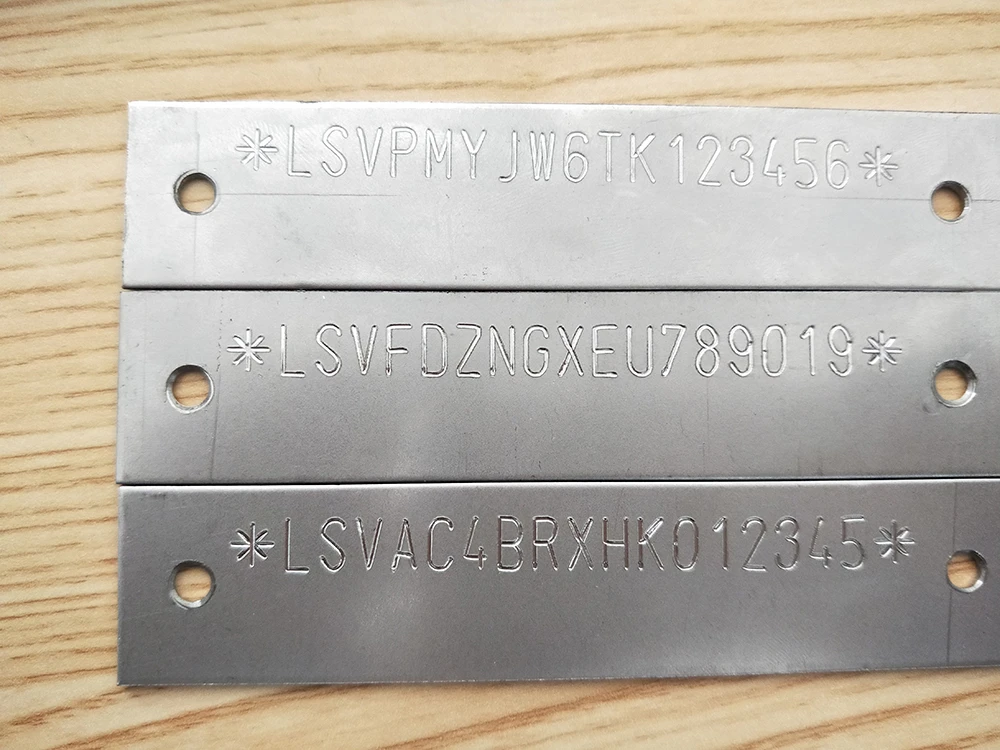
This is a practical problem with several technical dimensions. The material itself is increasingly difficult to mark. Modern body structures use high-strength steel and hot-formed steel, and the marking method must produce a durable result without compromising the panel. At the same time, marking must fit into an automated production line, which means positioning, cycle time, and integration with robots and handling equipment all matter. Finally, traceability requirements mean the marking result must be verified, not assumed.
This article explains how permanent VIN identification is achieved in practice. It covers the role of marking depth, the behavior of high-strength materials, the working principle of deep laser marking, key process features, applications in automotive manufacturing, and the inspection methods used to confirm that the VIN remains identifiable over time.
Why Permanent VIN Identification Is a Process Problem
A VIN that is only printed, etched lightly, or applied as a surface mark can lose legibility after painting. Paint fills shallow marks, and abrasion during assembly or vehicle use can wear down the character edges. When the mark is too shallow, the rubbing result after painting becomes unclear, which creates problems for identification during registration, inspection, service, and resale.
Permanent identification therefore depends on producing a mark that extends into the material rather than sitting on top of it. Depth is the primary factor. A deeper mark is more resistant to paint coverage, surface wear, and mechanical contact. However, depth cannot be increased without limit, because the marking process must not weaken the body panel or introduce distortion. The correct approach is to select a marking method and process parameters that produce sufficient depth on the actual material used in the body structure.
This is why permanent VIN identification should be treated as a process engineering task, not as an equipment purchase alone. The material grade, panel thickness, marking depth, positioning method, and inspection method must all be considered together.
Product Overview: Deep Laser Marking for VIN
A deep laser marking machine is designed to produce permanent VIN marks on high-strength body materials. In the KINMARK deep laser marking system, the marking process is built around deep VIN marking on high-strength steel, with the marking depth on body-in-white reaching more than 0.2 mm.
The system is intended for automotive mass production environments. It enables permanent VIN deep marking on high-strength steel plates with yield strength exceeding 700 MPa and on hot-formed steel plates with strength up to 1500 MPa. These are the materials commonly found in modern body structures, where conventional surface marking methods may not produce a durable result.
Beyond the marking head itself, the system is designed for integration into automated production lines. It supports robot integration and assisted manipulator integration, and it can be combined with optional vision guidance and traceability functions. The goal is not only to mark the VIN, but to mark it accurately, repeatedly, and in a way that can be verified online. For other industrial deep laser marking machines, the same equipment category is relevant when evaluating permanent marking requirements.
Technical Specifications
| Power Supply | AC220V ±10%, 50Hz ±2% |
| Power Consumption | <1000W |
| Laser Power | 200W |
| Marking Area | 112mm × 112mm |
| Marking Depth | ≥0.2mm |
| Operating Temperature | 0~40℃ |
| Operating Humidity | ≤90% RH (Non-condensing) |
Working Principle of Deep Laser VIN Marking
Deep laser marking removes or displaces material to create a mark that extends below the original surface. Rather than relying on a color change or a thin surface layer, the process produces a defined depth that remains visible after painting and rubbing.
In the KINMARK system, a 200W laser is used with a marking area of 112mm × 112mm. The marking depth on body-in-white can reach more than 0.2 mm. This depth is the basis for permanence: when paint is applied over the body, the mark remains deep enough that a rubbing process can reveal a clear VIN impression.
The process also includes a special marking technique that ensures clear rubbing results after painting. This is an important distinction. A deep mark alone is not sufficient if the character geometry is not suitable for rubbing. The marking process must produce characters that can be clearly transferred or revealed after the paint layer is treated.
For automated lines, the marking head is integrated with robot or manipulator systems. The marking position is determined by the production system, and where higher positioning accuracy is required, an optional 3D vision guidance system can be used to complete precise positioning and marking. After marking, optional 3D laser scanning measurement and OCR recognition can be used for online inspection of marking quality and traceability. These functions can be considered as part of a broader marking machine solution for automated manufacturing.
Key Features That Support Permanent Identification
Easy rubbing: A special marking process ensures clear rubbing results after painting, which is essential for VIN verification on a painted body.
Easy integration: The system is designed with different types of mounting interfaces and can be quickly integrated with industrial robots or assisted manipulators for automated production lines.
Deep VIN marking: Permanent VIN deep marking is possible on high-strength steel plates with yield strength exceeding 700 MPa and hot-formed steel plates with strength up to 1500 MPa. The marking depth on body-in-white can reach more than 0.2 mm.
Vision guidance: An optional 3D vision guidance system enables precise positioning and accurate marking to improve production efficiency.
Automatic traceability: Optional 3D laser scanning measurement and OCR recognition systems provide online inspection of marking quality and support 100% traceability.
Why Marking Depth Matters on High-Strength Steel
High-strength and hot-formed steels are used in body structures because they provide strength with relatively low weight. They are also more difficult to mark than mild steel. A marking method that works on a conventional panel may not achieve the same depth or consistency on a 1500 MPa hot-formed component.
The KINMARK deep laser marking system is specified to mark these materials with a depth of more than 0.2 mm on body-in-white. This specification is directly relevant to permanence, because it defines how much material is removed or displaced. When the mark is deeper than the paint layer and resistant to surface wear, the VIN remains identifiable.
Applications in Automotive Manufacturing
Deep laser VIN marking is used in automotive manufacturing where permanent identification is required on the body-in-white. The system is relevant to:
Automotive manufacturing: VIN marking on body structures before painting and assembly.
Automotive components: Permanent identification on high-strength and hot-formed parts where traceability is required.
New energy vehicles: Body and component identification in EV production, where lightweight high-strength materials are common.
Powertrain manufacturing: Marking and traceability for powertrain-related components within automated production lines.
Intelligent factory automation: Integration with robot cells, vision systems, and online inspection for automated traceability.
The system is designed for mass production. It supports robot integration and can be combined with optional vision guidance and OCR-based inspection, which allows the marking process to be embedded in an automated line rather than treated as a manual station. For related identification requirements, KINMARK also provides marking and traceability solutions for industrial production.
How to Verify That a VIN Mark Is Permanent
Verification is part of the permanent identification process. A VIN mark that is not inspected cannot be assumed to be correct. Two inspection functions are relevant in the KINMARK system:
3D laser scanning measurement: Used to measure marking depth and confirm that the mark meets the required depth specification.
OCR recognition: Used to read the marked characters and confirm that the VIN content is correct and legible.
Together, these optional systems provide online inspection of marking quality and support 100% traceability. For production managers, this means the marking result can be checked in line, rather than discovered later during a downstream inspection or after painting.
Practical note: Permanent VIN identification depends on three factors working together — sufficient marking depth on the actual body material, a marking process that produces clear rubbing results after painting, and an inspection method that confirms depth and character readability. Changing one factor without reviewing the others can reduce the reliability of the final mark.
Benefits for Production and Traceability
Improved traceability: Optional 3D laser scanning and OCR recognition support online inspection and 100% traceability of the marking result.
Better process consistency: Deep marking with defined depth parameters supports repeatable results on high-strength and hot-formed steel.
Production integration: Mounting interfaces and robot compatibility allow the marking system to be integrated into automated production lines.
Accurate positioning: Optional 3D vision guidance supports precise positioning and accurate marking.
Quality management: Online inspection of marking quality helps identify issues before the body moves to downstream processes.
Why Choose KINMARK for Deep VIN Marking
KINMARK has been involved in automotive marking and traceability since 1997, when the company began providing printing equipment for engine production lines. Over the following decades, the company expanded into automatic marking equipment for engines, bodies, and nameplates, and later into robot automatic marking systems, VIN automatic identification systems, and laser deep marking systems.
The deep laser marking system is part of this longer development path. The company's product portfolio covers marking and traceability, servo press systems, fluid filling systems, and robot automation systems, with business covering complete vehicles, powertrain, automotive components, engineering machinery, home appliances, new energy, electronic communications, and rail transit.
For permanent VIN identification, the relevant strengths are the focus on high-strength and hot-formed steel marking, the design of the marking head for robot and manipulator integration, and the availability of optional vision guidance and traceability functions. The complete machine is covered by a 12-month warranty, with technical support and maintenance service, and engineers provide installation, commissioning, and operator training.
Frequently Asked Questions
What marking depth is required for permanent VIN identification?
For the KINMARK deep laser marking system, the marking depth on body-in-white can reach more than 0.2 mm. The required depth depends on the material and the downstream painting and rubbing process, but depth is the primary factor that allows the VIN to remain legible after painting and surface wear.
Can deep laser marking be used on high-strength and hot-formed steel?
Yes. The system enables permanent VIN deep marking on high-strength steel plates with yield strength exceeding 700 MPa and hot-formed steel plates with strength up to 1500 MPa. These materials are commonly used in modern body structures where permanent identification is required.
How is the VIN mark verified after marking?
Optional 3D laser scanning measurement and OCR recognition systems provide online inspection of marking quality. The 3D scanning measurement checks the mark, while OCR reads the characters, together supporting 100% traceability of the marking result.
Can the marking system be integrated into an automated production line?
Yes. The system is designed with various mounting interfaces and can be quickly integrated with industrial robots or assisted manipulators. An optional 3D vision guidance system can be added for precise positioning and accurate marking in automated production lines.
What does “easy rubbing” mean in VIN marking?
Easy rubbing refers to the ability to obtain a clear rubbing result after painting. The KINMARK deep laser marking system uses a special marking process to ensure that the VIN can be clearly revealed after the body has been painted, which is essential for identification and verification.
Conclusion
Permanent VIN identification is achieved by combining sufficient marking depth, a marking process that produces clear rubbing results after painting, and an inspection method that confirms both depth and character readability. On modern body structures made from high-strength and hot-formed steel, these requirements are more demanding than on conventional materials.
The KINMARK deep laser marking system addresses these requirements with deep VIN marking on high-strength steel, a marking depth of more than 0.2 mm on body-in-white, robot and manipulator integration, optional 3D vision guidance, and optional 3D laser scanning and OCR recognition for traceability. For automotive engineers and production managers, the practical takeaway is that permanence should be specified, integrated, and verified as part of the production process — not left to chance after painting.
If you're interested in any of the equipment mentioned in this article, feel free to contact our sales engineers for detailed product information and customized technical solutions.