Automated Laser Marking for Labels: Key Production Processes
Introduction
Identification labels are a small component in automotive and industrial production, but they carry a large share of the traceability responsibility. A VIN plate, a component label, or a barcode sticker on a powertrain assembly must remain readable for years, survive assembly line handling, and stay linked to the correct production record. When labels are produced manually or in semi-automated steps, the risk of inconsistent print quality, misaligned cutting, and mixed-up batches increases.
Automated laser marking for labels addresses this problem by combining several label production steps into one continuous process. Rather than printing labels in one place and finishing them in another, a flexible fiber laser marking machine can unwind the label stock, inspect it, level it, mark it, and cut it within a single automated workflow. For manufacturers that consume large volumes of identification labels, this changes label production from a secondary task into a controlled, repeatable process.
This guide explains how automated laser marking for labels works, which production processes are involved, what types of flexible label materials are suitable, and where the technology fits into automotive manufacturing, component production, and intelligent factory automation.
Product Overview
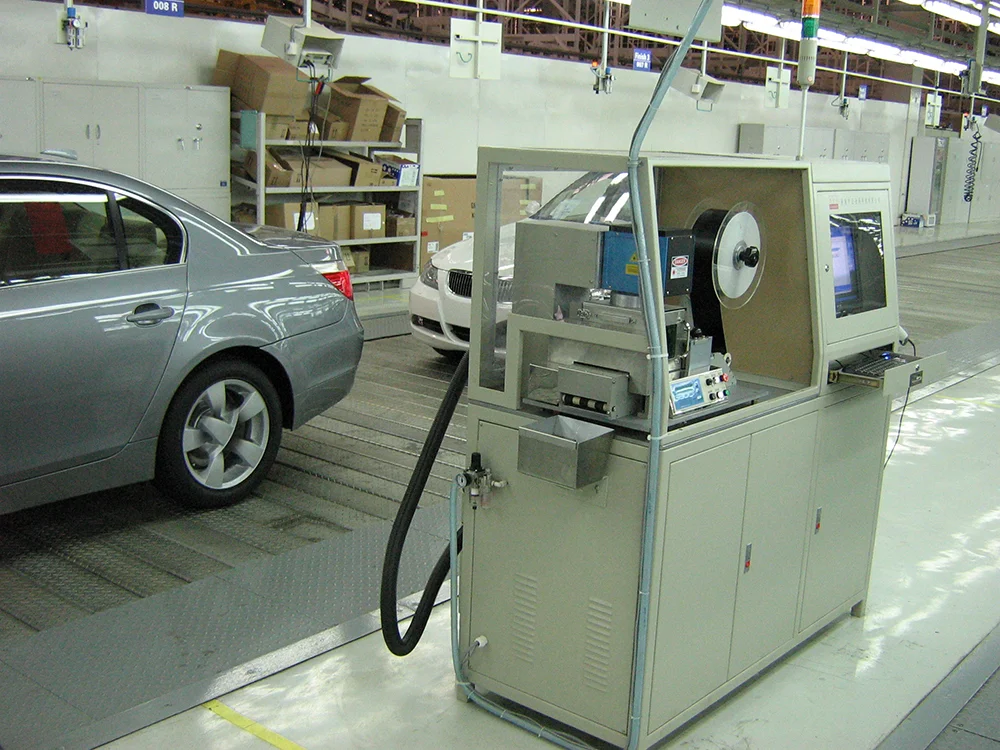
The KINMARK Flexible Fiber Laser Marking Machine is designed specifically for laser marking on flexible film labels. It is suitable for labels based on ethyl acetate laser films from brands such as TESA, 3M, and Schreiner. These are not rigid metal nameplates or standard paper stickers; they are flexible film materials that require controlled handling before, during, and after marking.
The machine supports automated processing that covers unwinding, inspection, leveling, marking, and cutting. In practical terms, this means a roll of flexible label material can be loaded, processed, and converted into finished labels without manual intervention between each step. The output is a set of customized identification labels with permanent marking of characters, text, graphics, 1D barcodes, and 2D codes.
The system is positioned as a complete label manufacturing process rather than a standalone marking head. It integrates multiple operations into one automated solution, which is relevant for production environments where label quality, batch consistency, and traceability data all need to be controlled together.
Working Principle
Automated laser marking for labels is a multi-stage process. The flexible film label material is first unwound from the supply roll. Unwinding must be controlled so that the web advances at a consistent rate and tension; otherwise, downstream marking and cutting positions will drift.
After unwinding, the material passes through an inspection stage. Inspection helps confirm that the label stock is in acceptable condition before marking, reducing the chance that defective material consumes laser time and produces unusable labels.
Leveling follows inspection. Flexible film labels can develop slight curvature or unevenness during storage and unwinding. A leveling stage helps present a flat, stable surface to the marking position, which supports consistent marking results across the label area.
The marking stage uses fiber laser technology. The laser applies permanent marks to the flexible film, producing characters, text, graphics, 1D barcodes, and 2D codes. Because the marking is laser-based rather than ink-based, it does not depend on consumable inks or ribbons in the same way as conventional printing.
Finally, the cutting stage separates the marked labels from the web. Because unwinding, inspection, leveling, marking, and cutting are handled as one automated sequence, the position of the mark relative to the cut edge can be managed as part of the same process.
Why Process Integration Matters
When these steps are separated across different machines or manual stations, each transfer introduces a potential alignment error. Integrating them into one automated flow reduces handling and keeps the label web under continuous control from start to finish.
Key Features
Flexible label compatibility: Designed for ethyl acetate laser film labels from TESA, 3M, and Schreiner, as well as comparable flexible film materials.
Automated multi-stage processing: Supports unwinding, inspection, leveling, marking, and cutting within one automated solution.
Permanent laser marking: Capable of marking characters, text, graphics, 1D barcodes, and 2D codes on flexible label materials.
Barcode and traceability support: The marking capability supports identification labels used in traceability systems.
Modular design: The modular structure allows adaptation to different production requirements and provides flexible integration options for industrial applications.
Standardized core components: Core components are standardized, and the marking process is mature, supporting reliable operation in continuous production.
Customized label output: The system produces the various types of labels required by customers, based on the marking data provided.
The Five Core Production Processes
The value of an automated laser marking machine for labels comes from how the individual processes work together. Each stage has a specific role in producing a finished, traceable label.
1. Unwinding
Unwinding is the entry point of the process. The label web is fed from the supply roll into the machine. Stable unwinding is the foundation for everything that follows, because marking position and cutting position are both referenced to the moving web.
2. Inspection
Inspection checks the label material before marking. This stage supports quality control by identifying material issues early, before laser time and finishing effort are invested in a label that may not meet requirements.
3. Leveling
Leveling prepares the flexible film for marking. A flat and stable label surface helps the laser produce clear, consistent characters and codes across the label area.
4. Marking
Marking is the core operation. The fiber laser creates permanent marks on the flexible film, including characters, text, graphics, 1D barcodes, and 2D codes. This is the stage where the label receives its identity content, such as part numbers, serial numbers, or traceability codes. For broader laser marking applications, see the laser marking machine product category.
5. Cutting
Cutting separates the finished labels from the web. Because cutting follows marking within the same automated flow, the relationship between the marked content and the label outline is managed as part of one process rather than as a separate offline operation.
Applications
Automated laser marking for flexible labels is relevant wherever durable, traceable identification labels are required in industrial production.
Automotive Manufacturing
Vehicle assembly and component identification depend on labels that remain readable throughout the production lifecycle. Flexible film labels marked with barcodes and 2D codes support identification and traceability requirements on the line.
Automotive Components
Component suppliers need labels that can be applied to parts, subassemblies, and packaging while maintaining a clear link to production records. Laser-marked flexible labels provide permanent marking without relying on ink consumables.
New Energy Vehicles
New energy vehicle production involves battery, motor, and electronic assemblies that require traceability. Identification labels marked with 1D and 2D codes support the data capture needed in these production environments.
Powertrain Manufacturing
Engine, transmission, and drivetrain production uses component-level identification. Flexible labels with permanent laser marking can support the traceability practices used in powertrain lines.
Intelligent Factory Automation
In automated factories, labels are often read by scanners and vision systems. Consistent mark quality and accurate code placement support automated identification and data collection across production stations.
Benefits of Automated Label Marking
The benefits of this approach are practical and process-oriented rather than based on theoretical performance claims.
Improved traceability: Permanent marking of 1D and 2D codes supports the identification and tracking of parts and components.
Better process consistency: Integrating unwinding, inspection, leveling, marking, and cutting into one automated flow reduces variation caused by manual handling between steps.
Reduced manual handling: Automated processing limits the number of times the label web is transferred or repositioned by hand.
Flexible production integration: The modular design allows the system to be adapted to different production requirements.
Stable industrial operation: Standardized core components and a mature marking process support reliable operation in continuous production.
Customized label output: The machine produces the specific label types required by the customer, based on the marking content supplied.
Note: Label material compatibility should be confirmed against the specific film grade being used. The machine is designed for ethyl acetate laser film labels from TESA, 3M, and Schreiner, and comparable flexible film materials.
Why Choose KINMARK
KINMARK has been involved in marking and traceability systems since its founding in 1996, starting from marking machines and expanding into automotive intelligent automation equipment. The company's product scope includes marking and traceability systems, servo press systems, fluid filling systems, and robot automation systems.
For flexible label marking, this background matters because label production is rarely an isolated task. It connects to identification systems, traceability requirements, and production data. A supplier with experience across marking, automation, and production integration can address the label process as part of a wider manufacturing workflow.
KINMARK serves vehicle manufacturers, powertrain producers, component suppliers, and new energy vehicle companies, and also provides automation solutions for industrial enterprises outside the automotive sector. The company operates offices and service centers in multiple cities and provides installation, commissioning, operator training, warranty coverage, and after-sales technical support.
Service and Support
12-month warranty: The complete machine is covered by a 12-month warranty, with professional technical support and long-term maintenance service.
Fast response service: Efficient after-sales support, remote diagnosis, and technical assistance help maintain continuous operation.
Installation and commissioning: Engineers provide equipment installation, commissioning, and operator training to help customers start production smoothly.
Frequently Asked Questions
What types of labels can be processed with automated laser marking?
The KINMARK Flexible Fiber Laser Marking Machine is designed for flexible film labels made from ethyl acetate laser films, including materials from TESA, 3M, and Schreiner. It supports marking of characters, text, graphics, 1D barcodes, and 2D codes on these flexible label materials.
Which production steps are included in the automated process?
The system supports automated processing that includes unwinding, inspection, leveling, marking, and cutting. These steps are integrated into one automated solution so that the label web is processed continuously rather than being transferred between separate machines or manual stations.
What marking content can be produced on flexible labels?
The machine can mark various characters, text, graphics, 1D barcodes, and 2D codes. This makes it suitable for producing customized identification labels used in traceability and component identification applications.
How does the modular design support different production requirements?
The modular design allows the system to be adapted to different production requirements and provides flexible integration options for industrial applications. This means the configuration can be adjusted to match the label format, marking content, and production environment.
What support is available after installation?
KINMARK provides installation, commissioning, and operator training, along with a 12-month warranty on the complete machine. After-sales support includes remote diagnosis and technical assistance, supported by service offices in multiple cities.
Conclusion
Automated laser marking for labels is not simply about replacing ink with a laser. It is about controlling the full sequence of unwinding, inspection, leveling, marking, and cutting so that each finished label carries a permanent, readable, and correctly positioned identification mark. For manufacturers producing or consuming large volumes of flexible labels, this integrated approach supports traceability, process consistency, and production stability.
The KINMARK Flexible Fiber Laser Marking Machine is built around this integrated process concept, with compatibility for TESA, 3M, and Schreiner flexible film labels, modular design for production adaptation, and support services that cover installation through long-term maintenance. For production teams evaluating an automated laser marking machine for labels, the key question is not only what the laser can mark, but how well the surrounding processes are controlled. That is where an integrated automated solution makes the difference.
If you're interested in any of the equipment mentioned in this article, feel free to contact our sales engineers for detailed product information and customized technical solutions.