
What to Know About CNC Servo Presses for Precision Assembly
Introduction
A CNC servo press is a programmable pressing unit that uses servo motion control together with force and displacement measurement to perform controlled assembly operations. Instead of relying on a fixed mechanical stroke or a hydraulic ram, a servo press drives the press ram to a defined position or force and monitors the result of every cycle.
In automotive assembly and component manufacturing, many joining operations depend on press fitting: bearings into housings, bushings into control arms, pins into linkages, sleeves into transmission parts, and similar interference-fit assemblies. These operations are sensitive to variation in material batch, surface condition, lubrication and part tolerance. A press that only reaches a mechanical stop cannot distinguish a correctly seated part from one that is oversized, misaligned or damaged.
This article explains what a CNC servo press is, how the pressing process is controlled and monitored, which features matter for precision assembly, where these systems are applied, and what engineering and purchasing teams should evaluate before specifying one for a production line.
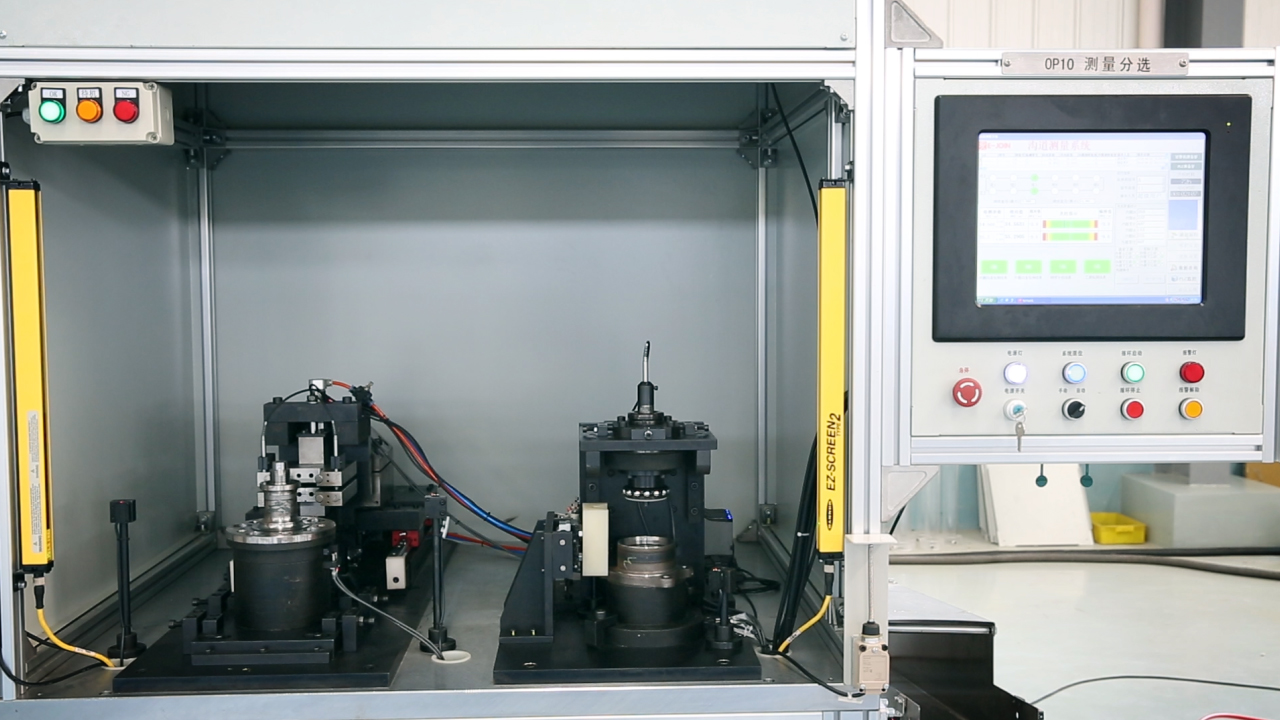
Product Overview
The N-Series Servo Press Fitting System is a high-precision CNC press unit designed for automated assembly and manufacturing applications. It integrates servo motion control, force and displacement measurement, process monitoring and production data management, making it suitable for precision assembly in automotive manufacturing and industrial production lines.
The system is built around a servo electric cylinder rather than a hydraulic or pneumatic actuator. Force is generated by the servo drive and measured by an integrated pressure sensor, while ram position is controlled and measured by the servo system. Because both force and position are available as continuous signals, the press can be programmed to stop on force, stop on position, or respond to an external control signal.
The N-Series is offered in multiple force configurations, from 2 kN up to 350 kN, so the same control concept and software environment can be applied to low-force precision assembly as well as higher-force industrial pressing. Typical uses include press fitting and component assembly, forming and riveting, punching operations, elasticity and performance testing, and high-cycle automated assembly.
Working Principle
A CNC servo press converts rotary motion from a servo motor into linear motion of a press rod, and controls that motion according to a programmed pressing profile. During each cycle, the system continuously acquires force and displacement data and compares the resulting curve against the limits defined for that assembly.
Motion and Force Generation
The servo electric cylinder provides the pressing motion. Because the drive is electrically controlled, the ram speed and stopping point can be programmed per step rather than fixed by the actuator design. The integrated pressure sensor measures the pressing force throughout the stroke, which allows the controller to switch from position-based control to force-based control at the appropriate point in the cycle.
Force and Displacement Measurement
Force and displacement are detected together and monitored in real time. The system samples the process at 20 kHz with 24-bit acquisition accuracy, so the force-displacement curve is captured in sufficient detail to evaluate how the part behaved during the press, not only whether the final position was reached.
Process Evaluation
After the press stroke, the recorded curve is evaluated against the criteria configured for that part. Built-in evaluation functions include judgment windows, envelope curves and measurement analysis. The result is an OK or NG judgment for the individual cycle, which can be used to release the part, trigger a rework path, or stop the station.
Engineering note: The value of a servo press in precision assembly comes from measuring the press fit itself. A force-displacement curve recorded during the stroke shows whether the part seated normally, bottomed out early, or required abnormal force — information a mechanical press cannot provide.
Key Features
High-Precision Servo Control
Force accuracy up to 1% FS
Position accuracy up to 0.01 mm
Stable and precise servo motion control
Integrated Force and Displacement Detection
Real-time monitoring of pressing conditions
Continuous measurement throughout the assembly process
Flexible Process Control
Force-controlled pressing
Displacement-controlled pressing
External signal-based control
100% Process Monitoring
Each pressing cycle can be monitored in real time to detect process deviations and maintain consistent assembly quality. Because every cycle is evaluated, process drift caused by tool wear, material variation or setup changes can be identified at the station rather than at end-of-line inspection.
Process Data Traceability
Measurement data and assembly results can interact with PLCs and production servers, supporting process data recording and traceability. Output formats include CSV and XLS, and the system supports OPC, EtherNet/IP and PROFINET fieldbus communication for integration with line control and MES-level systems.
Modular System Architecture
The system consists of a servo electric cylinder, industrial software, control box, monitoring instrument and cable module. This modular design allows the press to be integrated into automated assembly equipment and automotive production lines, and allows the pressing unit to be specified independently of the surrounding station structure. For different equipment configurations, KINMARK also provides press fitting functional modules.
E-Press Industrial Software
Real-time force-displacement curve display
Real-time force-time curve display
Multiple pressing steps and process curves
Judgment window and envelope curve evaluation
Measurement and OK/NG result evaluation
Hierarchical user permission management
Press fitting history and operation logs
Alarm log management
Support for MS SQL and Microsoft Access databases
Servo Electric Cylinder Construction
High-strength mechanical construction for demanding production environments
Integrated pressure sensor for accurate force measurement
Anti-torsion press rod that can be connected directly to press tooling
Technical Specifications
The N-Series covers eleven force configurations. Stroke, running speed and maximum pressure for each model are listed below.
| Model | Stroke (mm) | Maximum Pressure (kN) | Running Speed (mm/s) | Force Accuracy | Position Accuracy (mm) |
|---|---|---|---|---|---|
| 2 kN | 100–200 | 2 | 0.02–260 | 1% FS | 0.01 |
| 5 kN | 100–200 | 5 | 0.02–260 | 1% FS | 0.01 |
| 10 kN | 100–400 | 10 | 0.02–250 | 1% FS | 0.01 |
| 20 kN | 100–400 | 20 | 0.02–125 | 1% FS | 0.01 |
| 30 kN | 200–400 | 30 | 0.02–200 | 1% FS | 0.01 |
| 50 kN | 200–400 | 50 | 0.02–200 | 1% FS | 0.01 |
| 80 kN | 300–400 | 80 | 0.02–160 | 1% FS | 0.01 |
| 100 kN | 300–400 | 100 | 0.02–140 | 1% FS | 0.01 |
| 150 kN | 200–400 | 150 | 0.02–140 | 1% FS | 0.01 |
| 200 kN | 200–400 | 200 | 0.02–100 | 1% FS | 0.01 |
| 350 kN | 200–400 | 350 | 0.02–50 | 1% FS | 0.01 |
General Specifications
| Position accuracy | ≤ 0.01 mm |
| Force control accuracy | ≤ 1% FS |
| Maximum pressure holding time | 3 s |
| Noise | < 75 dB |
| Sampling frequency | 20 kHz |
| Acquisition accuracy | 24 bit |
| Service life | > 12 million cycles |
| Protection rating | IP54 |
| Fieldbus communication | OPC, EtherNet/IP, PROFINET |
| Rated power | 0.2–14.5 kW, 50/60 Hz |
| Rated voltage | Single-phase 220 V, three-phase 220 V, or three-phase 380 V (depending on model) |
| Operating environment | 0–50°C, 10–90% RH non-condensing |
| Supported languages | Chinese / English (CN / EN) |
| Output formats | CSV / XLS |
Specifications may vary depending on the product model. Please refer to the actual product configuration.
Applications
The N-Series Servo Press Fitting System is intended for automated assembly and manufacturing environments. Within the automotive sector, the following application areas are supported by the product configuration.
Automotive Component Assembly
Press fitting of bearings, bushings, pins and similar interference-fit components into housings, brackets and subassemblies. The combination of 0.01 mm position accuracy and force-displacement monitoring supports repeatable assembly of parts where seating condition matters to function and durability.
Automotive Production Line Integration
The system can be integrated with PLCs, industrial control systems and production servers. Its precise control and process data capabilities make it suitable for automotive assembly lines requiring high repeatability, quality control and process traceability. KINMARK provides servo press fitting systems for automated manufacturing and assembly applications.
Forming and Riveting
Controlled force and displacement allow forming and riveting operations to be carried out with a defined profile and a recorded result for each cycle.
Punching Operations
The press can be programmed for punching tasks where stroke and force need to be controlled and verified.
Elasticity and Performance Testing
Because force and displacement are measured continuously, the system can be used for elasticity and performance testing in addition to production pressing.
High-Cycle Automated Assembly
With a rated service life of more than 12 million cycles and a protection rating of IP54, the servo electric cylinder is designed for repetitive automated production duty.
Benefits
Improved Process Consistency
Programmable force and position control reduces dependence on operator judgment. Each cycle follows the same configured profile, and the OK/NG judgment is applied consistently across cycles and shifts.
Better Traceability
Measurement data and assembly results can be recorded and transferred to production servers, supporting traceability requirements in automotive manufacturing. History and operation logs in E-Press provide a record of what was pressed, when, and with what result.
Early Detection of Process Deviation
Real-time curve monitoring with judgment windows and envelope curves allows deviations to be detected during the cycle rather than after the part has moved downstream.
Flexible Integration
The modular architecture and support for OPC, EtherNet/IP and PROFINET allow the press to be integrated into existing line control architectures. Multiple pressing steps and process curves can be configured within the same software environment.
Range Across Force Levels
With models from 2 kN to 350 kN, a single control and software approach can be applied across different stations and component types, simplifying programming, training and data handling.
Why Choose KINMARK
KINMARK (Jinan Zhongzheng Jinma Technology Co., Ltd.) was established in 1996 and is a developer and manufacturer of marking and traceability systems, fluid filling systems, servo press systems and robot automation systems. The company is recognized as a Shandong Province “Gazelle” enterprise and a “Specialized, Refined, Distinctive and Innovative” enterprise, with offices and service centers in Shanghai, Beijing, Guangzhou, Changchun, Wuhan and Chongqing.
KINMARK began with marking equipment and has developed progressively into automotive intelligent automation equipment. Its product lines now cover marking and traceability, servo press fitting, and fluid filling and dosing. Business areas include complete vehicles, powertrain, automotive components, construction machinery, home appliances, new energy, electronics and communications, and rail transit.
The company has established long-term cooperation with automotive manufacturers at home and abroad, and also provides automation solutions to industrial enterprises outside the automotive sector. For press fitting projects, this background is relevant in three ways:
Automotive process understanding: the servo press system is designed around automotive assembly requirements, including repeatability, quality control and process traceability.
Integration experience: KINMARK supplies marking, filling, pressing and robot automation systems, so press stations can be considered as part of a wider line architecture rather than a standalone machine.
Service coverage: the complete machine is covered by a 12-month warranty, with professional technical support and long-term maintenance service. Engineers provide installation, commissioning and operator training, and remote diagnosis and technical assistance are available for after-sales support.
Frequently Asked Questions
What is a CNC servo press used for in automotive assembly?
A CNC servo press is used for controlled pressing operations such as press fitting and component assembly, forming and riveting, punching, and elasticity and performance testing. In automotive production it is typically applied where the seating condition of a pressed part must be verified for each cycle, and where the result needs to be recorded for traceability.
How does a servo press differ from a conventional press in terms of process control?
A servo press controls the ram through a servo electric cylinder and can operate in force-controlled, displacement-controlled or external-signal-based modes. Force and displacement are measured continuously during the stroke, and the resulting curve is evaluated against configured criteria. This allows each cycle to receive an OK/NG judgment based on how the press fit actually behaved, rather than only on whether a mechanical stop was reached.
What accuracy can the N-Series Servo Press Fitting System achieve?
The N-Series provides position accuracy of 0.01 mm and force accuracy of 1% FS across its models. General specifications include force control accuracy of ≤ 1% FS, sampling frequency of 20 kHz and acquisition accuracy of 24 bit. Specifications may vary depending on the product model, so the actual product configuration should be confirmed for a specific application.
Can the press system be integrated with existing line control and data systems?
Yes. Measurement data and assembly results can interact with PLCs and production servers, and the system supports OPC, EtherNet/IP and PROFINET fieldbus communication. E-Press software supports MS SQL and Microsoft Access databases, and data can be output in CSV or XLS format. The modular architecture — servo electric cylinder, industrial software, control box, monitoring instrument and cable module — is intended to simplify integration into automated assembly equipment.
Which force capacity should be selected for a given press fitting application?
The N-Series covers maximum pressures from 2 kN to 350 kN, with stroke options from 100 mm to 400 mm depending on the model. Selection depends on the required pressing force, the required stroke, the running speed appropriate to the process, and the evaluation method needed for the part. Because specifications vary by model, the application requirements should be reviewed against the actual product configuration before ordering.
Conclusion
A CNC servo press brings programmable force and position control, continuous force-displacement measurement and per-cycle evaluation into the assembly station. For precision assembly in automotive manufacturing, this changes the nature of the pressing operation: the press fit is measured and judged rather than simply executed, and the result can be recorded and traced.
The N-Series Servo Press Fitting System applies this approach across a force range from 2 kN to 350 kN, with position accuracy up to 0.01 mm, force accuracy up to 1% FS, real-time process monitoring, and data interaction with PLCs and production servers. Its modular architecture and fieldbus support allow it to be integrated into automated assembly equipment and automotive production lines where repeatability, quality control and process traceability are required.
If you're interested in any of the equipment mentioned in this article, feel free to contact our sales engineers for detailed product information and customized technical solutions.