
How 3D Vision-Guided Laser Marking Systems Work
Introduction
Laser marking has become a standard process in automotive manufacturing for applying vehicle identification numbers, component codes, and other permanent identifiers to parts and body structures. As marking requirements have become more demanding, particularly for deep VIN marking on high-strength steel and hot-formed steel, the ability to position the marking head accurately has become a critical factor in achieving consistent results. Manual positioning or fixed mechanical fixtures can struggle to accommodate the dimensional variation that exists in body-in-white assemblies and large stamped components.
3D vision guided laser marking addresses this challenge by using a vision system to locate the marking position before the laser process begins. Rather than relying on a fixed coordinate, the system identifies the actual position of the workpiece and adjusts the marking operation accordingly. This guide explains what 3D vision guided laser marking is, how the guidance function works alongside a deep laser marking system, where it is applied in automotive production, and what practical considerations engineers should keep in mind when evaluating this type of equipment.
Product Overview
A 3D vision guided laser marking system combines a deep laser marking machine with an optional 3D vision guidance system. The marking machine itself is designed to produce permanent identification marks, including VIN deep marking, on high-strength steel plates and hot-formed steel plates. The vision guidance function is an add-on capability that supports precise positioning and accurate marking on the production line.
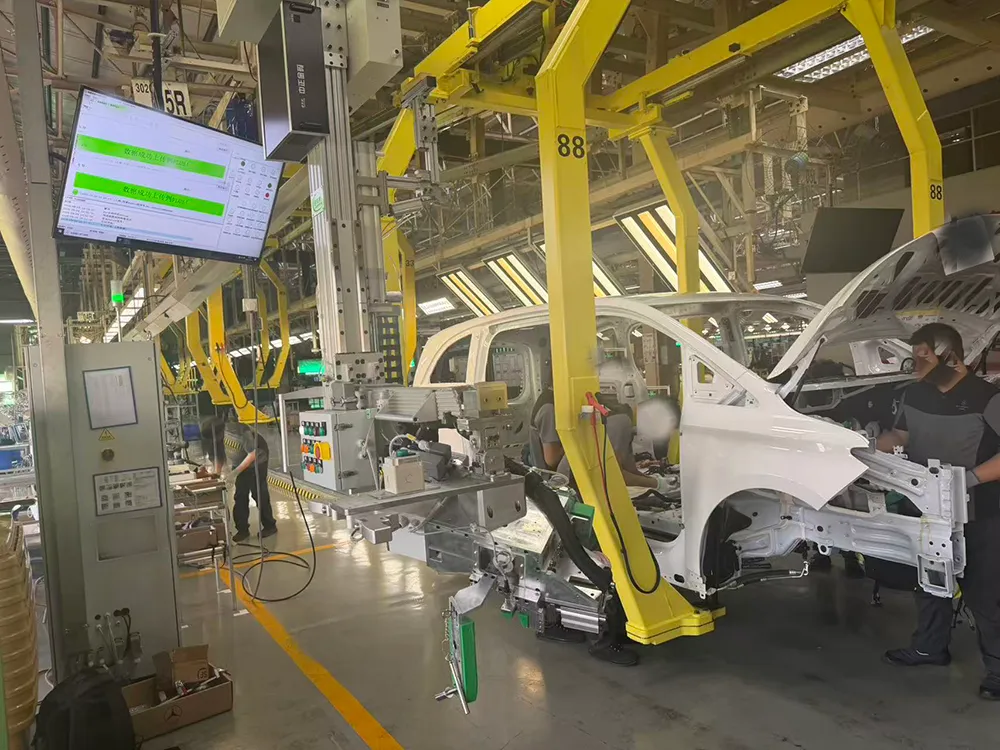
Within the KINMARK Deep Laser Marking Machine range, the 3D vision guidance system is offered as an optional configuration. When selected, it works with the marking head to locate the target area on the workpiece and align the marking process with the actual part position. This is particularly relevant in automotive body assembly, where panels and structures may present slight positional variation between units.
The marking system is also designed for integration with industrial robots and assisted manipulators. Different mounting interfaces are available to support automated production lines, allowing the marking head to be mounted on a robot arm or a manipulator for flexible operation. The combination of deep marking capability and vision guidance supports automated, repeatable marking in high-volume manufacturing environments.
Working Principle
The working principle of a 3D vision guided laser marking system can be understood in two connected stages: positioning and marking. In the positioning stage, the 3D vision system captures information about the workpiece and determines the correct location for the mark. This allows the system to compensate for part-to-part variation rather than assuming a fixed position. In the marking stage, the laser marking head applies the mark at the identified location.
The KINMARK Deep Laser Marking Machine uses a special marking process intended to ensure clear rubbing results after painting. This matters because VIN marks on body-in-white are often covered during the paint process, and the ability to produce a clear rubbing after painting is a practical requirement in vehicle production.
For deep marking, the system is designed to mark high-strength steel plates with yield strength exceeding 700 MPa, as well as hot-formed steel plates with strength up to 1500 MPa. The marking depth on body-in-white can reach more than 0.2 mm. Achieving this depth consistently depends on stable positioning and process control, which is where 3D vision guidance contributes to the overall result.
In addition to vision guidance, the system can be configured with a 3D laser scanning measurement and OCR recognition system. This optional combination provides online inspection of marking quality and supports traceability by verifying that the mark has been applied correctly.
Key Features
The following features are associated with the KINMARK Deep Laser Marking Machine and its optional vision and inspection configurations.
Deep VIN Marking: Enables permanent VIN deep marking on high-strength steel plates with yield strength exceeding 700 MPa and hot-formed steel plates with strength up to 1500 MPa. Marking depth on body-in-white can reach more than 0.2 mm.
Vision Guidance: An optional 3D vision guidance system supports precise positioning and accurate marking to improve production efficiency.
Automatic Traceability: Optional 3D laser scanning measurement and OCR recognition systems provide online inspection of marking quality and support traceability.
Easy Rubbing: A special marking process is adopted to ensure clear rubbing results after painting.
Easy Integration: Various mounting interfaces allow the system to be quickly integrated with industrial robots or assisted manipulators for automated production lines.
Technical Specifications
| Power Supply | AC220V ±10%, 50Hz ±2% |
| Power Consumption | <1000W |
| Laser Power | 200W |
| Marking Area | 112mm × 112mm |
| Marking Depth | ≥0.2mm |
| Operating Temperature | 0~40℃ |
| Operating Humidity | ≤90% RH (Non-condensing) |
Applications
3D vision guided laser marking is relevant wherever permanent identification must be applied to large or high-strength components in an automated production setting. In automotive manufacturing, the most common application is VIN deep marking on body-in-white. Because body structures can vary slightly in position from unit to unit, vision guidance helps the system locate the correct marking area before the laser process starts.
The deep marking capability is suited to high-strength steel and hot-formed steel, which are widely used in modern vehicle body structures for structural reinforcement and crash performance. Marking these materials permanently requires a process capable of producing sufficient depth, and the system is designed for marking depths of 0.2 mm and above on body-in-white.
Beyond body-in-white VIN marking, the combination of robot integration and vision guidance supports use in automated production lines where the marking head is carried by a robot or manipulator. This type of configuration is relevant to automotive manufacturing environments that rely on flexible automation rather than fixed-position marking stations.
The optional 3D laser scanning measurement and OCR recognition functions extend the application into quality verification and traceability. Where production requires confirmation that a mark has been applied and is legible, online inspection can be integrated into the same marking process.
Benefits
The primary benefit of adding 3D vision guidance to a deep laser marking system is improved positioning accuracy. By locating the workpiece before marking, the system reduces the dependence on fixed fixtures and manual alignment, which supports more consistent results across a production run.
A second benefit is support for automation. Because the marking head can be integrated with robots and assisted manipulators through various mounting interfaces, vision guidance fits naturally into automated production lines. This is consistent with the broader direction of intelligent factory automation, where equipment is expected to operate as part of a connected process rather than as a standalone station.
A third benefit relates to traceability. When the marking system is configured with optional 3D laser scanning measurement and OCR recognition, marking quality can be inspected online. This supports the goal of verifying that identification marks are present and readable, which is important for vehicle identification and downstream quality management.
Finally, the deep marking process itself supports durability. Permanent VIN marking on high-strength and hot-formed steel is intended to remain legible over the life of the vehicle, and the ability to produce a clear rubbing after painting is directly relevant to how the mark is verified during production.
Why Choose
KINMARK has been engaged in marking and traceability systems since its early work in automotive marking equipment, and the company's product range now covers marking and traceability, servo press, fluid filling, and robot automation systems. This background is relevant when evaluating a deep laser marking system, because marking is rarely a standalone operation in automotive production. It connects to identification, traceability, and downstream assembly processes.
The Deep Laser Marking Machine reflects this focus. It is designed for deep VIN marking on high-strength materials, supports integration with robots and manipulators, and can be configured with 3D vision guidance, 3D laser scanning measurement, and OCR recognition. For production environments where marking quality and traceability are priorities, these optional capabilities allow the system to be adapted to the specific requirements of the line.
KINMARK also provides service support around the equipment, including a 12-month warranty on the complete machine, after-sales support with remote diagnosis and technical assistance, and installation, commissioning, and operator training provided by engineers. For manufacturers adopting new marking equipment, this support helps shorten the path from installation to stable production.
Frequently Asked Questions
What does 3D vision guidance add to a laser marking system?
3D vision guidance is an optional function that supports precise positioning and accurate marking. Instead of relying on a fixed position, the system uses vision to locate the marking area, which helps accommodate positional variation in the workpiece and supports consistent marking in automated production.
What materials can the deep laser marking system mark?
The KINMARK Deep Laser Marking Machine is designed to perform VIN deep marking on high-strength steel plates with yield strength exceeding 700 MPa and hot-formed steel plates with strength up to 1500 MPa. The marking depth on body-in-white can reach more than 0.2 mm.
Can the marking system be integrated with robots?
Yes. The system is designed with various mounting interfaces and can be quickly integrated with industrial robots or assisted manipulators for automated production lines.
How is marking quality verified?
The system can be configured with an optional 3D laser scanning measurement and OCR recognition system, which provides online inspection of marking quality. This supports traceability by verifying marking quality as part of the production process.
What are the power requirements?
The system operates on AC220V ±10%, 50Hz ±2%, with power consumption below 1000W. The laser power is 200W, and the marking area is 112mm × 112mm.
Conclusion
3D vision guided laser marking combines deep marking capability with vision-based positioning to support accurate, repeatable identification marking in automotive production. For applications such as VIN deep marking on body-in-white, where materials are strong and part positions can vary, vision guidance helps the marking system locate the correct position before the laser process begins.
The KINMARK Deep Laser Marking Machine is designed for deep VIN marking on high-strength and hot-formed steel, with a marking depth of 0.2 mm and above on body-in-white. Optional 3D vision guidance, 3D laser scanning measurement, and OCR recognition extend the system into precise positioning and online traceability. Combined with robot integration and service support, these capabilities make the system relevant to automotive manufacturers and component producers looking to strengthen marking quality and traceability within automated production lines.
If you're interested in any of the equipment mentioned in this article, feel free to contact our sales engineers for detailed product information and customized technical solutions.