
Laser Marking on Hot Formed Steel Components
Introduction
Hot formed steel has become a standard material strategy for body-in-white structures that must absorb crash energy while reducing vehicle weight. Parts such as B-pillars, door reinforcement beams, front and rear bumper beams, roof rails, and tunnel reinforcements are formed at austenitizing temperature and then quenched in the die, which produces tensile strengths that conventional cold-formed steels cannot reach. The same material behavior that makes these parts valuable also makes them difficult to mark. A shallow surface mark that works on mild steel may not survive the paint shop, and an incomplete VIN or component code can break the traceability chain required by automotive quality systems.
Laser marking on hot formed steel components is therefore not simply a marking operation. It is a process decision that links material metallurgy, marking depth, paint shop exposure, robot integration, and online inspection. This technical guide explains how deep laser marking is applied to hot formed and other high-strength steel components, what parameters define a reliable mark, how the marking system integrates into automated production lines, and which traceability functions can be added to support automotive manufacturing requirements.
Why Hot Formed Steel Is Difficult to Mark
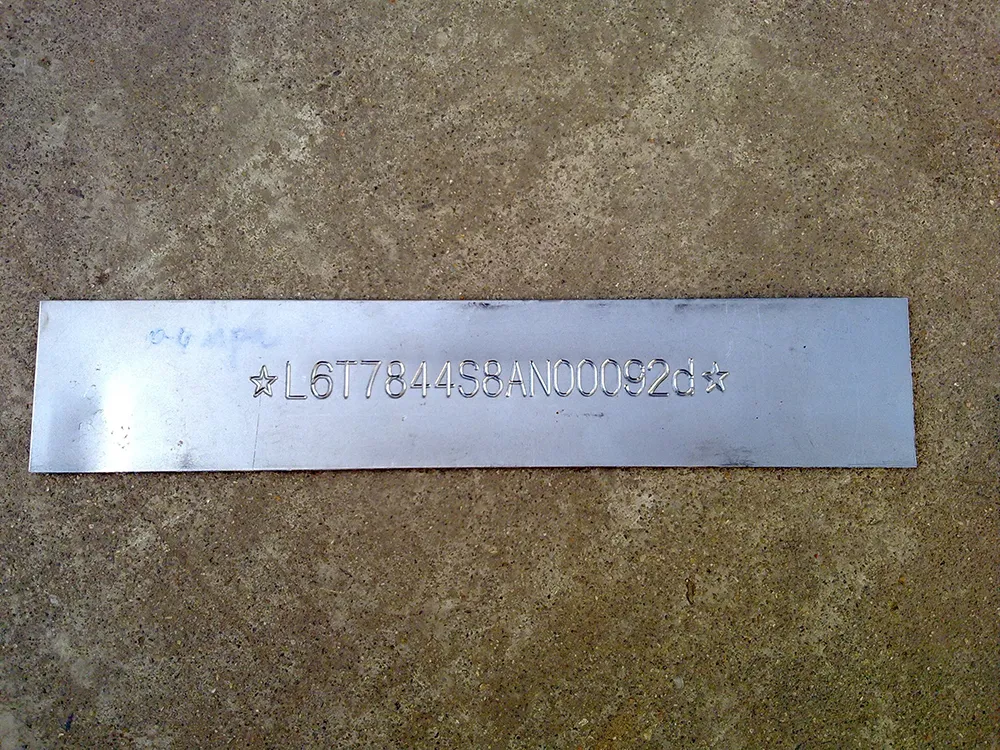
Hot formed steel parts typically reach strength levels far above those of conventional body panels. In the KINMARK deep laser marking system specification, the process is described as capable of permanent VIN deep marking on high-strength steel plates with yield strength exceeding 700 MPa and on hot-formed steel plates with strength up to 1500 MPa. At these strength levels, the material resists surface deformation, and a marking method that relies on shallow surface displacement may produce a mark that is visually present but insufficiently deep for downstream processes.
The second difficulty comes from the paint shop. After body-in-white marking, the component passes through pretreatment, e-coat, primer, and topcoat. Paint fills and covers the marked surface. If the mark is too shallow, the character edges become indistinct, and the rubbing or transfer operation used to verify the VIN may produce an unclear result. This is why the marking process must be evaluated not only on the bare steel surface but also after painting.
A third consideration is part geometry and presentation. Hot formed components are often produced as complex closed or semi-closed sections, and they may be presented to the marking station by robot, conveyor, or assisted manipulator. Marking position, focal distance, and part orientation must be controlled consistently to keep the mark within the specified area and depth.
Product Overview: Deep Laser Marking for High-Strength Steel
The KINMARK Deep Laser Marking Machine is a marking and traceability system developed for deep VIN marking on high-strength materials. It is positioned as a production-grade solution for automotive mass production, supporting robot integration and intelligent traceability. The system is designed to produce permanent marks on body-in-white and high-strength steel components where conventional marking depth is not sufficient.
The machine uses a 200W laser source and provides a marking area of 112 mm × 112 mm. The specified marking depth is ≥0.2 mm, which is the depth range typically required for VIN marking on body-in-white structures. The system operates on AC220V ±10%, 50Hz ±2%, with power consumption below 1000W. It is rated for an operating temperature of 0~40°C and a relative humidity of up to 90% RH without condensation.
Beyond the marking head itself, the product is offered with optional vision and inspection functions. An optional 3D vision guidance system supports precise positioning and accurate marking. An optional 3D laser scanning measurement and OCR recognition system provides online inspection of marking quality and supports 100% traceability. These options allow the marking station to function as both a marking operation and a quality gate.
Key specification summary: 200W laser power, 112 mm × 112 mm marking area, marking depth ≥0.2 mm, AC220V ±10% / 50Hz ±2% power supply, power consumption below 1000W, operating temperature 0~40°C, operating humidity ≤90% RH non-condensing.
Working Principle of Deep Laser Marking
Deep laser marking removes or displaces material from the component surface to a controlled depth rather than relying on a thin surface layer. The KINMARK system applies a special marking process so that the marked characters remain clearly readable after painting and rubbing. The process is designed around the requirements of high-strength steel, including hot formed steel up to 1500 MPa, where the mark must be deep enough to survive subsequent paint shop operations.
In an automated production cell, the marking head is mounted on a robot or assisted manipulator through defined mounting interfaces. The part is presented to the marking position, and the system marks the VIN or component code within the 112 mm × 112 mm marking area. When the optional 3D vision guidance system is used, the system performs precise positioning before marking to improve accuracy and production efficiency. After marking, the optional 3D laser scanning measurement and OCR recognition system can inspect character depth and readability online, confirming that the mark meets the required quality before the part leaves the station.
This combination of deep marking, optional vision guidance, and optional online inspection turns the marking operation into a closed-loop process. The mark is created, verified, and recorded within the production flow rather than being checked later in a separate inspection area.
Key Features
Deep VIN marking: Permanent VIN deep marking on high-strength steel plates with yield strength exceeding 700 MPa and hot-formed steel plates with strength up to 1500 MPa. Marking depth on body-in-white can reach more than 0.2 mm.
Easy rubbing: A special marking process ensures clear rubbing results after painting, supporting downstream VIN verification operations.
Easy integration: Various mounting interfaces allow the system to be quickly integrated with industrial robots or assisted manipulators for automated production lines.
Vision guidance: An optional 3D vision guidance system enables precise positioning and accurate marking to improve production efficiency.
Automatic traceability: Optional 3D laser scanning measurement and OCR recognition systems provide online inspection of marking quality and support 100% traceability.
Production-grade hardware: 200W laser power, 112 mm × 112 mm marking area, marking depth ≥0.2 mm, power consumption below 1000W, and operating range of 0~40°C at up to 90% RH non-condensing.
Applications in Automotive Manufacturing
Deep laser marking on hot formed steel components is used where permanent identification must survive painting and remain readable for the life of the vehicle. Typical application areas within automotive manufacturing include:
Body-in-white VIN marking: Permanent VIN marking on body structures, including areas made from high-strength and hot formed steel.
High-strength steel components: Marking of parts with yield strength exceeding 700 MPa where conventional marking depth is insufficient.
Hot formed steel components: Marking of hot-formed parts with strength up to 1500 MPa, such as safety-relevant body structures.
Automated marking cells: Robot-mounted or manipulator-assisted marking stations integrated into body assembly and component production lines.
Traceability-driven production: Lines where marking quality must be inspected online and linked to production records for 100% traceability.
These applications are relevant to automotive manufacturing, automotive components, new energy vehicles, powertrain manufacturing, and intelligent factory automation environments where permanent identification and process verification are required.
Benefits for Production and Quality Teams
The primary benefit of deep laser marking on hot formed steel is a permanent, readable mark that remains verifiable after painting. For production teams, this reduces the risk of rework or rejected parts caused by unclear or incomplete marks. For quality teams, the optional online inspection functions provide a way to confirm marking quality within the production flow rather than after the fact.
Integration flexibility is another practical benefit. Because the system is designed with various mounting interfaces, it can be combined with industrial robots or assisted manipulators, allowing the marking operation to be embedded into existing or new automated lines. The optional 3D vision guidance system supports precise positioning, which helps maintain marking accuracy when part presentation varies.
From a traceability perspective, the optional 3D laser scanning measurement and OCR recognition systems support online inspection and 100% traceability. This allows marking data to be connected to production records and quality documentation, which is important for automotive manufacturers that must maintain identification integrity across the vehicle lifecycle.
Why Choose KINMARK for Laser Marking on Hot Formed Steel
KINMARK has been engaged in marking and traceability systems since its founding period, beginning with marking equipment and expanding into automotive intelligent automation equipment. The company's product scope includes marking and traceability systems, servo press systems, fluid filling systems, and robot automation systems. This background is relevant to deep laser marking because the marking station is rarely a standalone machine; it is part of a larger production and traceability architecture.
The Deep Laser Marking Machine reflects this system-level approach. It combines a production-grade marking head with optional vision guidance and optional online inspection, allowing the marking operation to be integrated into automated lines and quality systems. The company provides installation and commissioning support, operator training, a 12-month warranty on the complete machine, and after-sales support including remote diagnosis and technical assistance.
For automotive manufacturers working with high-strength and hot formed steel, the relevant question is whether the marking process can deliver a permanent, readable, and traceable mark in mass production. KINMARK's deep laser marking system is designed around that requirement, with marking depth, integration interfaces, and optional traceability functions specified for high-strength steel applications.
Frequently Asked Questions
What marking depth can be achieved on hot formed steel components?
The KINMARK Deep Laser Marking Machine specifies a marking depth of ≥0.2 mm. The system is described as capable of permanent VIN deep marking on body-in-white, with marking depth on body-in-white reaching more than 0.2 mm. It supports high-strength steel plates with yield strength exceeding 700 MPa and hot-formed steel plates with strength up to 1500 MPa.
Will the mark remain readable after painting?
The system adopts a special marking process designed to ensure clear rubbing results after painting. This is intended to support downstream VIN verification, where the mark must remain legible after paint shop operations.
Can the marking system be integrated with robots?
Yes. The system is designed with various mounting interfaces and can be quickly integrated with industrial robots or assisted manipulators for automated production lines. An optional 3D vision guidance system is available for precise positioning and accurate marking.
How is marking quality verified?
An optional 3D laser scanning measurement and OCR recognition system provides online inspection of marking quality. This supports 100% traceability by verifying character depth and readability within the production flow.
What are the power and environmental requirements?
The system operates on AC220V ±10%, 50Hz ±2%, with power consumption below 1000W. The operating temperature range is 0~40°C, and the operating humidity is ≤90% RH non-condensing. The laser power is 200W and the marking area is 112 mm × 112 mm.
Conclusion
Laser marking on hot formed steel components requires a process that can produce a permanent mark in material with yield strength exceeding 700 MPa and hot-formed steel up to 1500 MPa, while keeping that mark readable after painting. The KINMARK Deep Laser Marking Machine addresses this requirement with a 200W laser source, a 112 mm × 112 mm marking area, and a specified marking depth of ≥0.2 mm on body-in-white.
For automotive production lines, the value of the system extends beyond the mark itself. Optional 3D vision guidance supports precise positioning, and optional 3D laser scanning measurement with OCR recognition supports online inspection and 100% traceability. Combined with robot and manipulator integration interfaces, these functions allow deep laser marking to be embedded into automated manufacturing and quality workflows. Manufacturers working with high-strength and hot formed steel can use this approach to maintain identification integrity from body-in-white through final assembly.
If you're interested in any of the equipment mentioned in this article, feel free to contact our sales engineers for detailed product information and customized technical solutions.