
Refrigerant Vacuum Charging System for Automotive Manufacturing
Introduction
In automotive manufacturing, the accuracy and reliability of fluid filling operations directly affect vehicle performance and production efficiency. Coolant and antifreeze systems are critical to engine thermal management, and any inconsistency in filling volume or liquid level can lead to quality issues on the assembly line. A refrigerant vacuum charging system, also known as an automotive vacuum filling machine, is designed to automate the coolant filling process while ensuring system tightness through integrated leak testing.
This article provides a detailed product guide to the Antifreeze Vacuum Filling Machine, covering its working principle, key features, applications, and benefits for automotive production. It is intended for manufacturing engineers, production managers, and purchasing professionals who need to evaluate vacuum filling equipment for automotive assembly lines.
Product Overview
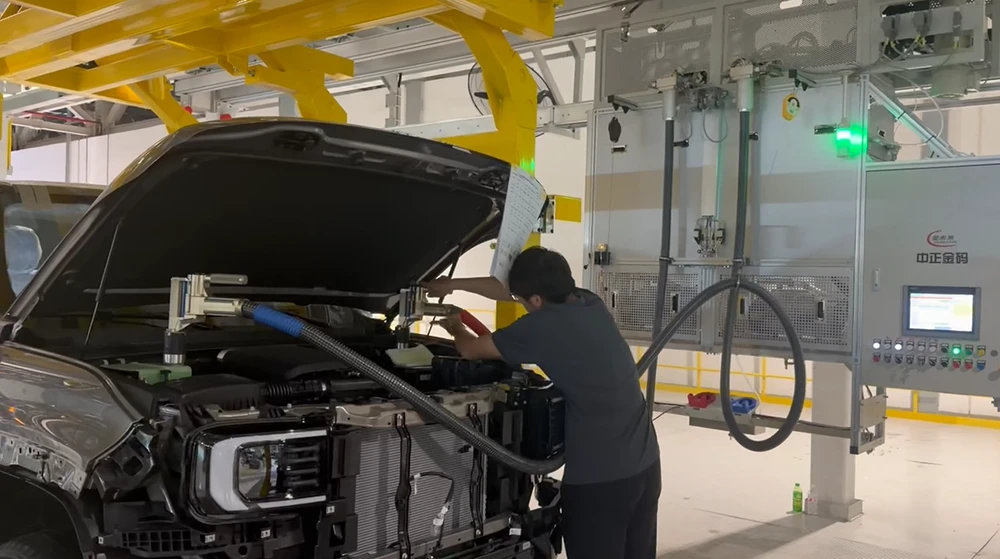
The Antifreeze Vacuum Filling Machine is a PLC-controlled system designed for automated vacuum filling and leak testing of coolant and antifreeze in automotive manufacturing. It performs a complete cycle that includes vacuum evacuation, leak testing under vacuum and pressure conditions, secondary vacuum creation, pressure filling, and back suction to achieve a stable liquid level.
This machine is suitable for automotive production and assembly lines where precise coolant filling and system tightness verification are required. It addresses common industrial challenges such as inconsistent filling volumes, coolant level drop after filling, and the need for reliable leak detection before vehicles leave the production line.
Working Principle
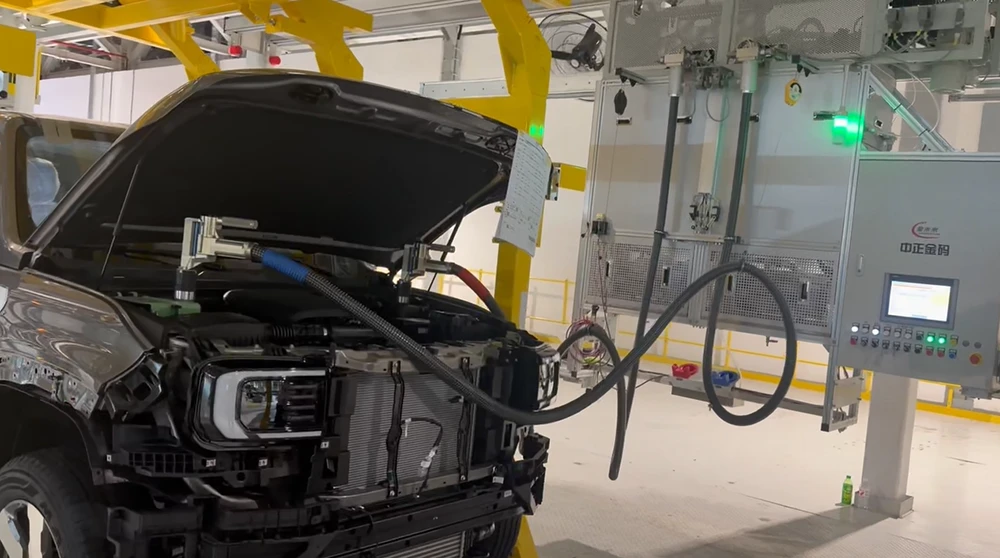
The refrigerant vacuum charging system operates through a sequence of controlled stages. First, the system performs vacuum evacuation to remove air and moisture from the coolant circuit. This is followed by leak testing under vacuum and pressure conditions to confirm system tightness. After the system passes the leak test, a secondary vacuum is created before the coolant is introduced under controlled pressure.
Once the filling pressure reaches equilibrium, the system automatically vents to atmospheric pressure and performs back suction to remove excess coolant. This back suction step helps achieve the specified liquid level and prevents the coolant level from dropping after filling. The entire cycle is managed by a PLC, ensuring repeatability and integration with automated production lines.
Key Features
PLC-controlled automation: Automates the complete coolant filling process, including vacuum evacuation, leak testing, pressure filling, and back suction.
Integrated leak testing: Performs leak testing under vacuum and pressure conditions with a negative pressure leak rate of ≤0.5 mbar / 60 s and positive pressure leakage of<1.4 g/year.
Precise filling: Filling precision of ±0.5% and liquid level accuracy of ±2 mm ensure consistent coolant volume.
Stable liquid level: Back suction after filling removes excess coolant and prevents level drop.
Wide filling volume range: Supports filling volumes from 1 to 400 L, suitable for various vehicle and component requirements.
High filling speed: Maximum filling speed of 60 L/min supports efficient production line operation.
Customizable dimensions: Equipment dimensions of 1800 × 1000 × 800 mm can be customized to fit specific line layouts.
Technical Specifications
| Parameter | Specification |
|---|---|
| Filling Medium | Antifreeze / Coolant |
| Filling Volume | 1–400 L |
| Filling Pressure | 1–4 bar |
| Maximum Filling Speed | 60 L/min |
| Filling Precision | ±0.5% |
| Liquid Level Accuracy | ±2 mm |
| Measurement Display Range | 0.0–999.9 L |
| Vacuum Pump Capacity | 40–65 m³/h |
| Negative Pressure Leak Rate | ≤0.5 mbar / 60 s |
| Positive Pressure Leakage | <1.4 g/year |
| Power Supply | AC 380 V ±10%, 50 Hz ±2% |
| Equipment Dimensions | 1800 × 1000 × 800 mm (customizable) |
Applications
The Antifreeze Vacuum Filling Machine is designed for automated coolant and antifreeze filling applications on automotive production and assembly lines. It is suitable for:
Automotive manufacturing – engine coolant filling at the end of assembly.
Automotive components – filling of coolant circuits in components and subassemblies.
New energy vehicles – thermal management system filling where precise coolant volume is required.
Powertrain manufacturing – coolant filling for engines and transmissions.
Intelligent factory automation – integration into automated production lines with PLC control.
The system can be integrated into existing assembly lines and is adaptable to different vehicle models through customizable equipment dimensions.
Benefits
Improved traceability: PLC-controlled process records filling and leak test results for quality documentation.
Better process consistency: Automated sequence reduces operator variability and ensures repeatable filling results.
Reliable leak detection: Integrated vacuum and pressure leak testing helps identify system tightness issues before vehicles leave the line.
Stable liquid level: Back suction function prevents coolant level drop after filling, reducing rework.
Production integration: Designed for automated assembly lines, supporting efficient workflow.
Quality management: Precise filling and leak testing contribute to overall vehicle quality and reliability.
Why Choose KINMARK
KINMARK (Jinan Zhongzheng Jinma Technology Co., Ltd.) has been engaged in automotive intelligent automation equipment since 1996. The company develops and manufactures marking and traceability systems, servo press systems, fluid filling systems, and robot automation systems. Its fluid filling systems include the Antifreeze Vacuum Filling Machine, which is designed for precise coolant filling and leak testing on automotive production lines.
KINMARK serves the automotive manufacturing, automotive components, new energy vehicles, powertrain manufacturing, and intelligent factory automation sectors. The company has established long-term cooperation with automotive manufacturers and suppliers. Its product development includes VIN laser deep marking systems, robot automatic marking systems, and various fluid filling equipment. KINMARK provides a 12-month warranty on the complete machine, fast response service with remote diagnosis, and installation and commissioning support with operator training.
Frequently Asked Questions
What is the filling precision of the Antifreeze Vacuum Filling Machine?
The filling precision is ±0.5%, and the liquid level accuracy is ±2 mm, ensuring consistent coolant filling for automotive applications.
What is the maximum filling speed?
The maximum filling speed is 60 L/min, which supports efficient production line operation.
Does the machine perform leak testing?
Yes. The system performs leak testing under vacuum and pressure conditions. The negative pressure leak rate is ≤0.5 mbar / 60 s, and positive pressure leakage is<1.4 g/year.
What is the filling volume range?
The filling volume range is 1–400 L, suitable for a variety of automotive coolant filling requirements.
Is the equipment customizable?
Yes. The standard equipment dimensions are 1800 × 1000 × 800 mm, and dimensions can be customized to fit specific production line layouts.
Conclusion
The Antifreeze Vacuum Filling Machine is a PLC-controlled refrigerant vacuum charging system designed for precise coolant and antifreeze filling with stable liquid level in automotive manufacturing. By integrating vacuum evacuation, leak testing, pressure filling, and back suction, it addresses common filling quality issues and supports automated production lines. For automotive engineers and production managers evaluating fluid filling equipment, this system offers a reliable solution for coolant filling and leak testing applications.
If you're interested in any of the equipment mentioned in this article, feel free to contact our sales engineers for detailed product information and customized technical solutions.