
Why Position Accuracy Matters in Precision Press Fitting
Introduction
In precision press fitting, the final quality of an assembly is determined by how force and displacement interact during every cycle. Position accuracy is the foundation of that interaction. When a servo press cannot control or measure ram position reliably, the resulting press-fit depth, interference condition and component stress can vary from part to part, even when the commanded force appears correct.
For automotive engineers and production managers, position accuracy is not simply a catalog number. It affects how a pressing process is designed, monitored and evaluated. It determines whether a press-fit operation can be repeated consistently, whether process deviations can be detected in real time, and whether assembly data can be traced back to a specific vehicle or component.
This technical guide explains the role of position accuracy in precision press fitting, how a servo press fitting system uses force and displacement data, and what manufacturing teams should consider when specifying equipment for automotive assembly and component production.
Product Overview
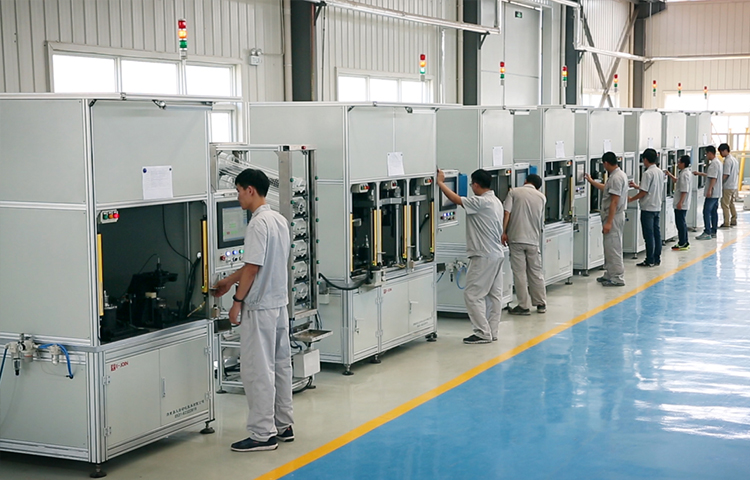
The N-Series Servo Press Fitting System is a high-precision CNC press unit designed for automated assembly and manufacturing applications. It integrates servo motion control, force and displacement measurement, process monitoring and production data management. The system is intended for precision assembly in automotive manufacturing and industrial production lines.
The product is available in multiple force configurations, ranging from 2 kN to 350 kN. Position accuracy is specified at 0.01 mm, and force accuracy is up to 1% FS. These characteristics make the system relevant to press fitting and component assembly tasks where the relationship between ram position and applied force must be controlled and recorded.
The servo press fitting system is built around a modular architecture that includes a servo electric cylinder, industrial software, a control box, a monitoring instrument and a cable module. This modular design allows the system to be integrated into automated assembly equipment and automotive production lines.
Working Principle
A servo press fitting system controls the movement of a press ram through a servo electric cylinder. During a pressing cycle, the system continuously measures force and displacement. The integrated pressure sensor provides force measurement, while position feedback supports displacement-controlled and force-controlled pressing modes.
The system can operate in several control modes, including force-controlled pressing, displacement-controlled pressing and external signal-based control. In force-controlled pressing, the system applies force until a target condition is reached. In displacement-controlled pressing, the ram moves to a defined position. The appropriate mode depends on the assembly requirements and the evaluation method used for the process.
Process data is captured throughout the cycle. The E-Press industrial software displays real-time force-displacement and force-time curves, allowing operators to observe the pressing condition as it develops. The system supports multiple pressing steps and process curves, and it can evaluate results using judgment windows, envelope curves and measurement analysis.
Measurement data and assembly results can interact with PLCs and production servers. This supports process data recording and traceability, which is important in automotive assembly environments where each pressing operation may need to be linked to a specific component or production record.
Why Position Accuracy Matters
Position accuracy defines how closely the actual ram position matches the intended position during pressing. In precision press fitting, small position deviations can change the way components interact. A bearing, bushing, pin or other component may be pressed to a different depth than intended, which can affect fit, seating and the force required to complete the operation.
When position accuracy is insufficient, the press may still reach a force target, but the resulting assembly may not meet the intended displacement condition. This can lead to inconsistent press-fit results, additional inspection requirements or rework. In high-cycle automated assembly, these effects can accumulate across many parts and affect overall process stability.
Position accuracy also supports meaningful process evaluation. Judgment windows and envelope curves compare the actual force-displacement curve against an expected process window. If position measurement is not reliable, the evaluation may not reflect the true assembly condition. Accurate position data helps the system distinguish between normal process variation and a genuine deviation.
In automotive manufacturing, traceability requirements add another dimension. When pressing data is recorded, position accuracy contributes to the usefulness of that data. A recorded curve is only as valuable as the measurement accuracy behind it. For production managers and quality engineers, reliable position data supports informed decisions about process capability and component quality.
Key Features
The N-Series Servo Press Fitting System includes features that support precision press fitting and process control:
High-precision servo motion control with position accuracy up to 0.01 mm
Force accuracy up to 1% FS
Integrated force and displacement detection
Real-time monitoring of pressing conditions throughout the assembly process
Force-controlled pressing, displacement-controlled pressing and external signal-based control
100% process monitoring for each pressing cycle
Process data traceability through interaction with PLCs and production servers
Built-in evaluation functions including judgment windows, envelope curves and measurement analysis
Multiple force configurations from 2 kN to 350 kN
Modular system architecture with servo electric cylinder, industrial software, control box, monitoring instrument and cable module
E-Press industrial software with real-time force-displacement and force-time curve display
Support for multiple pressing steps and process curves
Measurement and OK/NG result evaluation
Hierarchical user permission management
Press fitting history and operation logs
Alarm log management
Support for MS SQL and Microsoft Access databases
Fieldbus communication via OPC, EtherNet/IP and PROFINET
Protection rating IP54
Service life greater than 12 million cycles
Sampling frequency 20 kHz and acquisition accuracy 24 bit
Technical Specifications
The N-Series is available in multiple force configurations. The table below summarizes the main specifications by model.
| Model | Stroke (mm) | Maximum Pressure (kN) | Running Speed (mm/s) | Force Accuracy | Position Accuracy (mm) |
|---|---|---|---|---|---|
| 2KN | 100-200 | 2 | 0.02-260 | 1%FS | 0.01 |
| 5KN | 100-200 | 5 | 0.02-260 | 1%FS | 0.01 |
| 10KN | 100-400 | 10 | 0.02-250 | 1%FS | 0.01 |
| 20KN | 100-400 | 20 | 0.02-125 | 1%FS | 0.01 |
| 30KN | 200-400 | 30 | 0.02-200 | 1%FS | 0.01 |
| 50KN | 200-400 | 50 | 0.02-200 | 1%FS | 0.01 |
| 80KN | 300-400 | 80 | 0.02-160 | 1%FS | 0.01 |
| 100KN | 300-400 | 100 | 0.02-140 | 1%FS | 0.01 |
| 150KN | 200-400 | 150 | 0.02-140 | 1%FS | 0.01 |
| 200KN | 200-400 | 200 | 0.02-100 | 1%FS | 0.01 |
| 350KN | 200-400 | 350 | 0.02-50 | 1%FS | 0.01 |
General parameters include position accuracy ≤ 0.01 mm, force control accuracy ≤ 1% FS, maximum pressure holding time 3 s, noise < 75 dB, sampling frequency 20 kHz, acquisition accuracy 24 bit, service life > 12 million cycles, protection rating IP54, and fieldbus communication via OPC, EtherNet/IP and PROFINET. Rated power ranges from 0.2 to 14.5 kW at 50/60 Hz. Rated voltage options include single-phase 220 V, three-phase 220 V or three-phase 380 V depending on the model. The operating environment is 0–50°C with 10–90% RH non-condensing. Supported languages are Chinese and English, and output formats include CSV and XLS.
Applications
The N-Series Servo Press Fitting System is suitable for a range of pressing and assembly operations. Supported applications include press fitting and component assembly, automotive component assembly, forming and riveting, punching operations, elasticity and performance testing, and high-cycle automated assembly.
In automotive manufacturing, the system can be integrated into assembly lines that require controlled pressing force and displacement. The modular architecture allows integration with PLCs, industrial control systems and production servers. This makes the system relevant to production environments where process monitoring, quality control and data traceability are part of the assembly strategy. For different equipment layouts, press fitting workstations can provide an integrated production solution.
The availability of multiple force configurations supports different assembly requirements, from low-force precision assembly to high-force industrial pressing. Production teams can select a configuration that matches the force and stroke requirements of the application, while using the same software environment for programming, monitoring and evaluation.
Benefits
Precision press fitting with reliable position accuracy offers several practical benefits for manufacturing operations:
Consistent assembly results: Servo motion control and position accuracy support repeatable pressing conditions across production cycles.
Real-time process visibility: Force-displacement and force-time curves allow operators to observe each pressing cycle as it happens.
Process deviation detection: 100% process monitoring helps identify deviations during the pressing cycle rather than after assembly.
Traceability: Measurement data and assembly results can interact with PLCs and production servers, supporting process data recording.
Flexible integration: The modular system architecture and fieldbus communication options support integration into automated assembly equipment.
Evaluation capability: Judgment windows, envelope curves and measurement analysis provide tools for assessing pressing results.
Production data management: History, operation logs and alarm logs support production monitoring and quality management.
Why Choose KINMARK
KINMARK is a manufacturer of marking and traceability systems, servo press systems, fluid filling systems and robot automation systems. The company serves automotive manufacturing, automotive components, new energy vehicles, powertrain manufacturing and intelligent factory automation. Its product development is focused on intelligent automated equipment for automotive production.
The N-Series Servo Press Fitting System reflects this focus by combining servo motion control, force and displacement measurement, process monitoring and data management in a modular system. For manufacturing engineers and purchasing managers evaluating press fitting equipment, the system provides a configurable platform with multiple force ratings and a software environment for process programming, monitoring and evaluation. Buyers can also explore the wider range of servo press fitting systems for other force and application requirements.
KINMARK provides a 12-month warranty for the complete machine, along with professional technical support and long-term maintenance service. The company also offers installation and commissioning support, including equipment installation, commissioning and operator training. These services are intended to help customers integrate the servo press system into production and begin operation smoothly.
Frequently Asked Questions
What does position accuracy mean in a servo press fitting system?
Position accuracy refers to how closely the press ram reaches the intended position during a pressing cycle. In the N-Series Servo Press Fitting System, position accuracy is specified at 0.01 mm. This accuracy supports displacement-controlled pressing and helps the system evaluate force-displacement curves against defined process windows.
How does the system monitor press fitting quality?
The system integrates force and displacement detection and monitors each pressing cycle in real time. The E-Press industrial software displays force-displacement and force-time curves and supports evaluation functions such as judgment windows, envelope curves and measurement analysis. Measurement and OK/NG results can be evaluated, and data can interact with PLCs and production servers for traceability.
Which force configurations are available?
The N-Series is available in multiple force configurations from 2 kN to 350 kN. Each configuration has defined stroke, running speed, force accuracy and position accuracy specifications. The appropriate configuration depends on the force and stroke requirements of the pressing application.
Can the servo press system be integrated into an existing production line?
The system uses a modular architecture that includes a servo electric cylinder, industrial software, control box, monitoring instrument and cable module. It supports fieldbus communication via OPC, EtherNet/IP and PROFINET, and can interact with PLCs, industrial control systems and production servers. This design supports integration into automated assembly equipment and automotive production lines. Depending on the equipment design, press fitting functional modules can also be considered for system integration.
What support is available after installation?
KINMARK provides a 12-month warranty for the complete machine, professional technical support and long-term maintenance service. Installation and commissioning support includes equipment installation, commissioning and operator training. Remote diagnosis and technical assistance are also available to support continuous operation.
Conclusion
Position accuracy is a fundamental requirement in precision press fitting. It influences how force and displacement interact during each cycle, how process deviations are detected, and how assembly data can be used for traceability. In automotive assembly and component manufacturing, these factors are directly connected to process consistency and quality management.
The N-Series Servo Press Fitting System combines servo motion control, force and displacement measurement, real-time process monitoring and data management in a modular platform. With position accuracy up to 0.01 mm, force accuracy up to 1% FS and multiple force configurations from 2 kN to 350 kN, the system is designed to support precision press fitting across a range of automated assembly applications. For engineering and production teams evaluating press fitting equipment, understanding the role of position accuracy is an important step toward selecting a system that matches the technical and traceability requirements of the application.
If you're interested in any of the equipment mentioned in this article, feel free to contact our sales engineers for detailed product information and customized technical solutions.