
Custom Automotive Coolant Filling Machines for Production Requirements
Introduction
Coolant and antifreeze filling is a critical process in automotive assembly and powertrain manufacturing. Incorrect fill levels, trapped air, or undetected leaks can lead to engine overheating, warranty claims, and rework on the line. A custom automotive coolant filling machine addresses these challenges by combining vacuum evacuation, leak testing, pressure filling, and back suction into a single automated cycle.
This article explains how vacuum-based coolant filling works, what technical capabilities are available, and how the equipment can be adapted to different production requirements. It is written for manufacturing engineers, production managers, and purchasing teams evaluating filling solutions for automotive assembly lines.
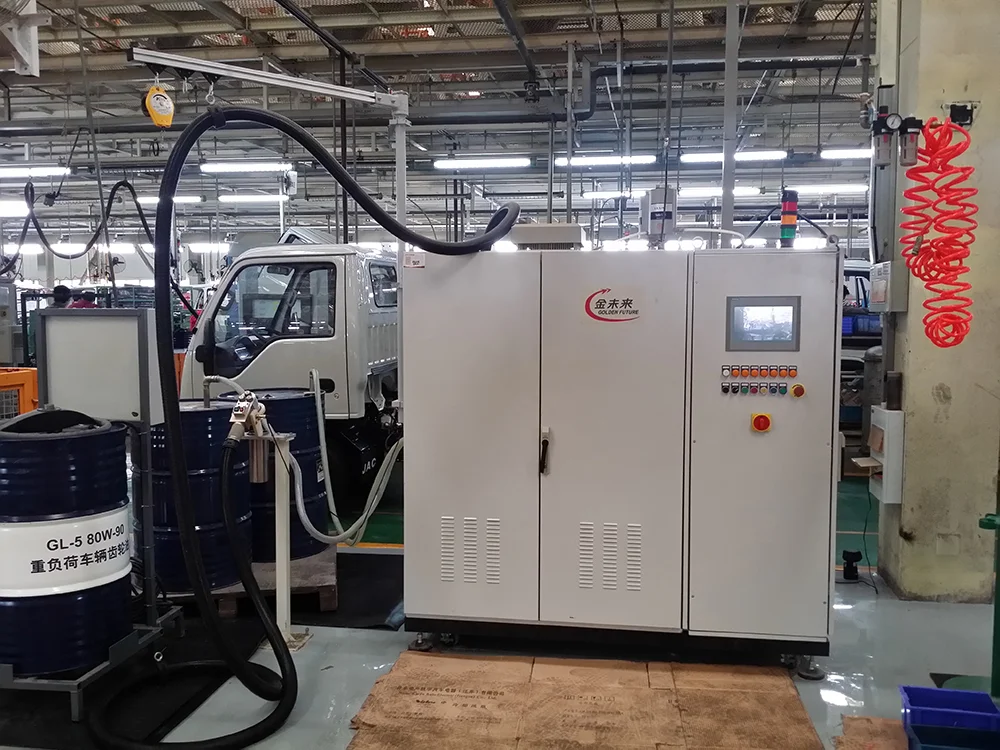
Product Overview
The Antifreeze Vacuum Filling Machine is a PLC-controlled system designed for automated coolant and antifreeze filling. It performs vacuum evacuation, leak testing under vacuum and pressure conditions, pressure filling, and back suction in a continuous sequence. The machine is intended for automotive production and assembly line environments where consistent fill quality and stable liquid levels are required.
The system is suitable for filling volumes from 1 to 400 L, making it adaptable to different vehicle and component configurations. Because the filling process is automated and controlled, it reduces dependence on manual judgment and helps maintain repeatable results across production shifts.
Working Principle
The filling cycle follows a defined sequence controlled by the PLC system:
Vacuum evacuation: The system first evacuates air from the cooling circuit to create a controlled vacuum environment.
Leak testing: The system checks for leaks under both vacuum and pressure conditions. The negative pressure leak rate specification is ≤0.5 mbar / 60 s, and positive pressure leakage is specified at <1.4 g/year.
Secondary vacuum: After confirming system tightness, a secondary vacuum is created before coolant is introduced.
Pressure filling: Coolant is introduced under controlled pressure within the 1–4 bar range.
Venting and back suction: Once filling pressure reaches equilibrium, the system automatically vents to atmospheric pressure and performs back suction to remove excess coolant. This helps achieve the specified liquid level and prevents the coolant level from dropping after filling.
This integrated cycle supports consistent filling results and reduces the risk of air pockets or overfill in the cooling system. KINMARK provides different vacuum filling machines for industrial and automotive filling applications.
Key Features
PLC-controlled automation: The complete filling cycle is managed by a PLC system, supporting repeatable and controlled operation.
Integrated leak testing: Vacuum and pressure leak testing are performed within the filling cycle, helping identify system tightness issues before production continues.
Back suction for stable liquid level: Excess coolant is removed after filling to help achieve the specified liquid level and prevent level drop after filling.
Wide filling volume range: Supports filling volumes from 1 to 400 L.
Controlled filling pressure: Filling pressure is adjustable within the 1–4 bar range.
Filling precision: The specified filling precision is ±0.5%, with liquid level accuracy of ±2 mm.
Measurement display: The measurement display range covers 0.0–999.9 L.
Vacuum pump capacity: Available with vacuum pump capacity of 40–65 m³/h.
Customizable dimensions: Equipment dimensions are 1800 × 1000 × 800 mm and can be customized.
Applications
The Antifreeze Vacuum Filling Machine is designed for automated coolant and antifreeze filling on automotive production and assembly lines. Typical application areas include:
Automotive manufacturing and final assembly
Powertrain manufacturing and engine assembly
New energy vehicle thermal management systems
Automotive component production
The system can be configured for different filling volumes and production requirements, making it suitable for both passenger vehicle and commercial vehicle assembly environments. It can also be used in new energy vehicle thermal management systems where controlled coolant filling is required.
Benefits
Consistent fill quality: Automated vacuum filling and back suction help maintain stable liquid levels and reduce variation between vehicles.
Integrated leak detection: Performing leak testing within the filling cycle helps identify tightness issues before the vehicle moves to the next station.
Reduced manual intervention: PLC-controlled operation supports repeatable results and reduces dependence on operator judgment.
Production line integration: The machine is designed for automated filling applications on assembly lines.
Flexible configuration: Filling volume, pressure, and equipment dimensions can be adapted to specific production requirements.
Why Choose KINMARK
KINMARK has been engaged in automotive intelligent automation equipment since 1996, with product lines covering marking and traceability systems, servo press systems, fluid filling systems, and robot automation systems. The company serves automotive manufacturing, powertrain, automotive components, new energy vehicles, and intelligent factory automation applications.
For coolant filling applications, KINMARK offers:
PLC-controlled vacuum filling and leak testing technology
Customizable equipment dimensions and filling parameters
Installation, commissioning, and operator training provided by engineers
12-month warranty with professional technical support and long-term maintenance service
Fast response service including remote diagnosis and technical assistance
Explore KINMARK's fluid filling solutions for automotive assembly and industrial production applications.
Note: Filling volume, pressure, and equipment dimensions can be customized to match specific production line requirements. Contact KINMARK to discuss your application.
Frequently Asked Questions
What is the filling volume range of the Antifreeze Vacuum Filling Machine?
The machine supports filling volumes from 1 to 400 L, with a measurement display range of 0.0–999.9 L.
How does the machine ensure a stable coolant level after filling?
After filling pressure reaches equilibrium, the system automatically vents to atmospheric pressure and performs back suction to remove excess coolant. This helps achieve the specified liquid level and prevents the coolant level from dropping after filling.
What leak testing capabilities does the system include?
The system performs leak testing under both vacuum and pressure conditions. The negative pressure leak rate specification is ≤0.5 mbar / 60 s, and positive pressure leakage is specified at <1.4 g/year.
Can the machine be customized for different production lines?
Yes. Equipment dimensions are 1800 × 1000 × 800 mm and can be customized. Filling volume and pressure parameters can also be adapted to specific production requirements.
What support is provided after installation?
KINMARK provides installation, commissioning, and operator training. The complete machine is covered by a 12-month warranty, with professional technical support and long-term maintenance service. Fast response service including remote diagnosis and technical assistance is also available.
Conclusion
Custom automotive coolant filling machines combine vacuum evacuation, leak testing, pressure filling, and back suction into a single automated cycle. This integrated approach supports consistent fill quality, stable liquid levels, and production line efficiency. For automotive manufacturers and powertrain producers evaluating coolant filling solutions, the Antifreeze Vacuum Filling Machine offers a PLC-controlled, customizable platform that can be adapted to specific production requirements.
If you're interested in any of the equipment mentioned in this article, feel free to contact our sales engineers for detailed product information and customized technical solutions.