Laser Marking vs Traditional Marking Methods
Introduction
Permanent identification is a core requirement in automotive manufacturing. Vehicle Identification Numbers (VINs), component serial numbers, and production codes must remain readable for the entire life of the vehicle, often under paint, coatings, and years of exposure. The method used to apply these marks directly affects traceability, regulatory compliance, and production line efficiency.
Traditional marking methods such as stamping, dot peen, and electrochemical etching have been used for decades. Laser marking, particularly deep laser marking, has emerged as an alternative for high-strength steel and body-in-white applications. This article compares laser marking and traditional marking methods in terms of marking depth, material compatibility, traceability, and integration with automated production lines. The goal is to help engineers and production managers evaluate which method fits their specific marking requirements.
Product Overview: Deep Laser Marking for Automotive Identification
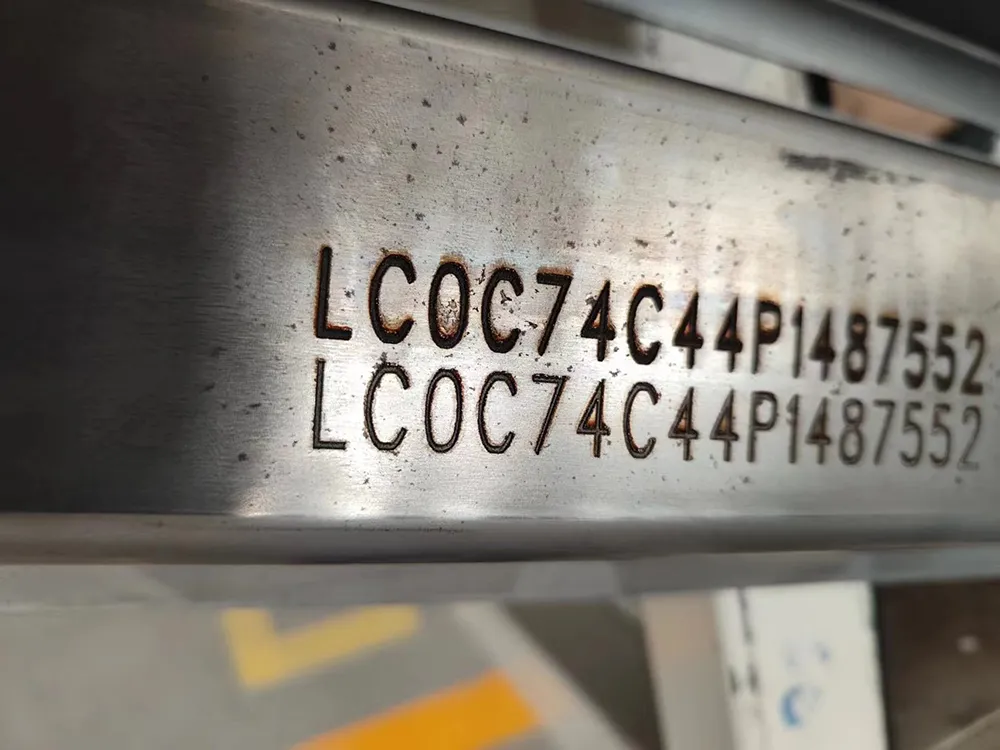
KINMARK Deep Laser Marking Machine is designed for permanent VIN deep marking on high-strength steel plates. The system can mark on materials with yield strength exceeding 700 MPa and hot-formed steel plates with strength up to 1500 MPa. On body-in-white, the marking depth can reach more than 0.2 mm.
The machine uses a special marking process that ensures clear rubbing results after painting. It is designed with various mounting interfaces for quick integration with industrial robots or assisted manipulators. Optional 3D vision guidance enables precise positioning, while optional 3D laser scanning measurement and OCR recognition systems provide online inspection of marking quality and support 100% traceability.
Technical specifications include:
| Power Supply | AC220V ±10%, 50Hz ±2% |
| Power Consumption | <1000W |
| Laser Power | 200W |
| Marking Area | 112mm × 112mm |
| Marking Depth | ≥0.2mm |
| Operating Temperature | 0~40℃ |
| Operating Humidity | ≤90% RH (Non-condensing) |
Working Principle of Deep Laser Marking
Deep laser marking uses a focused laser beam to remove or displace material from the surface, creating a permanent mark with measurable depth. The process is controlled by a laser source and scanning system that directs the beam according to the programmed pattern. For VIN marking on high-strength steel, the laser power and focusing parameters are adjusted to achieve the required depth without compromising the material structure.
Unlike surface marking, which only changes color or appearance, deep laser marking creates a physical indentation. This depth allows the mark to remain legible after painting and rubbing, which is critical for VIN verification during vehicle registration and inspection.
Traditional Marking Methods: An Overview
Traditional marking methods include mechanical stamping, dot peen marking, and electrochemical etching. Each method has distinct characteristics:
Stamping: A die is pressed into the material to form characters or codes. It produces deep marks but requires dedicated tooling for each character set and can be difficult to automate for variable data.
Dot peen marking: A carbide or diamond stylus impacts the surface to create a series of dots. It is flexible for variable data and can be integrated into automated lines, but marking depth on high-strength steel may be limited. Industrial dot peen marking machines are commonly used for permanent identification on metal components.
Electrochemical etching: Uses a stencil and electrolyte to create marks through a chemical reaction. It is suitable for flat surfaces and thin materials but typically produces shallow marks that may not survive painting or harsh environments.
Key Comparison Factors
Marking Depth and Durability
Deep laser marking can achieve a depth of ≥0.2 mm on body-in-white, which is sufficient to remain readable after painting. Traditional stamping can also produce deep marks, but dot peen and electrochemical etching typically produce shallower marks. On high-strength steel with yield strength above 700 MPa, achieving consistent depth is more challenging for mechanical methods due to material hardness and springback.
Material Compatibility
Laser marking is effective on a range of metals, including high-strength steel and hot-formed steel up to 1500 MPa. Traditional stamping may require higher tonnage and more robust tooling for these materials. Dot peen marking can mark hard materials but may experience stylus wear. Electrochemical etching is generally limited to conductive materials and may not be suitable for very hard or coated surfaces.
Traceability and Data Integration
Laser marking systems can be integrated with production databases and vision systems. Optional 3D laser scanning measurement and OCR recognition provide online inspection and 100% traceability. Traditional methods can also be integrated with data systems, but variable data marking with stamping requires complex tooling changes, and dot peen may require additional verification steps.
Automation and Integration
Deep laser marking machines are designed with mounting interfaces for quick integration with industrial robots or assisted manipulators. This makes them suitable for automated production lines. Traditional stamping is often a standalone operation, while dot peen marking can be automated but may have slower cycle times on hard materials. Electrochemical etching is typically a manual or semi-automated process.
Operating Costs and Maintenance
Laser marking systems have no consumable tooling for the marking process itself, although the laser source has a finite life. Traditional stamping requires periodic die replacement or refurbishment. Dot peen marking requires stylus replacement. Electrochemical etching consumes electrolytes and stencils. The total cost of ownership depends on production volume, material, and integration requirements.
Applications in Automotive Manufacturing
Deep laser marking is particularly relevant for VIN marking on body-in-white and high-strength steel components. It is also used for marking engine blocks, transmission cases, and other powertrain components where permanent identification is required. The ability to mark variable data without tooling changes makes it suitable for flexible production lines producing multiple models. KINMARK provides different marking machine solutions for automotive manufacturing applications.
Traditional marking methods remain in use for applications where marking depth requirements are less stringent, or where the material is more compatible with mechanical or chemical marking. For example, electrochemical etching is often used for marking aluminum or stainless steel components with flat surfaces.
Benefits of Deep Laser Marking
Permanent identification: Depth ≥0.2 mm ensures marks remain readable after painting and rubbing.
Material versatility: Effective on high-strength steel and hot-formed steel up to 1500 MPa.
Integration flexibility: Various mounting interfaces for robot or manipulator integration.
Traceability support: Optional 3D vision guidance and OCR recognition for online inspection.
No tooling for variable data: Programmable marking patterns eliminate the need for dedicated dies or stencils.
Why Choose KINMARK Deep Laser Marking Machine
KINMARK has been developing marking and traceability systems for automotive manufacturing since 1997. The company's Deep Laser Marking Machine is designed to meet the requirements of high-strength steel VIN marking, with a focus on integration and traceability. KINMARK provides installation, commissioning, and operator training, along with a 12-month warranty and after-sales support. The system is part of KINMARK's broader portfolio of marking, servo press, fluid filling, and robot automation systems for automotive production.
Note: The comparison in this article is based on general characteristics of marking methods and the specifications of KINMARK Deep Laser Marking Machine. Actual performance depends on material, marking pattern, and production conditions.
Frequently Asked Questions
What is the difference between laser marking and traditional marking?
Laser marking uses a focused laser beam to create permanent marks, often with measurable depth. Traditional marking includes mechanical stamping, dot peen, and electrochemical etching, which rely on physical impact or chemical reaction. Laser marking offers flexibility for variable data and can achieve deep marks on high-strength steel.
Can laser marking achieve the same depth as stamping?
Deep laser marking can achieve a depth of ≥0.2 mm on body-in-white, which is sufficient for VIN marking after painting. Stamping can also produce deep marks, but it requires dedicated tooling and may be less flexible for variable data.
Is laser marking suitable for high-strength steel?
Yes. KINMARK Deep Laser Marking Machine is designed for high-strength steel plates with yield strength exceeding 700 MPa and hot-formed steel plates up to 1500 MPa.
How does laser marking support traceability?
Optional 3D laser scanning measurement and OCR recognition systems provide online inspection of marking quality, enabling 100% traceability. The system can also be integrated with production databases.
Can laser marking be integrated into an automated production line?
Yes. The machine is designed with various mounting interfaces for quick integration with industrial robots or assisted manipulators, making it suitable for automated production lines.
Conclusion
Laser marking and traditional marking methods each have a place in automotive manufacturing. Traditional methods like stamping and dot peen are established and may be suitable for certain applications. However, for deep, permanent marking on high-strength steel and body-in-white, laser marking offers advantages in depth control, material compatibility, and integration with automated traceability systems. When evaluating marking methods, engineers should consider material type, required depth, production volume, and traceability requirements. KINMARK Deep Laser Marking Machine provides a solution for VIN deep marking on high-strength materials, with options for vision guidance and OCR inspection to support intelligent factory automation.
If you're interested in any of the equipment mentioned in this article, feel free to contact our sales engineers for detailed product information and customized technical solutions.