Why Use Laser Marking for Flexible Labels?
Introduction
Flexible film labels are used throughout automotive manufacturing to carry identification data on components, sub-assemblies, and finished vehicles. These labels must survive handling, storage, and long service life while keeping characters, graphics, 1D barcodes, and 2D codes readable. Conventional label printing methods can struggle with flexible film substrates, particularly when the label must remain legible for years and support traceability requirements.
Laser marking for flexible labels addresses this problem directly. A fiber laser marking machine designed for flexible labels marks the label material itself rather than applying ink or toner on top of it. KINMARK's Flexible Fiber Laser Marking Machine is built for this application, supporting flexible film labels from brands such as TESA, 3M, and Schreiner and integrating unwinding, inspection, leveling, marking, and cutting into one automated process.
This article explains how laser marking works on flexible labels, what the process offers production and quality teams, where the technology fits in automotive and industrial manufacturing, and how to evaluate a flexible label marking system for your own line.
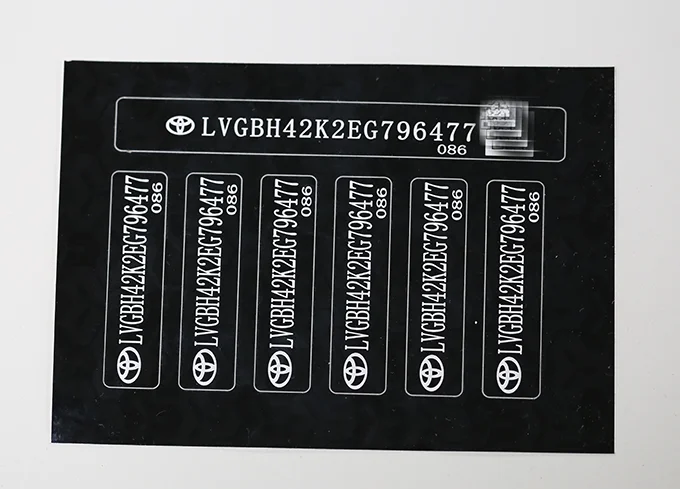
Product Overview
The KINMARK Flexible Fiber Laser Marking Machine is a dedicated solution for laser marking on flexible film labels. It is designed for flexible film labels from brands such as TESA, 3M, and Schreiner, and it supports automated processing that includes unwinding, inspection, leveling, marking, and cutting.
Rather than treating marking as an isolated step, the system integrates multiple label production processes into one automated solution. This allows manufacturers to produce customized identification labels with stable quality, reducing the need to move label stock between separate unwinding, marking, and cutting stations.
The machine is intended for industrial environments where labels must be produced reliably and consistently. Its modular design supports adaptation to different production requirements and provides flexible integration options for industrial applications. Core components are standardized and the marking process is mature, which supports reliable operation in continuous production.
In short, the product is a flexible label processing solution that combines laser marking capability with the material handling functions required to turn flexible film stock into finished, marked labels.
Working Principle
Laser marking for flexible labels uses a focused laser beam to create permanent marks on the label material. In a fiber laser marking machine, the laser interacts with the flexible film label to produce characters, texts, graphics, 1D barcodes, and 2D codes. Because the mark is created in the label material rather than applied as a separate layer of ink, the result is a clear and reliable marking result that is suited to identification and traceability use.
On the KINMARK system, the marking operation is part of a continuous automated flow. The process sequence includes:
Unwinding – flexible label stock is fed from the reel into the machine.
Inspection – the material is checked as part of the automated process.
Leveling – the flexible film is prepared so it is in the correct condition for marking.
Marking – the fiber laser marks the required characters, texts, graphics, 1D barcodes, or 2D codes.
Cutting – the marked labels are cut to produce the finished label format required by the customer.
This sequence is what makes the system a complete label manufacturing process rather than a standalone marking device. The operator defines the label content, and the machine carries out the handling and marking steps in one automated solution.
Key Features
The features below are drawn from the KINMARK Flexible Fiber Laser Marking Machine product information.
Flexible label processing solution – designed for laser marking on flexible film labels from brands such as TESA, 3M, and Schreiner.
Automated processing – supports unwinding, inspection, leveling, marking, and cutting in one integrated flow.
Complete label manufacturing process – integrates multiple processes into one automated solution for efficient production of customized identification labels with stable quality.
High-quality laser marking – supports permanent marking of characters, texts, graphics, 1D barcodes, and 2D codes on flexible label materials with clear and reliable marking results.
Flexible automation integration – modular design allows fast adaptation to different production requirements and provides flexible integration options for industrial applications.
Stable industrial performance – standardized core components and a mature marking process support reliable operation for continuous production.
12-month warranty – the complete machine is covered by a 12-month warranty, with professional technical support and long-term maintenance service.
Fast response service – efficient after-sales support, remote diagnosis, and technical assistance to help ensure continuous operation.
Installation and commissioning – engineers provide equipment installation, commissioning, and operator training to help customers start production smoothly.
Applications
Laser marking for flexible labels is relevant wherever flexible film labels are used for identification and traceability. The KINMARK system is designed for flexible film labels from brands such as TESA, 3M, and Schreiner, and it produces customized identification labels with characters, texts, graphics, 1D barcodes, and 2D codes.
Typical application areas include:
Automotive manufacturing – identification labels used in vehicle production and assembly environments.
Automotive components – labels for parts and sub-assemblies that require permanent, readable identification.
New energy vehicles – labeling requirements in new energy vehicle production.
Powertrain manufacturing – identification labels for powertrain components and assemblies.
Intelligent factory automation – label production integrated into automated manufacturing environments.
Because the system supports automated unwinding, inspection, leveling, marking, and cutting, it fits production environments where labels are consumed continuously and where consistent label quality matters. The barcode and 2D code marking capability also supports traceability workflows in which labels must be machine-readable.
Benefits
The benefits of laser marking for flexible labels follow from how the process works and how the KINMARK system is structured.
Permanent, Clear Marking
Laser marking produces permanent marks on flexible label materials. Characters, texts, graphics, 1D barcodes, and 2D codes are marked with clear and reliable results, which supports identification and traceability requirements.
Integrated Label Production
By combining unwinding, inspection, leveling, marking, and cutting in one automated solution, the system reduces the number of separate process steps required to produce a finished label. This supports efficient production of customized identification labels with stable quality.
Support for Traceability
The ability to mark 1D barcodes and 2D codes on flexible labels supports barcode traceability. Machine-readable codes on durable labels help manufacturers connect physical parts and assemblies to production and quality data.
Flexibility for Changing Requirements
The modular design allows the system to adapt to different production requirements. When label content, label format, or production needs change, the machine can be adjusted rather than replaced.
Reliable Continuous Operation
Standardized core components and a mature marking process support reliable operation for continuous production. Service support, including remote diagnosis and technical assistance, helps maintain uptime.
Note: Laser marking for flexible labels is a material-dependent process. Label performance depends on the specific flexible film label used. KINMARK's system is designed for flexible film labels from brands such as TESA, 3M, and Schreiner, and marking results should be validated for the exact label material in your application.
Why Choose KINMARK
KINMARK is a developer and manufacturer of intelligent automotive manufacturing equipment. The company's product lines include marking and traceability systems, servo press systems, fluid filling systems, and robot automation systems. Its business covers vehicle manufacturing, powertrain, automotive components, construction machinery, home appliances, new energy, electronic communications, and rail transit.
The Flexible Fiber Laser Marking Machine reflects this focus on automotive and industrial production. It is designed specifically for flexible film labels from brands such as TESA, 3M, and Schreiner, and it integrates unwinding, inspection, leveling, marking, and cutting into one automated solution. Standardized core components and a mature marking process support reliable operation in continuous production.
KINMARK supports customers beyond the initial purchase. The complete machine is covered by a 12-month warranty, with professional technical support and long-term maintenance service. The company provides efficient after-sales support, remote diagnosis, and technical assistance, and its engineers provide equipment installation, commissioning, and operator training to help customers start production smoothly. Service offices and repair centers are located in cities including Shanghai, Beijing, Guangzhou, Changchun, Wuhan, and Chongqing.
For manufacturers evaluating laser marking for flexible labels, these factors matter: a machine built for flexible film label processing, an integrated process flow, and service support that keeps the system running.
Frequently Asked Questions
What types of labels can be marked with this system?
The KINMARK Flexible Fiber Laser Marking Machine is designed for laser marking on flexible film labels from brands such as TESA, 3M, and Schreiner. It is intended for flexible label materials and supports marking of characters, texts, graphics, 1D barcodes, and 2D codes.
What processes does the machine perform automatically?
The system supports automated processing that includes unwinding, inspection, leveling, marking, and cutting. These steps are integrated into one automated solution for producing customized identification labels.
Can the machine mark barcodes and 2D codes for traceability?
Yes. The system supports permanent marking of 1D barcodes and 2D codes on flexible label materials, which supports barcode traceability and machine-readable identification.
What support is included with the machine?
The complete machine is covered by a 12-month warranty. KINMARK provides professional technical support, long-term maintenance service, efficient after-sales support, remote diagnosis, and technical assistance. Engineers also provide equipment installation, commissioning, and operator training.
Can the system be adapted to different production requirements?
The machine uses a modular design that allows fast adaptation to different production requirements and provides flexible integration options for industrial applications.
Conclusion
Laser marking for flexible labels is a practical answer to a common production problem: how to produce durable, readable identification labels on flexible film materials efficiently and consistently. By marking the label material directly, a fiber laser marking machine produces permanent characters, texts, graphics, 1D barcodes, and 2D codes with clear and reliable results.
The KINMARK Flexible Fiber Laser Marking Machine applies this principle in a complete, automated label manufacturing process. It is designed for flexible film labels from brands such as TESA, 3M, and Schreiner and integrates unwinding, inspection, leveling, marking, and cutting into one solution. For automotive manufacturing, automotive components, new energy vehicles, powertrain manufacturing, and intelligent factory automation, this integrated approach supports stable label quality and traceability.
When evaluating a flexible label marking system, consider the label materials you use, the marking content you require, the degree of automation your line needs, and the service support available after installation. These factors determine whether laser marking for flexible labels will deliver the production reliability your operation depends on.
If you're interested in any of the equipment mentioned in this article, feel free to contact our sales engineers for detailed product information and customized technical solutions.