
Laser Marking on Automotive Assembly Lines
Introduction
Laser marking on automotive assembly lines is the process of permanently applying vehicle identification and production data directly onto body-in-white structures, components, and assemblies as they move through the manufacturing flow. In modern vehicle plants, the marking station is no longer a standalone operation. It is a connected process step that must keep pace with line takt time, survive downstream paint and assembly operations, and feed reliable identification data into plant traceability systems.
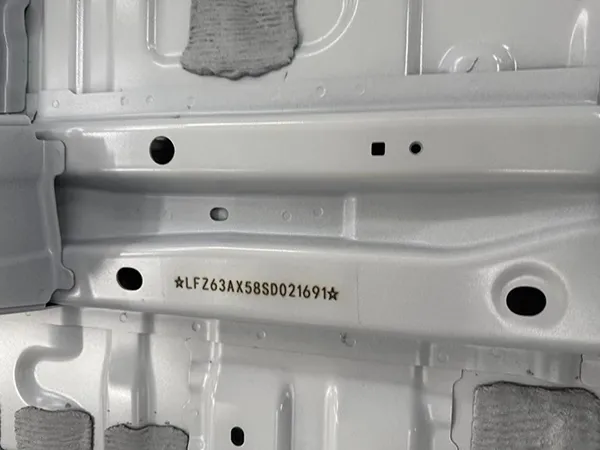
The challenge has increased as vehicle structures have changed. High-strength steel and hot-formed steel are now widely used in body construction, particularly in areas where the vehicle identification number is applied. These materials resist conventional marking methods, and a shallow surface mark may become unreadable after painting or may fail to meet the durability expectations of vehicle identification requirements. At the same time, assembly lines are increasingly automated, which places new demands on how marking equipment is positioned, triggered, and verified.
This application guide explains how laser marking is applied on automotive assembly lines, what deep laser marking involves, how marking systems integrate with robots and transfer systems, and which traceability functions can be added to support quality control. It is written for automotive engineers, manufacturing engineers, production managers, and purchasing teams evaluating marking equipment for body shop and final assembly applications.
What Laser Marking Does on an Assembly Line
On an automotive assembly line, laser marking serves two connected purposes: permanent identification and process traceability. The most familiar application is VIN marking on the body-in-white, where the vehicle identification number is marked into a structural area of the body. Beyond the VIN, laser marking is used for component identification, production data, and other permanent marks that must remain legible throughout the life of the vehicle.
A production marking station typically sits within the body shop or at a defined point in the assembly flow. The vehicle body or component arrives at the station, is positioned, and the marking head applies the required characters. Depending on line design, marking may be performed while the body is stationary at a station or while it is moving with a transfer system. After marking, the body continues to paint, final assembly, and inspection.
The marking operation must satisfy several practical conditions at once. The mark must be deep enough to remain readable after painting and rubbing. The cycle time must fit the line takt. The equipment must be robust enough for continuous production. And the marking result must be verifiable so that identification data can be trusted by downstream systems.
Product Overview: Deep Laser Marking Systems
A deep laser marking machine is designed for permanent marking on materials where surface marking is not sufficient. In automotive body applications, the system is used for deep VIN marking on high-strength materials. According to KINMARK product information, the system enables permanent VIN deep marking on high-strength steel plates with yield strength exceeding 700 MPa and hot-formed steel plates with strength up to 1500 MPa. The marking depth on body-in-white can reach more than 0.2 mm.
The product is positioned as a production-ready marking solution for automotive mass production. It supports integration with industrial robots and assisted manipulators, and it can be combined with optional vision guidance and traceability functions. The complete machine is covered by a 12-month warranty, with technical support and maintenance service.
Technical Specifications
| Parameter | Value |
| Power Supply | AC220V ±10%, 50Hz ±2% |
| Power Consumption | <1000W |
| Laser Power | 200W |
| Marking Area | 112mm × 112mm |
| Marking Depth | ≥0.2mm |
| Operating Temperature | 0~40℃ |
| Operating Humidity | ≤90% RH (Non-condensing) |
Working Principle of Deep Laser Marking
Deep laser marking uses a focused laser beam to remove or displace material from the workpiece surface, creating a mark with measurable depth rather than a surface discoloration. The depth requirement is what distinguishes deep marking from standard laser marking. In automotive VIN applications, the mark must remain identifiable after the body passes through paint processes and after the marked area is rubbed or processed.
The KINMARK deep laser marking machine adopts a special marking process to ensure clear rubbing results after painting. This is a critical detail in body-in-white VIN marking, because a mark that is visually present before paint may become difficult to read after paint and rubbing if the marking process is not controlled correctly.
For automated production, the marking head must be positioned accurately relative to the marked surface. The system is designed with various mounting interfaces so it can be integrated with industrial robots or assisted manipulators. When an optional 3D vision guidance system is used, the system performs precise positioning and accurate marking, which supports consistent results when body position varies slightly at the station.
From Positioning to Marking
A typical automated marking sequence includes vehicle or component arrival, positioning, marking, and verification. Positioning may be handled by the robot program, by mechanical fixtures, or by a vision guidance system. Marking is then performed by the laser head within the defined marking area. Verification can be added through optional measurement and recognition systems, which inspect the mark and confirm the characters.
Key Features for Assembly Line Integration
The features that matter most in an assembly line environment are those that affect integration, marking quality, and traceability. The following features are defined in the KINMARK deep laser marking product information.
Easy rubbing: A special marking process ensures clear rubbing results after painting, which is essential for body-in-white VIN marking.
Easy integration: Different types of mounting interfaces allow the system to be quickly integrated with industrial robots or assisted manipulators for automated production lines.
Deep VIN marking: The system performs permanent VIN deep marking on high-strength steel plates with yield strength exceeding 700 MPa and hot-formed steel plates with strength up to 1500 MPa. Marking depth on body-in-white can reach more than 0.2 mm.
Vision guidance: An optional 3D vision guidance system enables precise positioning and accurate marking to improve production efficiency.
Automatic traceability: Optional 3D laser scanning measurement and OCR recognition systems provide online inspection of marking quality and ensure 100% traceability.
Applications in Automotive Manufacturing
Deep laser marking is applied where permanent identification must survive downstream processes and remain readable over the life of the vehicle. The primary application is VIN marking on body-in-white structures, particularly on high-strength and hot-formed steel areas. Because these materials are increasingly used in modern body construction, the marking system must be capable of producing a deep, stable mark rather than a surface mark.
The system is also relevant to broader automotive manufacturing and intelligent factory automation environments where marking stations are integrated into automated lines. Mounting interfaces support robot integration, and optional vision and traceability functions support online inspection and data capture. This makes the system suitable for production lines where marking quality must be confirmed automatically rather than by manual inspection alone.
KINMARK marking and traceability systems are used across automotive manufacturing, automotive components, new energy vehicles, powertrain manufacturing, and intelligent factory automation. The company has supplied marking equipment to automotive production lines since its early cooperation with FAW-Volkswagen in 1997, and has since worked with a range of domestic and international vehicle manufacturers. This history reflects long-term involvement in automotive marking applications rather than a single-product offering.
Benefits for Production and Quality Teams
The value of a deep laser marking system on an assembly line comes from the combination of permanence, integration, and verification. A mark that remains readable after painting and rubbing supports reliable vehicle identification. A marking head that integrates with robots or manipulators supports automated production without adding manual handling steps. Optional vision guidance supports accurate positioning when body position varies. Optional measurement and OCR recognition support online inspection and traceability.
For production managers, the key considerations are cycle time compatibility and equipment reliability in continuous operation. For quality teams, the key considerations are marking depth, readability after paint, and the ability to verify each mark. For purchasing teams, the key considerations are integration effort, service support, and the ability to configure the system with the right options for the specific line.
Integration Considerations for Assembly Line Projects
Integrating a laser marking system into an existing or new assembly line requires coordination across several areas. The mechanical interface must match the robot or manipulator used at the station. The marking area must be sufficient for the required character layout; the KINMARK system provides a 112mm × 112mm marking area. The power supply and facility requirements must be met, including AC220V ±10%, 50Hz ±2% and power consumption below 1000W. Environmental conditions at the station should fall within the operating range of 0~40℃ and ≤90% RH non-condensing.
If vision guidance or traceability functions are required, they should be specified during project planning so that positioning strategy, inspection strategy, and data interfaces are defined before installation. KINMARK provides installation and commissioning support, including equipment installation, commissioning, and operator training, to help customers start production smoothly. After-sales support includes remote diagnosis and technical assistance.
Why Choose KINMARK for Marking and Traceability
KINMARK is a manufacturer of marking and traceability systems, servo press systems, fluid filling systems, and robot automation systems. The company has been involved in automotive marking since 1997, when its predecessor began supplying printing equipment for an engine production line. Over the following decades, it developed automatic marking equipment for engine, body, and nameplate applications, introduced robot automatic marking systems and VIN automatic identification systems, and later developed the deep laser marking system for VIN applications.
For assembly line marking projects, this background matters because it reflects experience with the specific requirements of automotive production: integration with robots and transfer systems, marking on challenging materials, and traceability functions that connect marking quality to plant data systems. KINMARK is recognized as a Shandong Province "Gazelle" enterprise and a "Specialized and Sophisticated" enterprise, and maintains offices and service centers in multiple Chinese cities to support customers.
Frequently Asked Questions
What materials can be marked with deep laser marking?
The KINMARK deep laser marking machine enables permanent VIN deep marking on high-strength steel plates with yield strength exceeding 700 MPa and hot-formed steel plates with strength up to 1500 MPa. Marking depth on body-in-white can reach more than 0.2 mm.
Can the marking system be integrated with robots on an assembly line?
Yes. The system is designed with various mounting interfaces and can be quickly integrated with industrial robots or assisted manipulators for automated production lines.
How is marking quality verified on the line?
An optional 3D laser scanning measurement and OCR recognition system provides online inspection of marking quality and supports 100% traceability. An optional 3D vision guidance system can also be used for precise positioning and accurate marking.
Will the mark remain readable after painting?
The system adopts a special marking process to ensure clear rubbing results after painting. This is particularly important for body-in-white VIN marking, where readability after paint and rubbing is a key requirement.
What are the installation requirements for the marking system?
The system operates on AC220V ±10%, 50Hz ±2% with power consumption below 1000W. Operating conditions are 0~40℃ and ≤90% RH non-condensing. KINMARK provides installation, commissioning, and operator training, along with remote diagnosis and technical support.
Conclusion
Laser marking on automotive assembly lines is a production process that must deliver permanent identification, fit line takt time, and support traceability. As body structures increasingly use high-strength and hot-formed steel, deep laser marking has become a practical requirement for VIN applications rather than an optional enhancement. A marking system that produces a mark deeper than 0.2 mm, integrates with robots and manipulators, and supports optional vision guidance and online inspection can be planned into the line as a reliable process step.
For engineering and purchasing teams evaluating marking equipment, the most useful starting point is to define the material, the required marking depth, the integration method, and the traceability function needed at the station. These requirements determine the configuration of the marking system and how it connects to the rest of the assembly line.
If you're interested in any of the equipment mentioned in this article, feel free to contact our sales engineers for detailed product information and customized technical solutions.