
When to Discuss Customized Positioning for Brake Disc Marking
Introduction
Brake disc marking sits at the intersection of two demanding requirements in automotive manufacturing: permanent part identification and continuous production flow. A brake disc is a safety-related component, and the marking applied to it often carries model codes, batch information, supplier data, or traceability references that must remain legible for the life of the part. At the same time, brake disc production lines run at high volume, and any manual intervention in the marking process becomes a bottleneck.
This is where the positioning question becomes practical rather than theoretical. A marking head can only produce a consistent, deep mark if the disc is held in a stable and repeatable position. When a production line handles a single disc family with stable geometry, a fixed or simple locating arrangement is often sufficient. When the line runs multiple disc models, mixed diameters, different hub designs, or frequent changeovers, the discussion shifts toward customized positioning for brake disc marking.
This guide examines when that discussion should take place, what positioning options exist in an automatic dot peen brake disc marking system, and how to evaluate the trade-offs between a standard configuration and a customized positioning approach. It is written for manufacturing engineers, production managers, and purchasing teams specifying custom brake disc marking equipment.
Product Overview
What an Automatic Dot Peen Brake Disc Marking Machine Does
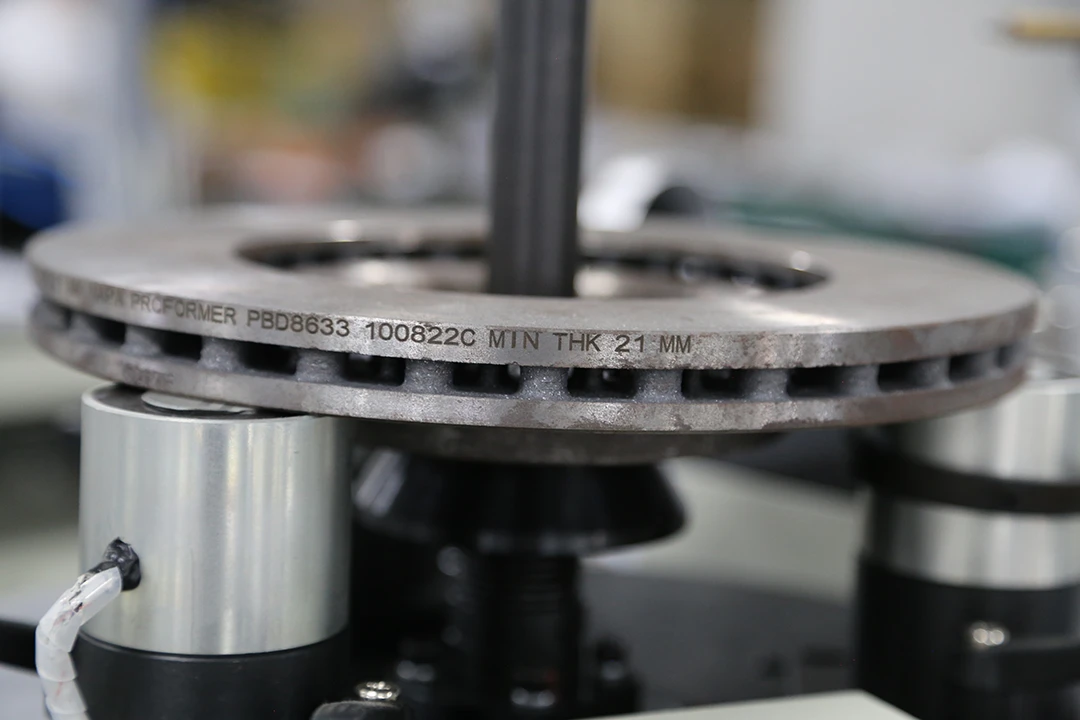
An automatic dot peen brake disc marking machine is designed for high-volume marking of automotive brake discs and round metal components. The system combines a high-performance marking head, a positioning system, and automatic inspection technology to deliver stable, deep, and permanent marks for production line traceability.
Unlike a standalone benchtop marker, this type of equipment is built for integration into brake disc production. It supports multiple positioning methods and automatic product changeover, which makes it suitable for multi-model and high-efficiency automotive manufacturing environments.
Where It Fits in the Production Flow
The machine is intended for marking applications where the disc must be identified before it moves downstream, whether into assembly, packaging, or a finished-goods buffer. Because marking is a traceability step, the equipment needs to keep pace with the line rather than operate as an offline station. That requirement is what drives the interest in automatic positioning and changeover.
Working Principle
Dot peen marking machines use a stylus that impacts the metal surface repeatedly to create a series of closely spaced indentations forming characters, codes, or symbols. The result is a permanent mark that is part of the material surface rather than a coating applied on top of it. The marking depth can be adjusted according to different materials and production requirements.
In an automatic brake disc marking system, the process can be summarized in a general sequence:
The disc arrives at the marking station through the production line.
The positioning system locates and holds the disc according to its geometry.
The marking head applies the required characters or codes at the defined depth.
An integrated inspection function monitors marking quality during operation.
The disc is released and the station prepares for the next part.
The critical variable in this sequence is the positioning step. If the disc is not located consistently, the mark position shifts, character spacing becomes uneven, or the stylus may not achieve the intended depth. The positioning method therefore directly affects whether the marking operation is reliable at production speed.
Key Features of an Automatic Dot Peen Brake Disc Marking System
Deep and permanent dot peen marking — high-strength impact marking technology creates clear and durable marks on metal surfaces, with adjustable marking depth.
Flexible positioning system — supports inner hole expansion, outer diameter clamping, threaded positioning, spring positioning, electromagnetic positioning, and chuck positioning.
Automatic positioning and changeover — the intelligent positioning system adjusts according to product specifications, reducing manual adjustment time in multi-product manufacturing.
Integrated marking quality inspection — audio-based marking detection technology monitors marking quality during operation to reduce defective products.
High-efficiency production design — built for large-scale brake disc production with fast marking speed and stable operation.
Factory data management integration — supports connection with factory management platforms for centralized management of marking templates, fonts, and production data.
Reliable industrial design — protective design suited to high metal dust exposure, with easy maintenance and high equipment availability.
Why Positioning Becomes a Customization Question
The list of supported positioning methods is not a menu to be applied at random. Each method suits a particular disc geometry and production context. When a line runs a narrow range of discs, one or two methods may cover the entire product mix. When the mix widens, the same station may need to switch between methods or adopt a locating approach that accommodates several disc families without mechanical changeover.
This is the point at which customized positioning for brake disc marking moves from a nice-to-have to a design requirement. The question is not whether customization is inherently better, but whether the standard configuration can hold the required accuracy and cycle time across the actual product mix.
When to Discuss Customized Positioning
1. The Line Runs Multiple Disc Models
Multi-model production is the most common trigger. If a brake disc line produces several disc variants with different diameters, hub bore sizes, or hat heights, a single fixed locating fixture will not cover all of them. The discussion should begin when the product mix is known, because the positioning concept determines how changeover is handled and how much manual adjustment remains in the process.
2. Disc Geometry Varies Beyond Standard Tolerances
Some brake discs include features that complicate locating: recessed hubs, ventilation slots, threaded holes, or asymmetric surfaces. Where the available locating surface is limited or irregular, a standard clamping approach may not provide the stability required for consistent marking depth. Customized positioning can be evaluated when the disc geometry does not present a clean, repeatable locating reference.
3. Changeover Frequency Is High
Even when each individual disc model is straightforward, frequent changeovers create their own cost. If operators must manually adjust fixtures between batches, the marking station becomes a source of downtime and variability. Automatic positioning and changeover are designed to reduce manual adjustment time, and the case for customization strengthens as changeover frequency rises.
4. Marking Position Requirements Are Strict
Traceability marks are often required at a defined location on the disc, and the position must be repeatable from part to part. When the tolerance on mark position is tight, the positioning method must be selected to match, rather than adapted after the fact. This is a natural point to discuss a customized locating solution with the equipment supplier.
5. The Station Must Integrate Into an Automated Line
A marking machine that operates as part of an automated production line has less tolerance for manual intervention than a semi-manual station. Integration requirements, part transfer method, and available space around the marking head all influence which positioning method is practical. Customization should be discussed during line layout planning, not after the equipment is ordered.
6. New Disc Programs Are Planned
If the production plan includes discs that are not yet in production, the positioning concept should be evaluated against that future mix. A configuration that only addresses today's parts may require rework when the next model is introduced. Discussing customization early allows the locating system to be specified with the product roadmap in view.
Positioning Methods and Their Practical Role
The automatic dot peen brake disc marking system supports several positioning methods, each suited to different disc features and production conditions:
| Positioning Method | Typical Basis |
|---|---|
| Inner hole expansion | Locates on the central bore of the disc |
| Outer diameter clamping | Grips the disc on its outer edge |
| Threaded positioning | Uses threaded features on the disc |
| Spring positioning | Spring-loaded locating elements |
| Electromagnetic positioning | Magnetic holding of the disc |
| Chuck positioning | Chuck-based clamping |
The availability of multiple methods is what makes customization feasible. Rather than forcing every disc onto a single locating principle, the system can be configured to use the method that matches each disc family. The customization discussion is essentially about deciding which combination of methods, and what level of automatic adjustment, is required for the actual production mix.
Applications
Automatic dot peen brake disc marking equipment is used in production environments where round metal components require permanent identification. Relevant application areas include:
Automotive manufacturing — brake disc marking as part of vehicle component traceability.
Automotive components — high-volume marking of brake discs and similar round metal parts.
New energy vehicles — traceability marking within modern vehicle production lines.
Powertrain manufacturing — marking operations in drivetrain-related production environments.
Intelligent factory automation — stations that connect to factory management platforms and operate within automated lines.
In each case, the marking station contributes to part identification and production data management rather than functioning as an isolated process step.
Benefits of Addressing Positioning Early
Improved traceability — consistent mark position and depth support reliable part identification.
Better process consistency — automatic positioning reduces variation introduced by manual adjustment.
Reduced changeover effort — automatic product changeover lowers manual adjustment time in multi-product manufacturing.
Quality monitoring — integrated marking inspection helps reduce defective products.
Production integration — the system supports connection with factory management platforms for marking templates, fonts, and production data.
Equipment availability — protective design and easy maintenance support continuous operation in high metal dust environments.
Why Choose KINMARK
KINMARK is a manufacturer of marking and traceability systems, servo press systems, fluid filling systems, and robot automation systems for automotive intelligent manufacturing. The company has worked with automotive manufacturers and industrial customers across vehicle production, powertrain, automotive components, new energy vehicles, and intelligent factory automation.
For brake disc marking projects, KINMARK provides equipment installation, commissioning, and operator training, along with a 12-month warranty on the complete machine. After-sales support includes remote diagnosis and technical assistance, which matters when a marking station is part of a running production line.
Because the marking system supports multiple positioning methods and automatic changeover, it can be configured around the actual disc mix rather than a single fixed part. That flexibility is the basis for discussing customized positioning when standard configurations do not match production requirements.
Planning note: The most useful input for a positioning discussion is a clear product matrix — disc models, diameters, hub features, marking location requirements, and expected changeover frequency. Sharing this information early allows the positioning concept to be evaluated against real production conditions.
Frequently Asked Questions
When should customized positioning be considered for brake disc marking?
Customized positioning should be considered when a production line runs multiple disc models, when disc geometry does not provide a clean locating reference, when changeover frequency is high, when mark position tolerances are strict, or when the marking station must integrate into an automated line. In these situations, a standard configuration may not cover the full product mix.
What positioning methods does an automatic dot peen brake disc marking machine support?
The system supports inner hole expansion, outer diameter clamping, threaded positioning, spring positioning, electromagnetic positioning, and chuck positioning. These methods allow flexible adaptation to different brake disc sizes and designs.
Does the machine handle product changeover automatically?
Yes. The intelligent positioning system automatically adjusts according to product specifications, which reduces manual adjustment time and supports multi-product manufacturing.
How is marking quality monitored during production?
The system is equipped with audio-based marking detection technology that monitors marking quality during operation. This helps reduce defective products and supports reliable traceability.
Can the marking system connect to factory management platforms?
Yes. The system supports connection with factory management platforms, enabling centralized management of marking templates, fonts, and production data.
Conclusion
Customized positioning for brake disc marking is not a default requirement — it is a response to specific production conditions. Single-model lines with stable geometry may run effectively with a standard locating arrangement. Lines with multiple disc models, frequent changeovers, strict mark position requirements, or full automation integration are the cases where the positioning discussion should happen early, before equipment is specified.
The automatic dot peen brake disc marking machine addresses this by supporting multiple positioning methods and automatic changeover, along with deep permanent marking, integrated quality inspection, and factory data management integration. For teams evaluating custom brake disc marking equipment, the practical starting point is a clear picture of the product mix and the traceability requirements that the marking station must satisfy.
If you're interested in any of the equipment mentioned in this article, feel free to contact our sales engineers for detailed product information and customized technical solutions.