
How Dot Peen Marking Machines Are Used for Brake Disc Traceability
Introduction
Brake discs are safety-critical components in every vehicle. Their manufacturing history—material batch, production line, date, and quality inspection results—must be traceable throughout the supply chain. For automotive manufacturers and component suppliers, marking each brake disc with a unique, permanent identifier is not optional; it is a fundamental requirement for quality control, recall management, and regulatory compliance.
A brake disc dot peen marking machine is designed specifically for this task. Unlike ink-based or label systems, dot peen marking creates deep, durable marks directly into the metal surface, ensuring the identifier survives handling, storage, and the harsh conditions of vehicle operation. This article explains how automatic dot peen marking systems are used for brake disc traceability, covering their working principle, key features, applications, and benefits for automotive production environments.
Product Overview
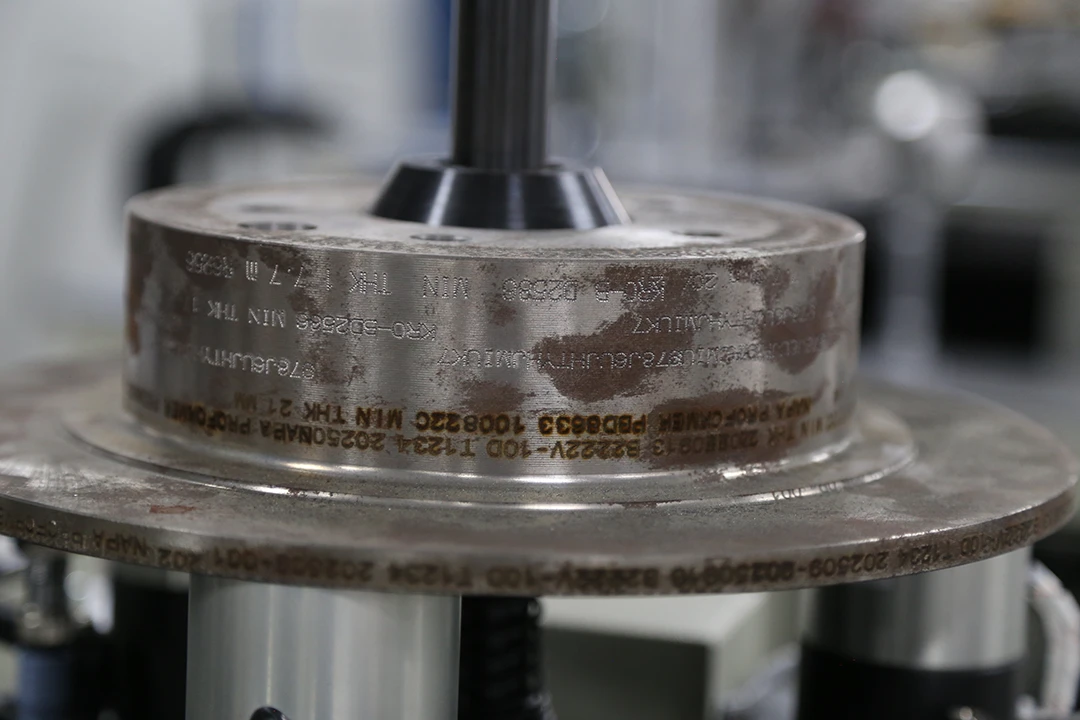
The automatic dot peen brake disc marking machine is a dedicated system for high-volume marking of automotive brake discs and round metal components. It combines a high-performance marking head, flexible positioning system, and automatic inspection technology to deliver stable, deep, and permanent marks for production line traceability.
This system is engineered for multi-model and high-efficiency automotive manufacturing. It supports multiple positioning methods and automatic product changeover, making it suitable for production environments where different brake disc sizes and designs are processed on the same line. The machine is designed to integrate with automated production lines and factory data management platforms, enabling centralized control of marking templates, fonts, and production data.
In essence, the automatic dot peen brake disc marking machine solves a specific industrial problem: how to apply a permanent, machine-readable identifier to every brake disc at production speed, without compromising the integrity of the component or disrupting line throughput.
Working Principle
Dot peen marking works by striking a hard, carbide or hardened steel stylus against the metal surface. Each strike creates a small indentation—a dot. By controlling the position of the stylus and the force of each strike, the system forms alphanumeric characters, data matrix codes, or custom logos. The result is a permanent, deep mark that cannot be removed without grinding or machining the surface.
In the automatic brake disc marking machine, the process is integrated into the production line. Brake discs are fed into the marking station, where the flexible positioning system secures the disc. The positioning system can use inner hole expansion, outer diameter clamping, threaded positioning, spring positioning, electromagnetic positioning, or chuck positioning, depending on the disc design and production requirements. This flexibility ensures accurate placement of the mark on different disc models.
Once the disc is secured, the marking head executes the programmed pattern. The system can automatically adjust to different product specifications, reducing manual changeover time. After marking, an audio-based marking detection system monitors the quality of the mark in real time. This integrated inspection helps identify incomplete or missing marks immediately, preventing defective products from advancing down the line.
The entire process is controlled by the machine's software, which can be connected to factory management platforms for centralized management of marking templates, fonts, and production data. These capabilities support broader marking and traceability applications in automotive manufacturing.
Key Features
Deep and Permanent Dot Peen Marking: High-strength impact marking technology creates clear, durable marks on metal surfaces. Marking depth can be adjusted to suit different materials and production requirements.
Flexible Positioning System: Supports multiple positioning methods including inner hole expansion, outer diameter clamping, threaded positioning, spring positioning, electromagnetic positioning, and chuck positioning. This allows adaptation to various brake disc sizes and designs.
Automatic Positioning and Changeover: The intelligent positioning system automatically adjusts according to product specifications, reducing manual adjustment time and improving efficiency in multi-product manufacturing.
Integrated Marking Quality Inspection: Equipped with audio-based marking detection technology, the system monitors marking quality during operation to reduce defective products and ensure reliable traceability.
High-Efficiency Automotive Production: Designed for large-scale brake disc production, the machine provides fast marking speed, stable operation, and seamless integration with automated production lines.
Factory Data Management Integration: Supports connection with factory management platforms, enabling centralized management of marking templates, fonts, and production data.
Reliable Industrial Design: Built for automotive manufacturing environments with high metal dust exposure, featuring protective design, easy maintenance, and high equipment availability.
Applications
The automatic dot peen brake disc marking machine is primarily used in automotive manufacturing and component production. Its main application is marking brake discs for traceability, but it is also suitable for other round metal components that require permanent identification.
Typical application scenarios include:
Automotive Brake Disc Production Lines: Marking each disc with a unique identifier for quality control and traceability.
Multi-Model Production: Flexible positioning and automatic changeover allow the same system to handle different brake disc models without manual reconfiguration.
New Energy Vehicles: Brake discs for electric vehicles and hybrid vehicles also require permanent traceability marking.
Powertrain Manufacturing: Similar round metal components in powertrain assemblies can benefit from the same marking technology.
Intelligent Factory Automation: Integration with factory data management platforms supports centralized control and data collection for smart manufacturing initiatives.
The system is designed for high-volume production, making it suitable for tier-one automotive suppliers and brake disc manufacturers who need to mark thousands of parts per shift.
Benefits
Implementing an automatic dot peen marking system for brake disc traceability offers several practical benefits for automotive manufacturers:
Improved Traceability: Permanent marks ensure each brake disc can be traced back to its production batch, date, and manufacturing parameters. This is essential for quality audits and recall management.
Better Process Consistency: Automated positioning and marking reduce human error, ensuring every disc receives the correct identifier in the correct location.
Production Integration: The machine integrates seamlessly with automated production lines and factory management platforms, supporting digital manufacturing strategies.
Manufacturing Efficiency: Automatic changeover and high-speed marking reduce downtime and manual adjustment, helping maintain line throughput in multi-model production.
Quality Management: Integrated audio-based inspection detects marking defects in real time, preventing defective products from advancing and reducing the risk of unmarked or poorly marked parts reaching assembly.
Durability: Dot peen marks withstand handling, storage, and harsh operating conditions, unlike ink or label-based identification.
Why Choose KINMARK
KINMARK (Jinan Zhongzheng Jinma Technology Co., Ltd.) has been developing and manufacturing marking and traceability systems since 1996. The company is a recognized "Gazelle" and "Specialized and Sophisticated" enterprise in Shandong Province, with a focus on automotive intelligent automation equipment.
KINMARK's product portfolio includes marking and traceability systems, servo press systems, fluid filling systems, and robot automation systems. The company serves the automotive manufacturing, automotive components, new energy vehicles, powertrain manufacturing, and intelligent factory automation sectors. It has established long-term cooperation with automotive manufacturers and suppliers, and provides automation solutions to well-known industrial companies.
For brake disc traceability, KINMARK offers the automatic dot peen brake disc marking machine with flexible positioning, deep permanent marking, automatic inspection, and high-efficiency production capability. The complete machine is covered by a 12-month warranty, with professional technical support and long-term maintenance service. KINMARK provides fast response service, including remote diagnosis and technical assistance, as well as installation and commissioning support with operator training to help customers start production smoothly.
Frequently Asked Questions
What is a brake disc dot peen marking machine?
A brake disc dot peen marking machine is an automated system that uses a hard stylus to strike the metal surface of a brake disc, creating a series of small indentations that form characters or codes. This produces a permanent, deep mark for traceability purposes. The automatic dot peen brake disc marking machine from KINMARK is designed for high-volume production and integrates flexible positioning, automatic changeover, and marking quality inspection.
How does dot peen marking ensure traceability?
Dot peen marking creates a permanent mark that cannot be removed without damaging the surface. Each brake disc can be marked with a unique identifier, such as a serial number, batch code, or data matrix code. This identifier can be linked to production data in factory management systems, allowing full traceability from manufacturing to assembly and end-use.
Can the machine handle different brake disc models?
Yes. The automatic dot peen brake disc marking machine supports multiple positioning methods, including inner hole expansion, outer diameter clamping, threaded positioning, spring positioning, electromagnetic positioning, and chuck positioning. The intelligent positioning system automatically adjusts according to product specifications, enabling efficient changeover between different brake disc models without manual reconfiguration.
What kind of inspection is integrated into the marking process?
The system is equipped with audio-based marking detection technology. This monitors the marking process in real time to verify mark quality and completeness. If a mark is missing or incomplete, the system can alert operators or halt the line, reducing the risk of defective products moving forward.
How does the machine integrate with factory data systems?
The system supports connection with factory management platforms. This enables centralized management of marking templates, fonts, and production data. Integration allows production managers to control marking parameters from a central system and collect traceability data for quality analysis and reporting.
Conclusion
Brake disc traceability is a critical requirement in automotive manufacturing. The automatic dot peen brake disc marking machine provides a reliable, efficient solution for applying permanent marks to brake discs at production speed. With flexible positioning, automatic changeover, integrated quality inspection, and factory data integration, this system addresses the key challenges of high-volume, multi-model brake disc production.
For automotive engineers, production managers, and purchasing decision-makers, understanding how dot peen marking technology works and what benefits it delivers is essential for specifying the right traceability solution. KINMARK's experience in marking and traceability systems, combined with its focus on automotive intelligent automation, makes it a suitable partner for brake disc marking applications.
If you're interested in any of the equipment mentioned in this article, feel free to contact our sales engineers for detailed product information and customized technical solutions.