
How Laser Marking Depth Control Works
Introduction
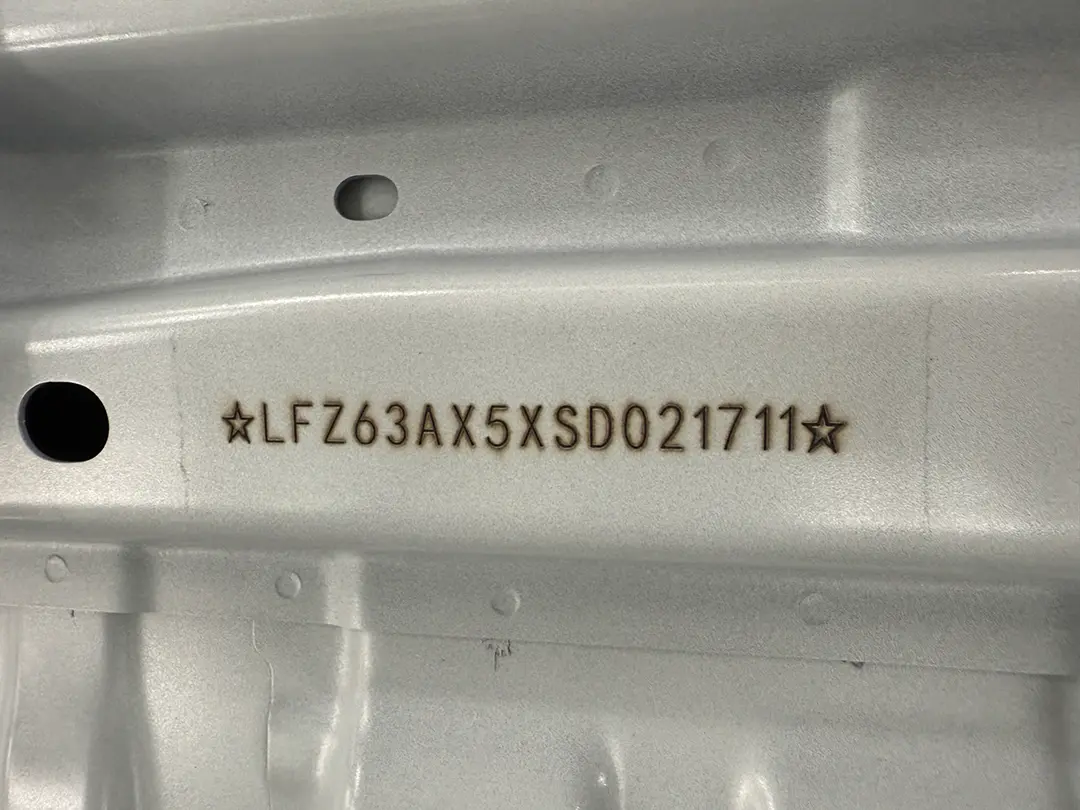
Laser marking depth control is a critical process parameter in industrial marking, particularly for automotive applications where permanent identification is required. In vehicle manufacturing, the Vehicle Identification Number (VIN) must remain legible throughout the vehicle's lifecycle, even after painting and years of exposure to environmental conditions. This requirement drives the need for deep laser marking on high-strength steel and hot-formed steel plates, where marking depth must be controlled within defined limits to ensure durability and traceability.
This technical guide explains how laser marking depth control works in deep laser marking systems. It covers the factors that influence marking depth, the methods used to control and verify depth, and the practical considerations for integrating depth-controlled marking into automotive production lines. The information is intended for manufacturing engineers, production managers, and technical decision-makers evaluating marking solutions for body-in-white and powertrain applications.
Product Overview
A deep laser marking machine is designed to produce permanent, high-contrast markings on metallic surfaces by removing or altering material to a controlled depth. Unlike surface marking, which only affects a thin layer of the material, deep laser marking creates a recessed mark that remains readable after subsequent manufacturing processes such as painting, e-coating, and assembly.
KINMARK Deep Laser Marking Machine is engineered for deep VIN marking on high-strength materials. It supports marking on steel plates with yield strength exceeding 700 MPa and hot-formed steel plates with strength up to 1500 MPa. The marking depth on body-in-white can reach more than 0.2 mm, ensuring the VIN remains traceable even after the paint shop process. The system is designed for integration with industrial robots or assisted manipulators, making it suitable for automated production lines.
The machine includes a 200W laser, a marking area of 112 mm × 112 mm, and operates on AC220V ±10%, 50Hz ±2% power with consumption below 1000W. It is intended for operation in ambient temperatures from 0 to 40°C and humidity up to 90% RH without condensation.
Working Principle of Laser Marking Depth Control
Laser marking depth control is achieved by managing the interaction between the laser beam and the material surface. When the laser beam strikes the metal, it delivers energy that melts or vaporizes the material at the focal point. The depth of the resulting mark depends on several process parameters that must be precisely controlled.
Key Process Parameters
Laser power: Higher power increases the energy delivered to the material, which can increase marking depth. The KINMARK system uses a 200W laser to achieve deep marks on high-strength steel.
Pulse duration and frequency: The duration of each laser pulse and the frequency of pulses affect how much material is removed per unit time. Shorter pulses with higher peak power can create deeper marks with less heat-affected zone.
Beam focus position: The focal point of the laser beam relative to the material surface determines the energy density. Precise focus control is essential for consistent depth.
Scanning speed: The speed at which the beam moves across the surface influences the overlap of pulses and the total energy delivered per unit area.
Number of passes: Multiple passes can incrementally increase marking depth, but each pass must be controlled to avoid excessive material removal or distortion.
Material Considerations
The material being marked also affects depth control. High-strength steel and hot-formed steel have different thermal properties and hardness, which influence how the laser interacts with the surface. For example, marking on steel with yield strength above 700 MPa requires sufficient laser energy to achieve the desired depth without causing micro-cracks or undesirable metallurgical changes. The KINMARK system is specifically designed to handle these materials, ensuring a marking depth of more than 0.2 mm on body-in-white.
Depth Measurement and Verification
Controlling marking depth also requires the ability to measure it. In automated production, depth verification can be performed using a 3D laser scanning measurement system. This optional module scans the marked area and provides quantitative depth data, allowing the system to confirm that the marking meets specifications. Additionally, OCR recognition can be integrated to verify character legibility and ensure 100% traceability. These measurement functions close the loop on depth control, enabling real-time process monitoring and adjustment.
Key Features for Depth Control
The KINMARK Deep Laser Marking Machine incorporates several features that support precise depth control and reliable marking in automotive production:
Deep VIN marking capability: Achieves marking depth greater than 0.2 mm on body-in-white, suitable for high-strength steel with yield strength over 700 MPa and hot-formed steel up to 1500 MPa.
Easy rubbing: A special marking process ensures clear rubbing results after painting, which is essential for VIN legibility during vehicle registration and inspection.
Easy integration: Various mounting interfaces allow quick integration with industrial robots or assisted manipulators for automated production lines.
Vision guidance (optional): A 3D vision guidance system enables precise positioning and accurate marking, reducing the risk of misalignment that could affect depth consistency.
Automatic traceability (optional): A 3D laser scanning measurement and OCR recognition system provides online inspection of marking quality and ensures 100% traceability.
Applications in Automotive Manufacturing
Laser marking depth control is particularly important in the following automotive applications:
Body-in-white VIN marking: Permanent VIN marking on high-strength steel and hot-formed steel plates, where depth must exceed 0.2 mm to survive painting and ensure long-term legibility.
Powertrain component marking: Marking of engine and transmission components for traceability, where depth control ensures the mark remains readable after cleaning and assembly processes.
Automotive component identification: Marking of safety-critical parts such as chassis components, where depth-controlled marks provide durable identification.
New energy vehicle manufacturing: VIN and component marking on battery trays and structural parts, where high-strength materials are increasingly used.
Intelligent factory automation: Integration with robot cells and production lines for automated marking and traceability, supported by vision guidance and online inspection.
Benefits of Controlled Marking Depth
Implementing laser marking depth control offers several practical benefits for automotive manufacturers:
Improved traceability: Deep, permanent marks ensure that VIN and component identification remain readable throughout the vehicle's life, supporting regulatory compliance and quality management.
Process consistency: By controlling depth parameters, manufacturers can achieve uniform marking quality across different materials and production shifts.
Reduced rework: Online depth measurement and OCR verification help detect marking defects early, reducing the need for rework or scrapping of marked parts.
Production integration: The system's mounting interfaces and optional vision guidance enable seamless integration into automated lines, supporting efficient production flow.
Material versatility: The ability to mark high-strength and hot-formed steel with controlled depth allows manufacturers to use advanced materials without compromising identification.
Why Choose KINMARK for Depth-Controlled Laser Marking
KINMARK has been involved in automotive marking and traceability since 1997, with a history of developing marking systems for major automotive manufacturers. The company's deep laser marking machine is designed to meet the specific requirements of VIN marking on high-strength materials, with a focus on depth control, integration, and traceability.
The system's 200W laser and marking depth of more than 0.2 mm on body-in-white make it suitable for demanding applications. Optional 3D vision guidance and 3D laser scanning measurement systems provide the tools needed for precise positioning and online quality verification. KINMARK also offers installation, commissioning, and operator training, along with a 12-month warranty and after-sales support to ensure continuous operation.
With experience serving automotive manufacturers and suppliers across various segments, KINMARK understands the practical challenges of integrating marking systems into production lines. The company's focus on marking and traceability, servo press systems, fluid filling systems, and robot automation systems allows it to provide solutions that address broader manufacturing needs.
Frequently Asked Questions
What is the typical marking depth for automotive VIN marking?
For automotive VIN marking on body-in-white, a marking depth of more than 0.2 mm is commonly required to ensure the VIN remains legible after painting and throughout the vehicle's lifecycle. The KINMARK Deep Laser Marking Machine achieves this depth on high-strength steel and hot-formed steel plates.
How is marking depth controlled during production?
Marking depth is controlled by managing laser power, pulse duration, beam focus position, scanning speed, and the number of passes. The KINMARK system uses a 200W laser and can be equipped with an optional 3D laser scanning measurement system for online depth verification, ensuring consistent quality.
Can the marking depth be verified automatically?
Yes. An optional 3D laser scanning measurement system can be integrated to measure marking depth online. Additionally, OCR recognition can verify character legibility, providing 100% traceability and enabling real-time process control.
What materials can be marked with controlled depth?
The KINMARK Deep Laser Marking Machine is designed for high-strength steel plates with yield strength exceeding 700 MPa and hot-formed steel plates with strength up to 1500 MPa. It is suitable for body-in-white and other automotive components where deep, permanent marking is required.
How does the system integrate with automated production lines?
The system features various mounting interfaces for quick integration with industrial robots or assisted manipulators. Optional 3D vision guidance enables precise positioning, and the compact design supports installation in robot cells and automated marking stations.
Conclusion
Laser marking depth control is essential for producing permanent, traceable markings on automotive components, especially VINs on high-strength steel and hot-formed steel. By understanding and managing the key process parameters—laser power, pulse characteristics, focus position, scanning speed, and pass count—manufacturers can achieve consistent marking depth that meets specifications. Measurement and verification tools, such as 3D laser scanning and OCR, close the loop on depth control and support 100% traceability.
The KINMARK Deep Laser Marking Machine is engineered to address these requirements, with a 200W laser, marking depth greater than 0.2 mm on body-in-white, and options for vision guidance and automatic traceability. For automotive manufacturers seeking reliable, depth-controlled marking solutions, understanding how depth control works is the first step toward integrating a system that supports quality, compliance, and production efficiency.
If you're interested in any of the equipment mentioned in this article, feel free to contact our sales engineers for detailed product information and customized technical solutions.