VIN Laser Marking Process: How It Works and Why It Matters
Introduction
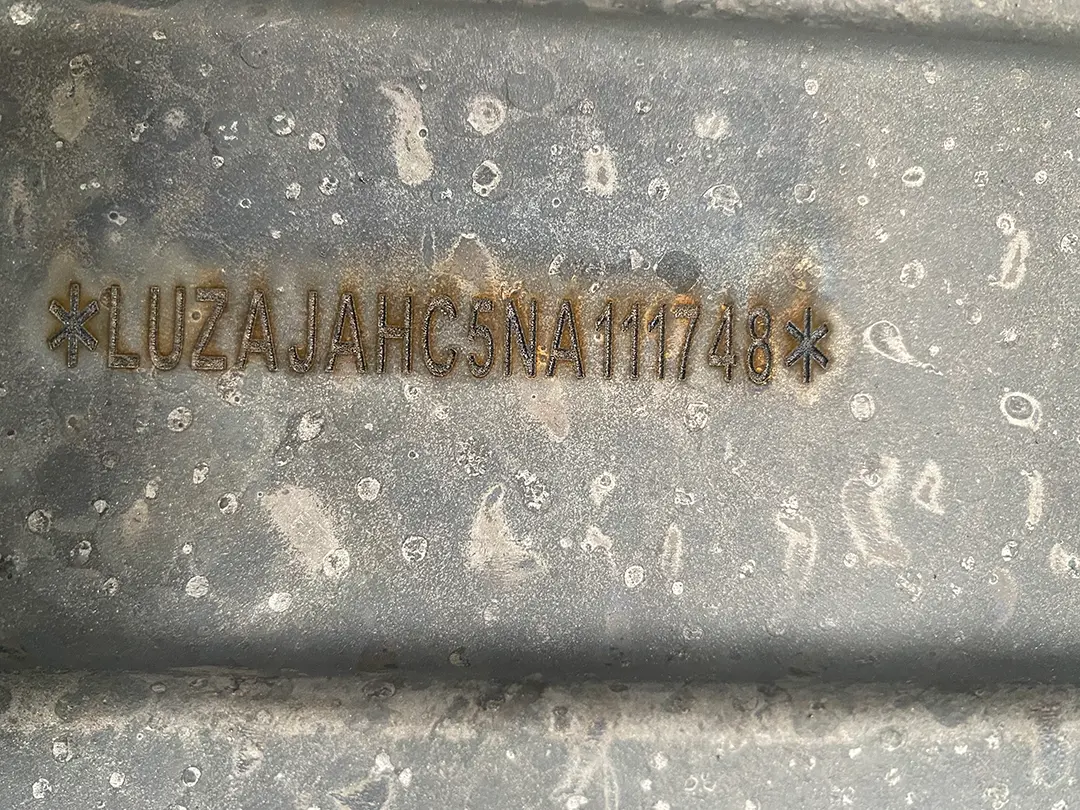
The Vehicle Identification Number (VIN) is the primary identity record of a vehicle. It links the finished car to its body, powertrain, and production history. For this reason, the VIN must remain readable for the entire life of the vehicle, including after the body has passed through the paint shop. The VIN laser marking process is the production step that creates this permanent identification on the body-in-white.
Modern body structures make this step more demanding than it once was. High-strength steel and hot-formed steel are now common in areas such as the cowl, door frames, and rear body panels, and these materials resist shallow surface marking. A VIN that is only marked on the surface can become difficult to read after painting, rubbing, or years of service. Deep laser marking addresses this by creating a mark with real depth in the material.
This guide explains how the VIN laser marking process works in an automotive production environment. It covers the principle of deep marking, the equipment characteristics that matter on a body-in-white line, integration with robots and manipulators, quality inspection and traceability, and the practical points engineers and production managers should consider when specifying a system.
Product Overview
A deep laser marking machine is a production system that uses a laser source to create a permanent VIN mark on vehicle body panels. It is positioned in the body-in-white area of the assembly plant, where the identification number is applied before painting and downstream assembly.
The KINMARK Deep Laser Marking Machine is designed for this application. According to the product information, it enables permanent VIN deep marking on high-strength steel plates with yield strength exceeding 700 MPa and on hot-formed steel plates with strength up to 1500 MPa. The marking depth on body-in-white can reach more than 0.2 mm.
The system is intended for automotive mass production. It is not a standalone bench tool. It is built to be integrated into an automated line, either with an industrial robot or with an assisted manipulator, and it can be combined with vision guidance and online inspection options.
Technical Specifications
| Power Supply | AC220V ±10%, 50Hz ±2% |
| Power Consumption | <1000W |
| Laser Power | 200W |
| Marking Area | 112mm × 112mm |
| Marking Depth | ≥0.2mm |
| Operating Temperature | 0~40℃ |
| Operating Humidity | ≤90% RH (Non-condensing) |
Working Principle
The VIN laser marking process uses a focused laser beam to remove or displace material from the surface of the body panel, creating a mark that has measurable depth rather than only a color change. This is the essential difference between deep marking and surface marking.
In practice, the marking head is positioned relative to the VIN area on the body-in-white. The laser then writes the character string according to the production data for that specific body. The result is a permanent, deep VIN mark on the steel panel.
Two process characteristics are central to the application. First, the marking depth must be sufficient to survive painting and rubbing. Second, the character quality must remain legible so that the VIN can be read and traced. The KINMARK system addresses both points: it adopts a special marking process to ensure clear rubbing results after painting, and the marking depth on body-in-white can reach more than 0.2 mm.
Because the mark is created in the material itself, it is not a label, sticker, or printed plate that can be removed or degraded. It becomes part of the body structure. This is why deep laser marking is used where long-term identification and traceability are required.
Positioning and Guidance
Accurate positioning is a prerequisite for a correct mark. An optional 3D vision guidance system can be used to complete precise positioning and accurate marking, which supports production efficiency. On a line where body position varies slightly from unit to unit, vision guidance helps the system locate the correct marking area before the laser is triggered.
Inspection and Traceability
Marking quality can be verified in line. An optional 3D laser scanning measurement system and OCR recognition system provide online inspection of marking quality. According to the product information, these options support 100% online identification of character print quality and OCR, which helps ensure full traceability of the marked body.
Key Features
Deep VIN marking: permanent VIN deep marking on high-strength steel plates with yield strength exceeding 700 MPa and hot-formed steel plates up to 1500 MPa, with marking depth on body-in-white reaching more than 0.2 mm.
Easy rubbing: a special marking process ensures clear rubbing results after painting.
Easy integration: various mounting interfaces allow quick integration with industrial robots or assisted manipulators for automated production lines.
Vision guidance: an optional 3D vision guidance system enables precise positioning and accurate marking.
Automatic traceability: optional 3D laser scanning measurement and OCR recognition provide online inspection of marking quality and support 100% traceability.
Production-ready configuration: 200W laser power, 112mm × 112mm marking area, power consumption below 1000W, and operation from 0~40℃ at up to 90% RH non-condensing.
Applications
The VIN laser marking process is applied in automotive manufacturing, specifically in body-in-white production where the vehicle identification number is marked before painting. The KINMARK Deep Laser Marking Machine is intended for automotive mass production and can be integrated into automated production lines.
Typical application areas include:
Automotive manufacturing: VIN marking on body-in-white in vehicle assembly plants.
High-strength body structures: marking on high-strength steel and hot-formed steel panels that resist shallow surface marking.
Automated production lines: robot-integrated or manipulator-assisted marking stations within a body shop.
Traceability systems: marking stations where online inspection and OCR verification are required to confirm mark quality.
Because the system is designed for robot and manipulator integration, it can be placed in a cell that matches the layout and cycle requirements of the existing body line rather than being limited to a fixed manual station.
Benefits
The main benefit of deep laser marking is permanence. A VIN mark with depth in the material is far less likely to be lost or degraded during painting, rubbing, and the rest of the vehicle's life than a surface mark. This supports identification and traceability requirements over the long term.
Other practical benefits in a production environment include:
Process consistency: the marking process is repeatable, so each body receives a comparable mark.
Production integration: mounting interfaces and robot compatibility allow the marking station to be built into an automated line.
Quality verification: optional 3D scanning and OCR inspection allow marking quality to be checked online rather than only at the end of the line.
Traceability: online inspection supports 100% traceability of the marked body.
Automation: the system is designed for automated production, reducing dependence on manual marking operations.
These benefits are process and quality related. They should be evaluated against the specific material mix, line layout, and traceability requirements of each plant.
Why Choose KINMARK
KINMARK is a developer and manufacturer of intelligent automotive manufacturing equipment, with product lines covering marking and traceability systems, servo press systems, fluid filling systems, and robot automation systems. The company's work in marking began with marking machines and has developed into automotive intelligent automation equipment.
For the VIN laser marking process, several points are relevant to the selection decision:
Application focus: the Deep Laser Marking Machine is specified for VIN deep marking on high-strength and hot-formed steel, which is the material reality of modern body-in-white structures.
Integration design: the system is designed with mounting interfaces for industrial robots and assisted manipulators, which supports automated production lines.
Optional inspection: 3D vision guidance and 3D laser scanning with OCR recognition can be specified when positioning accuracy and online quality verification are required.
Service support: the complete machine is covered by a 12-month warranty, with professional technical support and long-term maintenance service. Installation, commissioning, and operator training are provided to help customers start production smoothly.
After-sales response: efficient after-sales support, remote diagnosis, and technical assistance are available to support continuous operation.
KINMARK has established long-term cooperation with automotive manufacturers and suppliers across the industry, and its business covers complete vehicles, powertrain, automotive components, new energy vehicles, and related sectors. This background is relevant when a marking system must fit into an existing production and traceability environment.
Note for specification: The marking depth, material strength range, laser power, and marking area listed in this article are taken from the published product information for the KINMARK Deep Laser Marking Machine. Confirm the final configuration against the material mix and line requirements of the specific application.
Frequently Asked Questions
What is the VIN laser marking process?
It is the production step in which a laser creates the Vehicle Identification Number on the body-in-white. Deep laser marking produces a mark with real depth in the material, rather than only a surface color change, so the VIN remains legible after painting and rubbing.
Which materials can be marked with the deep laser marking process?
According to the product information, the KINMARK Deep Laser Marking Machine enables permanent VIN deep marking on high-strength steel plates with yield strength exceeding 700 MPa and on hot-formed steel plates with strength up to 1500 MPa.
What marking depth can be achieved on body-in-white?
The marking depth on body-in-white can reach more than 0.2 mm, and the specified marking depth is ≥0.2mm. This depth is what allows the mark to remain clear after painting and rubbing.
Can the system be integrated into an automated production line?
Yes. The system is designed with various mounting interfaces and can be quickly integrated with industrial robots or assisted manipulators for automated production lines. An optional 3D vision guidance system can be added for precise positioning and accurate marking.
How is marking quality verified?
Optional 3D laser scanning measurement and OCR recognition systems provide online inspection of marking quality and support 100% traceability. This allows character print quality and OCR results to be checked during production rather than only after the fact.
Conclusion
The VIN laser marking process is a critical step in automotive body-in-white production. It creates the permanent identification that links a vehicle to its production record, and it must remain readable through painting, rubbing, and the full service life of the vehicle. As body structures increasingly use high-strength and hot-formed steel, deep marking has become the practical way to meet this requirement.
The KINMARK Deep Laser Marking Machine is built around this application. It supports VIN deep marking on high-strength steel above 700 MPa and hot-formed steel up to 1500 MPa, with marking depth on body-in-white reaching more than 0.2 mm. Its integration interfaces, optional 3D vision guidance, and optional 3D scanning with OCR inspection allow it to be configured as part of an automated, traceable marking station.
For engineers and production managers evaluating a VIN marking solution, the key is to match the system configuration to the material mix, line layout, and traceability requirements of the plant. A deep laser marking system specified for those conditions provides a durable, verifiable VIN mark that supports both production quality and long-term vehicle identification.
If you're interested in any of the equipment mentioned in this article, feel free to contact our sales engineers for detailed product information and customized technical solutions.