Industrial VIN Marking Machine Selection Guide: Key Factors to Consider
Introduction
Vehicle Identification Number (VIN) marking is a mandatory process in automotive manufacturing. The VIN must remain legible throughout the life of the vehicle, which places strict requirements on marking depth, contrast, and durability. For production engineers and purchasing managers, selecting an industrial VIN marking machine is not simply a matter of choosing a laser source. It involves evaluating the marking technology, integration requirements, traceability functions, and long-term service support.
This guide provides a structured approach to selecting an industrial VIN marking machine for automotive body-in-white and component applications. It covers the technical principles behind deep laser marking, the key specifications to compare, and the practical factors that influence performance on high-strength steel and hot-formed steel. The information is intended for engineers and decision makers who need to match equipment capability with real production conditions.
Product Overview
An industrial VIN marking machine is a production-line system designed to permanently mark vehicle identification numbers onto metal surfaces. In automotive manufacturing, VIN marking is typically performed on body-in-white (BIW) structures, where the marking must withstand subsequent painting, assembly, and environmental exposure.
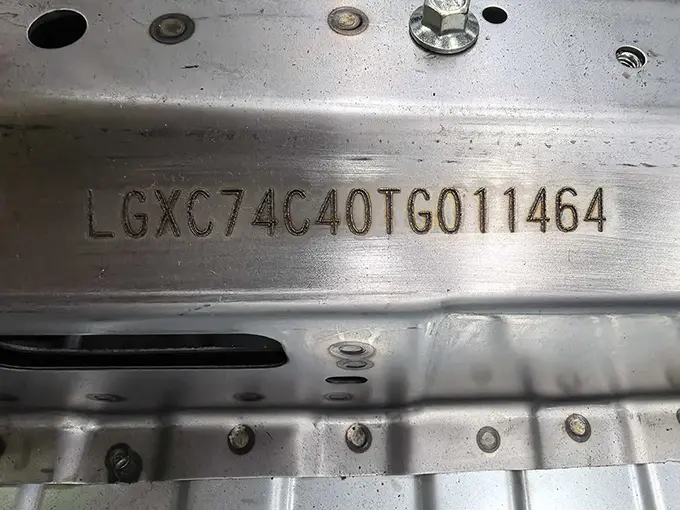
KINMARK offers a deep laser marking machine specifically developed for VIN marking on high-strength materials. The system is designed for deep VIN marking on high-strength steel plates with yield strength exceeding 700 MPa and on hot-formed steel plates with strength up to 1500 MPa. The marking depth on body-in-white can reach more than 0.2 mm, which supports permanent identification and reliable rubbing after painting.
The machine is intended for automotive mass production environments. It supports integration with industrial robots or assisted manipulators, and it can be equipped with optional vision guidance and traceability functions. This makes it suitable for manufacturers who need both marking quality and production-line automation.
Working Principle
Deep laser marking uses a focused laser beam to remove or alter material at the surface of the workpiece. Unlike surface marking methods that only change color or create a shallow oxide layer, deep marking creates a measurable depth in the base material. This depth is what allows the VIN to remain readable after painting and rubbing.
The KINMARK deep laser marking machine adopts a special marking process to ensure clear rubbing results after painting. The system is built around a 200W laser and a marking area of 112mm × 112mm. The marking depth of ≥0.2mm on body-in-white is achieved through controlled energy delivery and process parameters matched to the material.
For positioning, an optional 3D vision guidance system can be used to locate the marking position accurately. For quality verification, an optional 3D laser scanning measurement system and OCR recognition can be integrated. These options support online inspection of marking quality and help ensure traceability. The system is designed with various mounting interfaces for quick integration with industrial robots or assisted manipulators.
Key Features
When evaluating an industrial VIN marking machine, the following features are directly relevant to automotive production requirements:
Deep VIN marking: Enables permanent VIN deep marking on high-strength steel plates with yield strength exceeding 700 MPa and hot-formed steel plates with strength up to 1500 MPa. Marking depth on body-in-white can reach more than 0.2 mm.
Easy rubbing: A special marking process ensures clear rubbing results after painting, which is important for VIN legibility during vehicle registration and inspection.
Easy integration: Designed with various mounting interfaces, the system can be quickly integrated with industrial robots or assisted manipulators for automated production lines.
Vision guidance (optional):strong> A 3D vision guidance system enables precise positioning and accurate marking to improve production efficiency.
Automatic traceability (optional): A 3D laser scanning measurement system and OCR recognition provide online inspection of marking quality and support 100% traceability.
Production-ready specifications: Power supply AC220V ±10%, 50Hz ±2%; power consumption <1000W; laser power 200W; marking area 112mm × 112mm; marking depth ≥0.2mm; operating temperature 0~40℃; operating humidity ≤90% RH (non-condensing).
Selection Criteria
Choosing the right industrial VIN marking machine requires matching the equipment to the material, the production line, and the traceability requirements. The following criteria provide a practical framework.
1. Material and Marking Depth
The first consideration is the material to be marked. High-strength steel and hot-formed steel are common in modern body-in-white structures, and they behave differently from mild steel during laser marking. A machine must be capable of achieving the required marking depth without compromising the material or creating micro-cracks. The KINMARK deep laser marking machine is designed for yield strength above 700 MPa and hot-formed steel up to 1500 MPa, with a marking depth of ≥0.2mm on body-in-white.
2. Marking Area and Character Size
The marking area determines the maximum size of the VIN character field that can be marked in a single setup. The KINMARK system has a marking area of 112mm × 112mm. Engineers should verify that this area accommodates the required VIN format and any additional characters, such as production codes or plant identifiers.
3. Integration with Production Line
In mass production, the marking machine must integrate with the existing line layout. Mounting interfaces, communication with robot controllers, and cycle time are key factors. The KINMARK system is designed with various mounting interfaces for quick integration with industrial robots or assisted manipulators. This supports both new line installations and retrofits.
4. Positioning Accuracy
Positioning accuracy directly affects marking quality and repeatability. On a moving line or with complex part geometry, manual positioning may not be sufficient. An optional 3D vision guidance system can be specified to complete precise positioning and accurate marking, which helps improve production efficiency and reduce rework.
5. Traceability and Quality Inspection
Modern automotive manufacturing requires traceability of the VIN marking process. An optional 3D laser scanning measurement system and OCR recognition can provide online inspection of marking quality. This allows the system to verify depth and character legibility, and it supports 100% traceability. For manufacturers with strict quality management systems, these options are worth considering during the selection phase.
6. Environmental and Utility Requirements
The machine should match the available plant utilities and environment. The KINMARK deep laser marking machine operates on AC220V ±10%, 50Hz ±2%, with power consumption below 1000W. It is rated for operating temperatures of 0~40℃ and humidity up to 90% RH (non-condensing). These specifications should be checked against the installation site conditions.
Applications
Industrial VIN marking machines are used in automotive manufacturing and related industries where permanent identification is required. Based on the product information, the KINMARK deep laser marking machine is suitable for:
Automotive manufacturing: VIN marking on body-in-white and vehicle structures, including high-strength steel and hot-formed steel components.
Automotive components: Permanent marking on parts that require traceability through the production process.
New energy vehicles: VIN and component marking where durable identification is required.
Powertrain manufacturing: Marking applications on powertrain components that require deep, permanent identification.
Intelligent factory automation: Integration with robotic cells and automated lines, with optional vision guidance and traceability systems.
The system is designed for automated production lines and can be integrated with robots or assisted manipulators. This makes it applicable to both high-volume vehicle assembly and flexible manufacturing environments.
Benefits
Selecting an appropriate industrial VIN marking machine delivers several practical benefits for automotive manufacturers:
Permanent identification: Deep marking with a depth of ≥0.2mm on body-in-white helps ensure the VIN remains legible throughout the vehicle's life.
Clear rubbing after painting: The special marking process supports clear rubbing results, which is essential for VIN inspection and registration.
Production integration: Various mounting interfaces and robot compatibility allow the marking system to be integrated into existing or new automated lines.
Improved process consistency: Optional vision guidance and traceability systems help maintain consistent marking position and quality.
Traceability support: Optional 3D laser scanning measurement and OCR recognition enable online inspection and support 100% traceability.
Material versatility: Capable of marking high-strength steel above 700 MPa and hot-formed steel up to 1500 MPa.
These benefits are based on the documented features of the KINMARK deep laser marking machine. Actual results depend on the specific application, material, and production conditions.
Why Choose KINMARK
KINMARK (Jinan Zhongzheng Jinma Technology Co., Ltd.) has been involved in automotive intelligent automation equipment since 1996. The company develops and manufactures marking and traceability systems, servo press systems, fluid filling systems, and robot automation systems. Its products are used in automotive manufacturing, automotive components, new energy vehicles, powertrain manufacturing, and intelligent factory automation.
The deep laser marking machine is part of KINMARK's marking and traceability product line. It is designed for deep VIN marking on high-strength materials and supports integration with automated production lines. The company provides a 12-month warranty for the complete machine, along with professional technical support and long-term maintenance service. Fast response service, remote diagnosis, and technical assistance are available to support continuous operation. Installation and commissioning services, including operator training, are provided to help customers start production smoothly.
KINMARK has established long-term cooperation with automotive manufacturers and suppliers in the automotive industry. The company's focus on marking and traceability, combined with its experience in automation systems, makes it a relevant partner for VIN marking projects that require deep marking capability and production-line integration.
Frequently Asked Questions
What marking depth can be achieved on body-in-white?
The KINMARK deep laser marking machine can achieve a marking depth of ≥0.2mm on body-in-white. This depth supports permanent VIN identification and clear rubbing after painting.
Can the machine mark high-strength steel and hot-formed steel?
Yes. The system is designed for deep VIN marking on high-strength steel plates with yield strength exceeding 700 MPa and hot-formed steel plates with strength up to 1500 MPa.
Is the system suitable for robot integration?
Yes. The machine is designed with various mounting interfaces for quick integration with industrial robots or assisted manipulators. This supports automated production line configurations.
What are the power supply and environmental requirements?
The system requires AC220V ±10%, 50Hz ±2%, with power consumption below 1000W. It operates in temperatures of 0~40℃ and humidity up to 90% RH (non-condensing).
Does the machine support traceability and quality inspection?
Optional 3D vision guidance, 3D laser scanning measurement, and OCR recognition systems are available. These options support precise positioning, online inspection of marking quality, and 100% traceability.
Conclusion
Selecting an industrial VIN marking machine requires a clear understanding of material properties, marking depth requirements, integration needs, and traceability functions. For automotive manufacturers working with high-strength steel and hot-formed steel, deep laser marking technology offers a practical way to achieve permanent VIN identification with a marking depth of ≥0.2mm on body-in-white.
This guide has outlined the key selection criteria, including material compatibility, marking area, robot integration, positioning accuracy, traceability options, and utility requirements. The KINMARK deep laser marking machine provides a production-ready solution with a 200W laser, a 112mm × 112mm marking area, and optional vision guidance and traceability systems. For engineers and purchasing managers, matching these capabilities to the specific production environment is the foundation of a reliable VIN marking process.
If you're interested in any of the equipment mentioned in this article, feel free to contact our sales engineers for detailed product information and customized technical solutions.