
Automotive Refrigerant Filling Machine for Vehicle Assembly
Introduction
Coolant and antifreeze circuits on modern vehicles are sealed systems. Once a vehicle leaves the assembly line, the fluid level inside the cooling circuit must remain stable for the life of the vehicle. If the circuit is filled with air pockets, foam, or an inaccurate volume, the result is often a low coolant level after the first heat cycle, a warning light on the dashboard, or a returned vehicle at the dealership.
An automotive refrigerant filling machine addresses this problem by combining vacuum evacuation, leak testing, pressure filling, and back suction into a single automated cycle. Rather than pouring coolant into a circuit that still contains air, the machine first removes the air, verifies that the circuit is sealed, and only then introduces the fluid under controlled pressure.
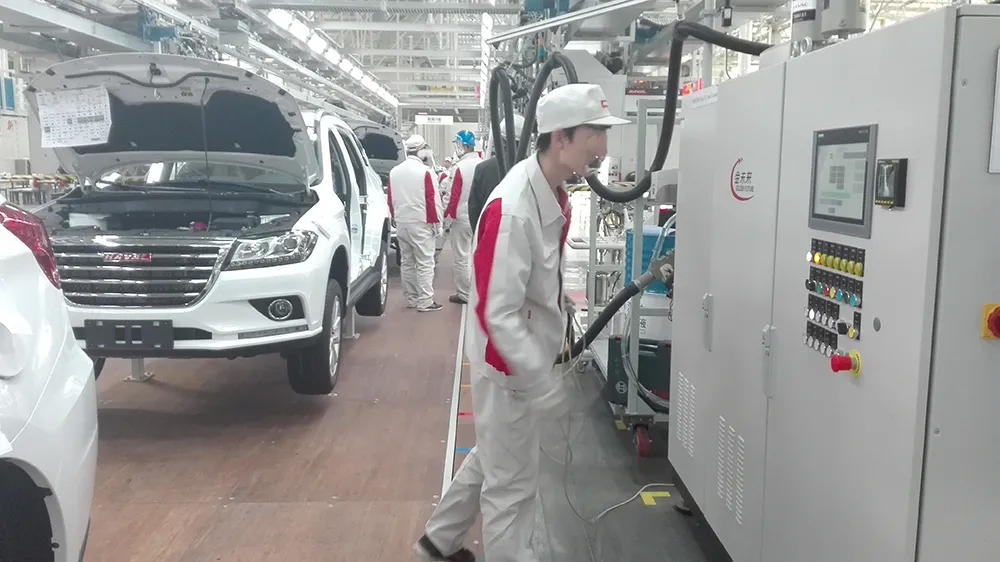
This article explains how the Antifreeze Vacuum Filling Machine works, what it is used for in vehicle assembly, and how engineers and production managers can evaluate whether this type of equipment fits their filling and leak-testing requirements.
Product Overview
The Antifreeze Vacuum Filling Machine is an automated filling system designed for coolant and antifreeze filling on automotive production and assembly lines. It uses a PLC-controlled process to manage the complete filling cycle, from initial vacuum evacuation through to final liquid level correction.
The machine is built around a filling medium of antifreeze or coolant, with a filling volume range of 1–400 L and a filling pressure range of 1–4 bar. The maximum filling speed is 60 L/min, and the filling precision is ±0.5%, with liquid level accuracy of ±2 mm. The measurement display range covers 0.0–999.9 L.
Vacuum is generated by a vacuum pump with a capacity of 40–65 m³/h. Leak verification is performed under both negative and positive pressure: the negative pressure leak rate is ≤0.5 mbar / 60 s, and positive pressure leakage is <1.4 g/year. The equipment operates on AC 380 V ±10%, 50 Hz ±2%, and has standard dimensions of 1800 × 1000 × 800 mm, which can be customized.
In practical terms, this is a machine for plants that need repeatable coolant filling with a stable final liquid level, rather than a manual or semi-manual filling station.
Working Principle
The filling cycle follows a defined sequence. Understanding this sequence helps explain why vacuum-based filling produces a more stable liquid level than simple gravity or pressure filling.
Step 1: Vacuum Evacuation
The system first performs vacuum evacuation on the cooling circuit. Air and any residual moisture inside the circuit are drawn out by the vacuum pump. Removing air before filling is what prevents trapped pockets from later collapsing and lowering the visible coolant level.
Step 2: Leak Testing Under Vacuum and Pressure
After evacuation, the machine performs leak testing under vacuum and pressure conditions. Because the circuit is already evacuated, the system can check whether it holds negative pressure, and then verify tightness under positive pressure as well. This dual check confirms system tightness before any fluid is introduced.
Step 3: Secondary Vacuum
Once tightness is confirmed, a secondary vacuum is created. This prepares the circuit for controlled fluid introduction and helps ensure that the incoming coolant fills the circuit evenly.
Step 4: Pressure Filling
Coolant is then introduced under controlled pressure, within the 1–4 bar filling pressure range. Because the circuit is under vacuum, the fluid is drawn in and distributed through the system rather than compressing air at the top of the circuit.
Step 5: Venting and Back Suction
Once the filling pressure reaches equilibrium, the system automatically vents to atmospheric pressure and performs back suction to remove excess coolant. This step is what achieves the specified liquid level and prevents the coolant level from dropping after filling.
Process note: The complete cycle integrates vacuum evacuation, leak testing, pressure filling, and back suction. Each stage is controlled by the PLC, so the same sequence is repeated for every vehicle rather than depending on operator judgment.
Key Features
PLC-controlled automation: The complete coolant filling process is automated under PLC control, covering evacuation, leak testing, filling, venting, and back suction.
Integrated leak testing: Both negative pressure leak rate (≤0.5 mbar / 60 s) and positive pressure leakage (<1.4 g/year) are checked as part of the filling cycle.
Stable liquid level: Back suction after filling removes excess coolant and helps achieve the specified liquid level, reducing the risk of level drop after filling.
Wide filling volume range: The machine supports filling volumes from 1 L to 400 L, covering a broad range of cooling circuit sizes.
Controlled filling pressure: Filling pressure is adjustable within 1–4 bar, with a maximum filling speed of 60 L/min.
Filling precision of ±0.5%: Combined with liquid level accuracy of ±2 mm, the system supports repeatable fill results.
Measurement display range of 0.0–999.9 L: Operators can monitor the measured volume during the cycle.
Customizable dimensions: The standard 1800 × 1000 × 800 mm footprint can be customized to suit line layout requirements.
Applications
The Antifreeze Vacuum Filling Machine is intended for automated coolant and antifreeze filling applications on automotive production and assembly lines. Typical areas where this type of equipment is relevant include:
Vehicle assembly: Coolant filling at the end of the assembly process, where the cooling circuit must be filled and verified before the vehicle moves on.
Powertrain manufacturing: Filling and leak verification on engine and powertrain assemblies that use liquid cooling circuits.
New energy vehicles: Battery thermal management and electric drive cooling circuits, which also require sealed, air-free coolant filling.
Automotive components: Filling operations at component suppliers where a sealed cooling or fluid circuit is part of the delivered part.
Intelligent factory automation: Integration into automated lines where filling is one station in a connected production sequence.
Because the machine handles antifreeze and coolant as its filling medium, it is used wherever a vehicle or assembly requires a sealed liquid cooling circuit to be filled to a defined level.
Benefits
For production and quality teams, the value of vacuum-based filling is mainly about consistency and verification.
Improved Traceability of the Fill Process
Because the cycle is PLC-controlled and follows the same sequence each time, the filling operation is repeatable. The measurement display range of 0.0–999.9 L allows the filled volume to be observed during the process.
Better Process Consistency
The combination of vacuum evacuation, controlled pressure filling, and back suction produces a stable liquid level. This reduces the variation that occurs when air remains in the circuit or when filling depends on manual judgment.
Leak Detection Before Filling
Leak testing is performed before coolant is introduced. Detecting a leak at the filling station is more efficient than discovering a coolant loss problem later in the production flow.
Integration into Assembly Lines
The machine is designed for automated coolant and antifreeze filling on production and assembly lines, and its dimensions can be customized to match line layout requirements.
Support for Different Circuit Sizes
With a filling volume range of 1–400 L and adjustable filling pressure of 1–4 bar, the same machine type can serve different cooling circuit sizes across a production program.
Why Choose KINMARK
KINMARK (Jinan Zhongzheng Jinma Technology Co., Ltd.) was established in 1996 and is a developer and manufacturer of marking and traceability systems, fluid filling systems, servo press systems, and robot automation systems. The company is located in the Jinan Eastern High-tech Development Zone and is recognized as a Shandong Province "Gazelle" enterprise and a "Specialized and Sophisticated" enterprise.
Fluid filling is one of the company's core product lines. The Antifreeze Vacuum Filling Machine reflects this focus, combining vacuum evacuation, leak testing, pressure filling, and back suction into one automated cycle for coolant and antifreeze applications.
KINMARK serves industries including complete vehicles, powertrain, automotive components, engineering machinery, home appliances, new energy, electronic communications, and rail transit. The company has established long-term cooperation with automotive manufacturers and also provides automation solutions to industrial companies in related sectors.
For buyers evaluating filling equipment, KINMARK offers:
12-month warranty: The complete machine is covered by a 12-month warranty, with professional technical support and long-term maintenance service.
Fast response service: Efficient after-sales support, remote diagnosis, and technical assistance to help maintain continuous operation.
Installation and commissioning: Engineers provide equipment installation, commissioning, and operator training to help customers start production smoothly.
Service network: Offices and maintenance centers are located in Shanghai, Beijing, Guangzhou, Changchun, Wuhan, Chongqing, and other cities.
Frequently Asked Questions
What is an automotive refrigerant filling machine used for?
It is used for automated coolant and antifreeze filling on automotive production and assembly lines. The machine evacuates air from the cooling circuit, performs leak testing, fills the circuit with coolant under controlled pressure, and then corrects the liquid level through back suction.
Why is vacuum evacuation performed before filling?
Vacuum evacuation removes air from the cooling circuit before fluid is introduced. If air remains in the circuit, it can create pockets that later collapse and cause the coolant level to drop after filling. Evacuation also allows the system to perform leak testing under vacuum before filling begins.
What filling precision and liquid level accuracy does the machine provide?
The filling precision is ±0.5%, and the liquid level accuracy is ±2 mm. The filling volume range is 1–400 L, and the filling pressure range is 1–4 bar, with a maximum filling speed of 60 L/min.
How is leak testing carried out during the filling cycle?
Leak testing is performed under both vacuum and pressure conditions after the initial evacuation. The negative pressure leak rate is ≤0.5 mbar / 60 s, and positive pressure leakage is <1.4 g/year. System tightness is confirmed before the coolant is introduced.
Can the machine be adapted to different line layouts?
The standard equipment dimensions are 1800 × 1000 × 800 mm, and the dimensions are customizable. The machine operates on AC 380 V ±10%, 50 Hz ±2%.
Conclusion
Coolant filling on a vehicle assembly line is not simply a matter of adding fluid. Air trapped in the cooling circuit, an unverified leak, or an inaccurate final level can all lead to problems that appear after the vehicle has left the plant. The Antifreeze Vacuum Filling Machine addresses these issues by integrating vacuum evacuation, leak testing under vacuum and pressure, controlled pressure filling, and back suction into one PLC-controlled cycle.
For engineers and production managers working on vehicle assembly, powertrain, new energy vehicle, or component filling applications, the key evaluation points are the filling volume and pressure ranges, the filling precision and liquid level accuracy, the leak-testing capability, and how the equipment integrates into the existing line. The Antifreeze Vacuum Filling Machine provides these functions in a single automated system, supported by installation, commissioning, training, and after-sales service from KINMARK.
If you're interested in any of the equipment mentioned in this article, feel free to contact our sales engineers for detailed product information and customized technical solutions.