
Refrigerant Vacuum Filling Machine: Complete Guide
Introduction
Coolant and antifreeze filling is one of the final process steps on an automotive assembly line, and it directly affects whether a vehicle can leave the line without a fluid-related fault. Filling a cooling system is not simply a matter of pouring liquid into a reservoir. Air trapped inside the circuit, an unstable liquid level, or an undetected leak can all lead to rework, warranty claims, and unplanned downtime.
A refrigerant vacuum filling machine addresses these problems by combining vacuum evacuation, leak testing, pressure filling, and back suction into one automated cycle. This guide explains what the equipment is, how the filling cycle works, the technical specifications that matter to production and process engineers, and where vacuum filling technology fits within automotive manufacturing and intelligent factory automation.
Product Overview
The refrigerant vacuum filling machine described in this guide is an automated vacuum filling and leak testing system designed for precise coolant and antifreeze filling with a stable liquid level. It is built for coolant and antifreeze as the filling medium and is intended for automated filling applications on automotive production and assembly lines.
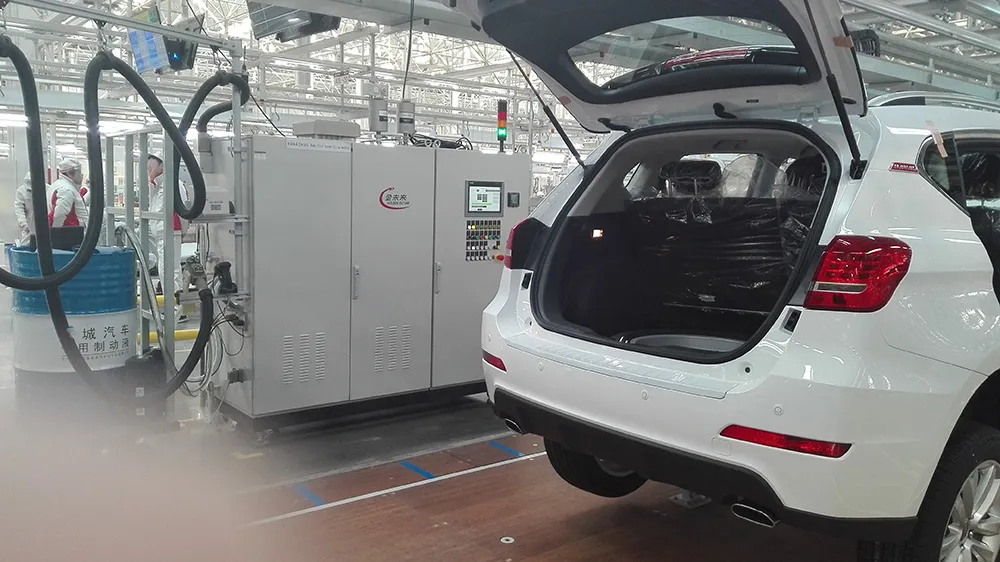
The machine uses a PLC-controlled system to automate the complete coolant filling process. Rather than relying on manual filling and level checking, the equipment executes a defined sequence: vacuum evacuation, leak testing under vacuum and pressure conditions, a secondary vacuum, controlled pressure filling, and back suction to reach the specified liquid level.
This approach is relevant to manufacturers who need repeatable filling results across many vehicles per shift, and who need the filling station to integrate into an existing production or assembly line rather than operate as an isolated manual workstation.
Working Principle
The working principle of the equipment follows a fixed, PLC-controlled sequence. Understanding this sequence helps process engineers evaluate how the machine behaves at each stage of the filling cycle.
Step 1: Vacuum Evacuation
The system first performs vacuum evacuation of the cooling circuit. Removing air from the system before filling is the basis for accurate filling and for a stable liquid level after the vehicle leaves the station.
Step 2: Leak Testing
After evacuation, the system performs leak testing under vacuum and pressure conditions. This confirms the tightness of the system before coolant is introduced. The equipment specification defines a negative pressure leak rate of ≤0.5 mbar / 60 s and a positive pressure leakage of<1.4 g/year, which gives engineers measurable acceptance criteria for the test stage.
Step 3: Secondary Vacuum
Once system tightness is confirmed, a secondary vacuum is created before the coolant is introduced under controlled pressure. This additional evacuation step supports consistent filling conditions.
Step 4: Pressure Filling
Coolant is then introduced under controlled pressure. Filling pressure is adjustable within the range of 1–4 bar, and the maximum filling speed is 60 L/min.
Step 5: Venting and Back Suction
Once the filling pressure reaches equilibrium, the system automatically vents to atmospheric pressure and performs back suction to remove excess coolant. This is the step that helps achieve the specified liquid level and prevents the coolant level from dropping after filling.
Process note: The complete cycle integrates vacuum evacuation, leak testing, pressure filling, and back suction. This integration is what allows the machine to be used for automated coolant and antifreeze filling on production and assembly lines.
Technical Specifications
The following equipment specifications are provided for the refrigerant vacuum filling machine. These values should be used when evaluating whether the machine matches a specific vehicle platform or production line requirement.
| Filling Medium | Antifreeze / Coolant |
| Filling Volume | 1–400 L |
| Filling Pressure | 1–4 bar |
| Maximum Filling Speed | 60 L/min |
| Filling Precision | ±0.5% |
| Liquid Level Accuracy | ±2 mm |
| Measurement Display Range | 0.0–999.9 L |
| Vacuum Pump Capacity | 40–65 m³/h |
| Negative Pressure Leak Rate | ≤0.5 mbar / 60 s |
| Positive Pressure Leakage | <1.4 g/year |
| Power Supply | AC 380 V ±10%, 50 Hz ±2% |
| Equipment Dimensions | 1800 × 1000 × 800 mm (customizable) |
Key Features
PLC-controlled automated cycle — the complete coolant filling process is automated under PLC control, from evacuation through back suction.
Integrated leak testing — leak testing is performed under both vacuum and pressure conditions before coolant is introduced.
Secondary vacuum before filling — a secondary vacuum is created after tightness confirmation and before the coolant is introduced under controlled pressure.
Automatic venting and back suction — the system vents to atmospheric pressure and performs back suction to remove excess coolant once filling pressure reaches equilibrium.
Stable liquid level — the venting and back suction sequence helps achieve the specified liquid level and prevents the coolant level from dropping after filling.
Configurable filling parameters — filling volume, filling pressure, and vacuum performance are defined by the equipment specification ranges.
Customizable dimensions — the equipment footprint is 1800 × 1000 × 800 mm and is customizable.
Service support — the complete machine is covered by a 12-month warranty, with professional technical support and long-term maintenance service, plus installation, commissioning, and operator training.
Applications
The refrigerant vacuum filling machine is suitable for automated coolant and antifreeze filling applications on automotive production and assembly lines. Its filling volume range of 1–400 L and its integrated leak testing make it relevant to vehicle assembly operations where the cooling system must be filled and verified as part of the production sequence.
Typical application areas include:
Automotive manufacturing — coolant and antifreeze filling stations within vehicle production and assembly lines.
New energy vehicles — cooling circuit filling where accurate liquid level and verified tightness are part of the assembly process.
Powertrain manufacturing — filling and leak testing operations where the cooling circuit must be validated before the unit moves to the next station.
Automotive components — filling of cooling circuits on components and sub-assemblies produced for vehicle assembly.
Intelligent factory automation — integration of an automated filling and testing station into a controlled production line.
Benefits
The value of vacuum filling technology in automotive assembly comes from combining several process steps into one controlled cycle. The benefits below are based on the equipment design and specifications described in this guide.
Repeatable Filling Accuracy
With a filling precision of ±0.5% and a liquid level accuracy of ±2 mm, the machine is designed to deliver consistent filling results. For production managers, this reduces the variability that comes from manual filling and level checking.
Leak Detection Before Filling
Because leak testing is performed under vacuum and pressure conditions before coolant is introduced, tightness is verified as part of the same cycle. This supports quality management at the filling station rather than downstream.
Stable Liquid Level After Filling
The automatic venting and back suction step removes excess coolant and helps achieve the specified liquid level. This addresses a common issue in coolant filling: the level dropping after the filling operation is complete.
Integration into Production Lines
The machine is designed for automated coolant and antifreeze filling applications on automotive production and assembly lines, which makes it suitable for manufacturers building or upgrading an automated filling station.
Wide Filling Range
A filling volume range of 1–400 L and a maximum filling speed of 60 L/min allow the equipment to be applied across different filling tasks within the specified range.
Why Choose KINMARK
KINMARK is a manufacturer of marking and traceability systems, servo press systems, fluid filling systems, and robot automation systems. The company was founded in 1996 and is based in the Jinan High-tech Development Zone, with offices and service centers in cities including Shanghai, Beijing, Guangzhou, Changchun, Wuhan, and Chongqing.
Fluid filling systems are one of KINMARK's core product lines. The company's work in fluid filling and marking systems has developed alongside the automotive industry, and its equipment is used across vehicle manufacturing, powertrain, automotive components, new energy vehicles, and intelligent factory automation.
For buyers evaluating a refrigerant vacuum filling machine, several practical factors are relevant:
Automotive focus — the equipment is designed for automotive production and assembly line applications.
Integrated process capability — vacuum evacuation, leak testing, pressure filling, and back suction are combined in one PLC-controlled cycle.
Service network — offices and maintenance centers in multiple Chinese industrial cities support installation, commissioning, and long-term maintenance.
After-sales support — a 12-month warranty on the complete machine, remote diagnosis, technical assistance, and operator training are provided.
Frequently Asked Questions
What is a refrigerant vacuum filling machine used for?
It is used for automated vacuum filling and leak testing of coolant and antifreeze. The machine performs vacuum evacuation, leak testing under vacuum and pressure conditions, a secondary vacuum, pressure filling, and back suction to achieve a stable liquid level. It is suitable for coolant and antifreeze filling applications on automotive production and assembly lines.
How does the machine achieve a stable liquid level?
Once the filling pressure reaches equilibrium, the system automatically vents to atmospheric pressure and performs back suction to remove excess coolant. This helps achieve the specified liquid level and prevents the coolant level from dropping after filling. The equipment specification lists a liquid level accuracy of ±2 mm.
What are the filling volume and pressure ranges?
The filling volume range is 1–400 L, and the filling pressure range is 1–4 bar. The maximum filling speed is 60 L/min, and the filling precision is ±0.5%. The measurement display range is 0.0–999.9 L.
How is leak testing performed?
Leak testing is performed under vacuum and pressure conditions after the initial vacuum evacuation and before coolant is introduced. The equipment specification defines a negative pressure leak rate of ≤0.5 mbar / 60 s and a positive pressure leakage of <1.4 g/year.
What support is available after installation?
The complete machine is covered by a 12-month warranty, with professional technical support and long-term maintenance service. KINMARK engineers provide equipment installation, commissioning, and operator training, and after-sales support includes remote diagnosis and technical assistance.
Conclusion
A refrigerant vacuum filling machine brings vacuum evacuation, leak testing, pressure filling, and back suction into a single PLC-controlled cycle for coolant and antifreeze filling. For automotive manufacturers, this means the filling station can verify system tightness before filling, fill to a controlled pressure, and deliver a stable liquid level after the operation is complete.
The equipment specifications — a filling volume of 1–400 L, filling pressure of 1–4 bar, maximum filling speed of 60 L/min, filling precision of ±0.5%, and liquid level accuracy of ±2 mm — provide the technical basis for evaluating whether the machine fits a specific production or assembly line requirement. For process engineers, production managers, and purchasing teams comparing coolant filling solutions, the key considerations are the integration of filling and leak testing, the stability of the final liquid level, and the level of service support available over the life of the equipment.
If you're interested in any of the equipment mentioned in this article, feel free to contact our sales engineers for detailed product information and customized technical solutions.